
Willow aphid
Pterocomma salicis
Description
How to identify
The willow aphid (Pterocomma salicis) is a member of the Aphididae family, primarily known for inhabiting willow and poplar trees across temperate regions.
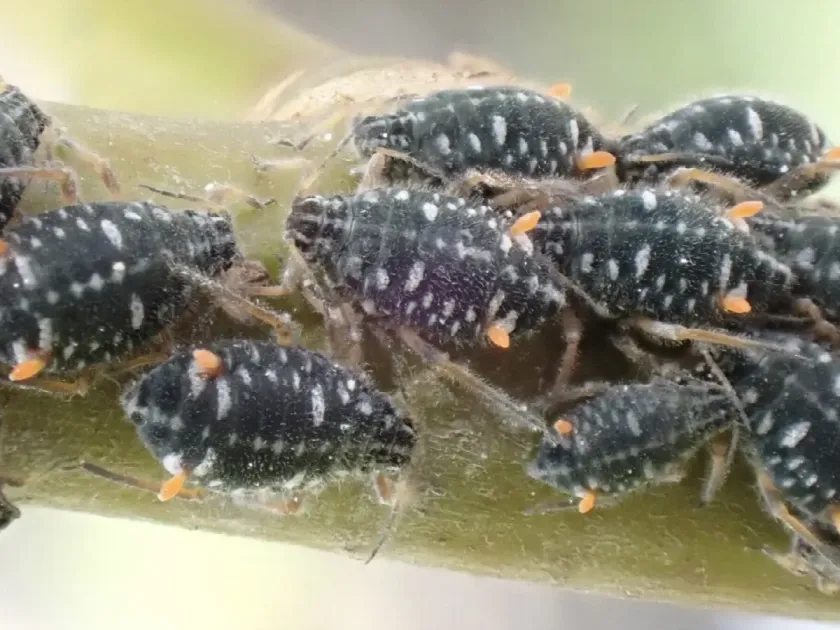
These aphids are relatively large, with adults reaching up to 3.5 mm in length, displaying a dark brown to black coloration, often covered in a slight waxy bloom.
A distinctive morphological feature of this species is the presence of long, prominent siphunculi (tubes) on the posterior part of the abdomen.
Unlike many other aphid species, Pterocomma salicis is monoecious, meaning it completes its entire life cycle on a single host plant species.
The species survives the winter stage as eggs, which are deposited in large numbers on the bark of twigs, ensuring survival through harsh weather conditions.
What it damages
The primary hosts for this pest include various species of willow (Salix) and poplar (Populus), with a preference for young, vigorous trees.
Feeding occurs primarily on the bark of young shoots and branches where the phloem sap is highly concentrated and easily accessible to the insects.
Heavy infestations can lead to significant physiological stress for the host, resulting in stunted growth and, in severe cases, the death of young branches.
In forest nurseries, this pest can cause substantial economic losses by ruining the shape and health of saplings, making them unsuitable for transplanting.
The constant sap extraction weakens the tree, making it susceptible to secondary infestations by wood-boring insects and pathogenic fungi.
When it appears
The life cycle initiates in early spring as eggs hatch into fundatrices (stem mothers), which synchronize their development with the host's bud break.
Throughout the spring and early summer, the population grows exponentially through asexual reproduction, often resulting in dense, crowded colonies.
Winged individuals (alatae) appear later in the season to facilitate migration to adjacent trees, ensuring the spread of the colony across the host population.
As autumn approaches and day length decreases, sexual forms appear, which mate and lay the overwintering eggs on the woody parts of the plants.
Environmental factors like spring temperature and the presence of natural enemies determine the intensity of the infestation for each growing season.
Signs of infestation
The most evident sign of infestation is the presence of dark, compact colonies of aphids clustered on the branches or young trunks of host trees.
Sticky honeydew secretions are a hallmark of aphid presence; this substance coats the leaves and stems, often leading to the growth of sooty mold.
Deformation of young shoots and curling of leaves are common symptoms of high-density populations where feeding causes systemic stress.
Ant activity is a strong indicator of an aphid colony, as ants are attracted to the sugary honeydew excreted by the aphids while they feed.
The yellowing and premature dropping of foliage are late-stage symptoms indicating that the tree is severely drained of nutrients by the pests.
Control measures
Early detection is the key to effective management; regular scouting of willow branches in early spring can help identify the first egg-laying sites.
Encouraging natural predators such as ladybirds, lacewings, and hoverfly larvae is an essential part of an Integrated Pest Management (IPM) strategy.
For ornamental or high-value trees, systemic insecticides can be applied to provide long-lasting control against sap-sucking insects.
Horticultural oils or insecticidal soaps can be used as a contact treatment to manage small colonies without harming beneficial insect populations.
Proper plant maintenance, including adequate hydration and avoiding excessive nitrogen fertilization, helps keep the trees strong and less attractive to aphids.
Taxonomy
- Latin name
- Pterocomma salicis
- Order
- Hemiptera (bugs, aphids, leafhoppers)
- Family
- Aphididae
- EPPO code
- PTEOSA
Discussion
No discussions yet — be the first.