
Poplar brown aphid
Pterocomma populifoliae
Description
How to identify
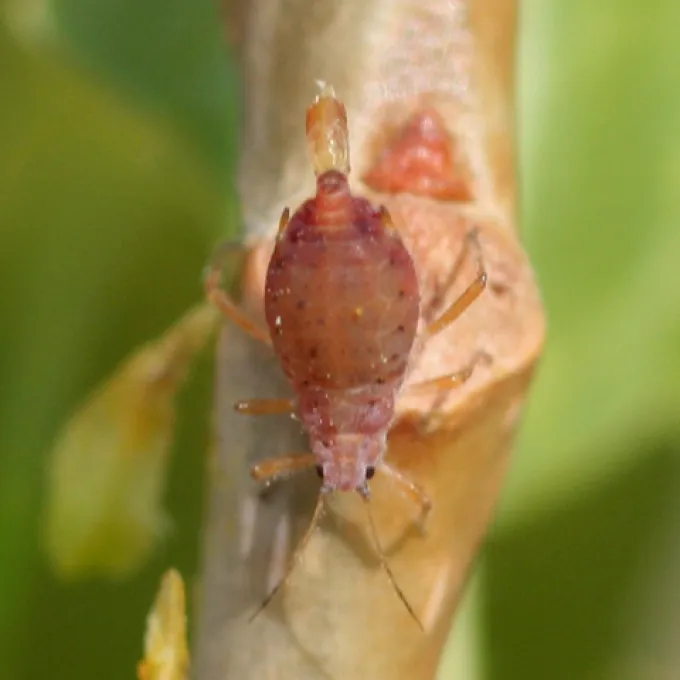
The poplar brown aphid (Pterocomma populifoliae) is a member of the order Hemiptera and the family Aphididae. These are relatively large insects, with adults measuring up to 3–4 mm in length.
The body color ranges from reddish-brown to dark brown, often covered with a fine waxy bloom. They possess prominent siphunculi and distinct tubercles on their body.
They overwinter as eggs, typically deposited by females in bark crevices or near the base of buds on host trees.
The species produces multiple generations throughout the growing season, which allows for rapid colony expansion under favorable conditions.
They are colonial insects, usually clustering in dense groups on young, succulent shoots of their host trees.
What it damages
This pest primarily infests various species of poplar (Populus) and occasionally willow (Salix), making them a common sight in urban forests.
Feeding occurs through the piercing of the plant's epidermis and extraction of nutrient-rich sap, causing significant physiological stress to the tree.
Heavy infestations on young saplings can lead to stunted growth, distorted foliage, and reduced wood quality in commercial plantations.
The constant sap extraction weakens the tree, making it significantly more susceptible to secondary stressors such as drought or fungal pathogens.
The cumulative damage often manifests as premature leaf drop, which disrupts the photosynthetic process and decreases the tree's vigor.
When it appears
Egg hatching begins in early spring, synchronized with the breaking of tree buds, providing nymphs with immediate access to tender growth.
The highest population densities are typically recorded during late spring and early summer when temperatures are optimal for aphid reproduction.
During the peak of summer heat, population levels may fluctuate as some individuals migrate or succumb to desiccation and natural enemies.
As autumn approaches, the aphid population shifts toward sexual reproduction to produce the winter-hardy eggs that will persist through the cold months.
The population trend is highly dependent on environmental factors, as heavy rains can physically dislodge colonies, while moderate spring warmth accelerates their growth.
Signs of infestation
The most obvious sign of infestation is the presence of large, visible dark-brown aphid colonies clinging to the bark of young twigs.
Yellowing, curling, and wilting leaves are common symptoms, often accompanied by early leaf senescence in mid-summer.
The production of large amounts of honeydew often leads to the development of black sooty mold on the surface of the branches and leaves.
Increased ant activity on the tree is a classic indicator, as ants actively "farm" the aphids to feed on the sweet honeydew secretions.
Deformation of the primary terminal shoots is another key sign, where the branch appears twisted and significantly weaker than uninfested counterparts.
Control measures
Biological control is highly effective through the encouragement of natural predators like lady beetles, lacewings, and hoverfly larvae.
In managed urban landscapes, chemical control using systemic insecticides may be necessary if the infestation threatens the health of valuable specimen trees.
Pruning out and properly disposing of severely infested twigs can significantly reduce the overwintering egg population and summer colony size.
Applying dormant horticultural oils in late winter can help destroy overwintering eggs before they have a chance to hatch in the spring.
Maintaining tree health through proper irrigation and fertilization reduces the tree's susceptibility to aphid-induced physiological stress.
Taxonomy
- Latin name
- Pterocomma populifoliae
- Order
- Hemiptera (bugs, aphids, leafhoppers)
- Family
- Aphididae
- EPPO code
- PTEOPP
Discussion
No discussions yet — be the first.