
Willow aphid
Pterocomma bicolor
Description
How to identify
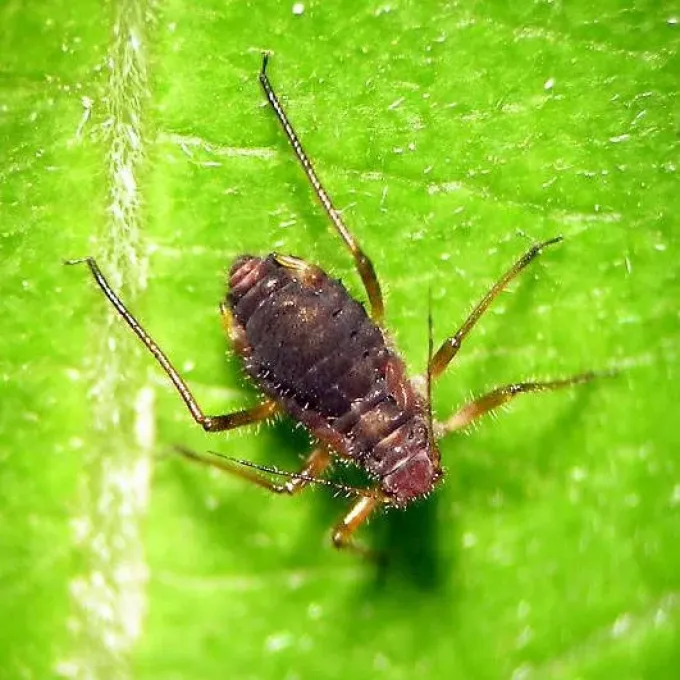
The Willow aphid (Pterocomma bicolor) is a member of the order Hemiptera and the family Aphididae. These are relatively large insects, reaching a body length of 3–4 mm.
Adults exhibit colors ranging from reddish-brown to dark brown, which allows them to blend into the bark of their host trees. They have an oval body shape, often covered with a fine waxy substance.
A key identifying feature is the presence of long, tubular structures (cornicles) on the abdomen, which often contrast in color with the rest of the body.
Nymphs resemble the adults but are smaller in size and typically have a lighter, sometimes translucent coloration during their early development stages.
They are gregarious insects, usually found in large, dense colonies covering young shoots, stems, or specific areas of the bark where sap flow is abundant.
What it damages
The primary host plants for this species are members of the genus Salix (Willows). They prefer young trees and shrubs with softer, thinner bark.
Populus species (Poplars) can also serve as secondary hosts where these aphids form large colonies and feed on the sap of young branches.
Mass infestations lead to significant sap loss, causing the tree to weaken, show reduced growth rates, and suffer from poor photosynthesis.
Chronic infestations make the trees more susceptible to secondary infections, including bark ulcers and various fungal pathogens that thrive on weakened tissues.
In landscaping and urban environments, the presence of these aphids significantly reduces the aesthetic value of the trees due to stunted growth and sticky honeydew deposits.
When it appears
The species overwinters in the egg stage. Eggs are laid by females in late autumn within bark crevices or near buds to survive the cold winter months.
In early spring, when temperatures rise above 8–10 degrees Celsius, the overwintered eggs hatch into fundatrices (foundress nymphs) as the tree buds begin to break.
Throughout the summer, several generations develop. Population levels typically peak during June and July, coinciding with the period of high sap activity.
During the latter part of summer, winged forms emerge to disperse to neighboring trees, allowing the colony to expand its territory.
As autumn approaches, sexual forms are produced; they mate, and the females lay the overwintering eggs, which will restart the cycle the following spring.
Signs of infestation
The most obvious sign of an infestation is the presence of numerous dark-colored insects clustered tightly together on the bark of twigs and branches.
Leaves on infested branches often exhibit yellowing, curling, and premature drop. The twigs themselves may appear distorted due to nutrient depletion.
The excretion of large amounts of honeydew is a diagnostic sign. This sticky, sugar-rich substance often attracts ants, which may protect the aphid colonies from predators.
Sooty mold frequently grows on the honeydew deposits, creating a dark, blackened appearance on the leaves and bark that interferes with gas exchange.
A fine "silvery" appearance on the bark is often noted, which consists of discarded white exuviae (cast-off skins) left behind after the aphids molt.
Control measures
Early spring monitoring is the first step in control. Regular inspection of willow branches helps detect the presence of nymphs before colonies become large.
Natural enemies such as ladybeetles, lacewings, hoverflies, and parasitic wasps are highly effective at keeping populations in check if pesticides are used sparingly.
If the infestation becomes severe and threatens the health of the tree, systemic insecticides may be applied to eliminate the colonies from within the plant tissues.
- Physical removal by spraying strong jets of water to dislodge colonies.
- Preservation of beneficial predator habitats in the garden.
- Use of targeted insecticides during early growth phases.
Agronomic management includes maintaining tree health through proper irrigation and avoiding excessive nitrogen fertilization, which can create an abundance of succulent growth preferred by aphids.
Taxonomy
- Latin name
- Pterocomma bicolor
- Order
- Hemiptera (bugs, aphids, leafhoppers)
- Family
- Aphididae
- EPPO code
- PTEOBI
Discussion
No discussions yet — be the first.