
Plane tree psyllid
Psyllopsis discrepans
Description
How to identify
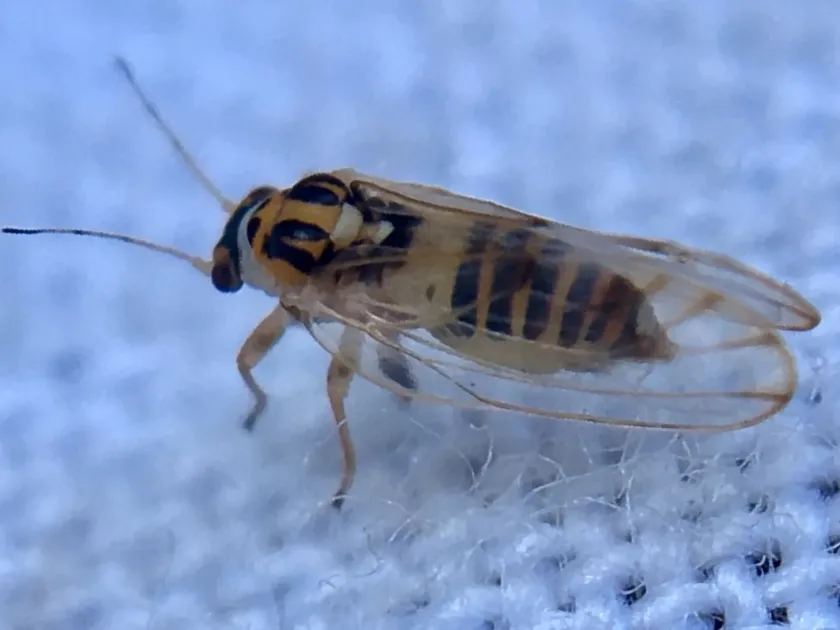
The Plane tree psyllid (Psyllopsis discrepans) belongs to the Psyllidae family within the order Hemiptera. These small insects, often referred to as jumping plant lice, are highly specialized to live on trees of the Platanus genus.
Adult psyllids are roughly 3–4 mm long, often possessing a greenish or yellowish hue that camouflages them against the foliage. Their wings are held roof-like over their backs when at rest, a common trait for the family.
The nymphs are the stage most responsible for plant damage. They are flattened, sedentary, and characterized by the production of waxy, white filaments that cover their bodies to protect them from predators and dehydration.
Identification is best achieved during the spring and summer by inspecting the underside of the leaves. Because they are specific to plane trees, their presence is almost always associated with these hosts.
These insects are highly mobile as adults and can jump rapidly when disturbed, which is why a sweep net or a magnifying lens is often necessary for accurate field identification.
What it damages
Psyllids feed by inserting their mouthparts into the leaf tissues to extract plant sap. This direct feeding causes localized cell damage and can lead to the wilting and curling of young leaves.
When infestation levels are high, the growth of new shoots is significantly stunted. The physiological stress caused by the loss of sap makes the trees more vulnerable to environmental factors and secondary pathogens.
A significant issue associated with these pests is the production of honeydew, a sticky substance excreted during feeding. This honeydew creates a perfect environment for the growth of sooty mold.
The aesthetic impact is substantial, as infested trees often appear discolored, curled, and covered in mold. This ruins the visual appeal of street plantings and landscape specimens.
Continuous, heavy infestation over several years can lead to premature leaf drop, which weakens the tree's vigor and reduces its ability to store nutrients for the following growing season.
When it appears
The lifecycle begins with eggs that are laid during the previous autumn, usually tucked away within bark crevices or near the base of buds. This ensures the species can survive the cold winter months.
Nymphs emerge in the spring, coinciding perfectly with the bud break of the plane trees. This timing allows them to immediately access the most nutritious and softest parts of the tree.
There are multiple generations per year, with the highest activity peaking during the warm summer months. Population explosions are common in late June and July when conditions are optimal.
As the weather begins to cool in the autumn, the final generation of adults prepares for overwintering, migrating to the protected areas of the tree bark to deposit their eggs.
Environmental factors, such as unusually dry or hot springs, can speed up the development time of the nymphs, leading to a faster turnover of generations and potentially higher pest numbers.
Signs of infestation
The most obvious sign of an infestation is the curling and distortion of leaf edges. Leaves may fold inward, creating protective pockets for the nymphs to reside in.
White, waxy, fluff-like deposits on the underside of leaves or at the leaf base are a primary indicator. These secretions are easily visible once you know where to look.
A sticky film of honeydew on the foliage is a classic sign of sap-sucking pests. This sticky residue often attracts ants and facilitates the growth of dark, dusty sooty mold.
Chlorosis or yellowing of the leaf tissue often occurs around the feeding sites. In severe cases, the entire canopy can look unhealthy, off-color, and thin.
- Leaf margins curling inward (pseudogalls).
- Presence of white waxy filaments under leaves.
- Sticky leaves coated with black sooty mold.
Control measures
Integrated Pest Management (IPM) is the most effective approach. This includes maintaining tree vigor through proper watering and fertilization, which helps the tree withstand psyllid damage.
When infestation is severe, systemic insecticides can be applied during the early spring as buds break. This targets the nymphs before they can establish a large colony.
Encouraging natural predators such as lady beetles, lacewings, and parasitic wasps is a sustainable way to control psyllid numbers without relying heavily on chemical intervention.
For high-value landscape trees, professional trunk injections can be used. This method delivers the insecticide directly into the tree's vascular system, providing long-term control.
Always ensure that sanitation practices, such as removing heavily infested or fallen debris, are followed to reduce the overwintering population of eggs for the next cycle.
Taxonomy
- Latin name
- Psyllopsis discrepans
- Order
- Hemiptera (bugs, aphids, leafhoppers)
- Family
- Liviidae
- EPPO code
- PSYPDI
Discussion
No discussions yet — be the first.