
Cereal leaf miner
Pseudonapomyza atra
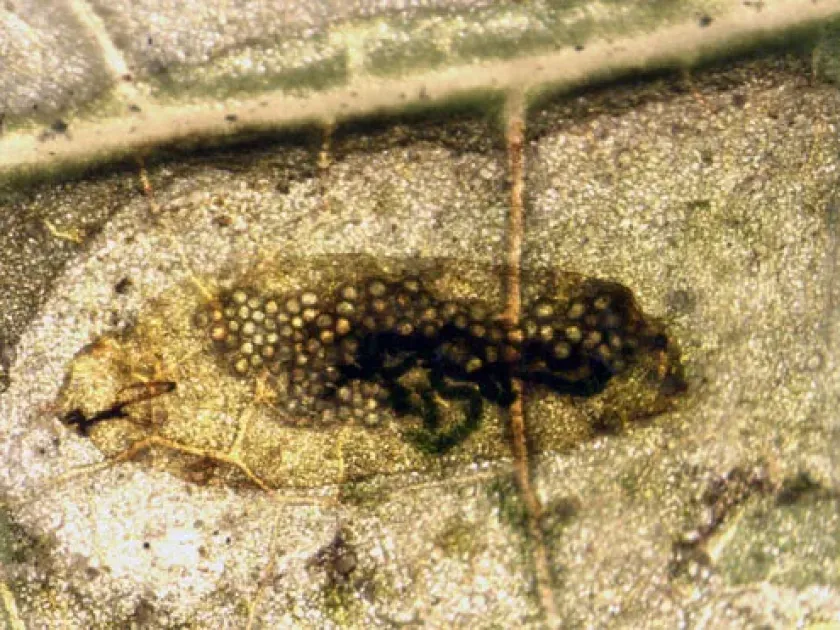
Description
How to identify
The cereal leaf miner (Pseudonapomyza atra) is a small dipteran insect from the Agromyzidae family. Adult flies are typically 1.5–2 mm in length with a shiny black body.
The larvae are light yellow, legless, and reach up to 3 mm in size. They live and feed exclusively within the leaf tissue, creating characteristic mines.
Adults are active during the day, feeding on plant sap and nectar. They use their ovipositors to pierce leaves, leaving tiny puncture marks.
The species undergoes a complete metamorphosis, passing through egg, larva, puparium, and adult stages throughout its life cycle.
Overwintering occurs primarily as a puparium, which is often found in the soil or protected within the debris of host plants.
What it damages
This pest mainly targets cereals, including wheat, barley, rye, oats, and occasionally corn, causing significant stress to young plants.
Larval feeding destroys the leaf's mesophyll, which reduces the plant's photosynthetic capacity and weakens the overall crop vigor.
Severe infestations can stunt plant growth, reduce the number of productive tillers, and lead to significant grain yield losses.
In addition to direct tissue damage, the mining activity exposes the plant to secondary pathogens, including various fungal infections.
If the damage occurs during the early growth stages, it can significantly impact the plant's ability to recover and produce a healthy ear.
When it appears
Emergence of overwintered adults typically begins in early spring as temperatures rise, signaling the start of the primary infestation period.
The insect produces several generations per year, with activity continuing throughout the entire growing season of the cereal crops.
Peak population levels are often observed during the stem elongation and heading phases, which coincide with high crop susceptibility.
In autumn, adults migrate to newly sown winter crops, where they lay eggs to ensure the pest's survival over the winter period.
Climatic conditions such as moderate temperature and high humidity promote faster development and increase the number of generations.
Signs of infestation
The most visible sign of infestation is the presence of narrow, light-colored, winding trails or "mines" inside the leaf blades.
These trails start as thin lines but can broaden into blotch-like yellow patches as the larva matures and consumes more tissue.
Affected leaves often turn yellow, wither, and die prematurely, particularly when multiple larvae are present on a single leaf.
Field inspections reveal uneven patches of chlorosis, which may be mistaken for nutrient deficiencies or early-stage fungal diseases.
Microscopic examination of the mines reveals the presence of larvae or empty puparia, confirming the identity of the causal agent.
Control measures
Good agricultural practices, such as the removal of crop residues and control of volunteer grains, are essential for limiting pest populations.
Crop rotation and proper field isolation help interrupt the lifecycle and prevent the pest from building up in specific areas.
Deep plowing after harvest is an effective mechanical method to bury puparia and prevent the successful emergence of the next generation.
Chemical control involving systemic insecticides is recommended only when monitoring confirms the pest density exceeds the economic threshold.
Integrated Pest Management (IPM) strategies, including the encouragement of natural parasitoids, remain the most sustainable long-term solution.
Taxonomy
- Latin name
- Pseudonapomyza atra
- Order
- Diptera (flies)
- Family
- Agromyzidae
- EPPO code
- PHYYAR
Discussion
No discussions yet — be the first.