
Cereal leaf miner
Agromyza albipennis
Description
How to identify
The cereal leaf miner (Agromyza albipennis) is a fly species belonging to the Agromyzidae family, order Diptera. Adult flies are small, typically measuring 2–3 mm in length, with dark coloration and transparent wings. They are recognized by their distinct wing venation and are active during the cereal growth season.
The larvae are legless, maggot-like, and pale yellowish in color. They undergo three larval instars, continuously feeding on the parenchyma tissue of the leaves. As they grow, their presence becomes more destructive to the host plant's internal structure.
The life cycle of the pest is highly dependent on ambient temperature and moisture. They overwinter as pupae within puparia, located in the topsoil or on plant residues. As soil temperatures rise in early spring, adults emerge and begin their mating cycle to infest new crops.
Depending on the climatic zone, the fly can produce several generations per year. The rapid development of these generations allows the population to increase significantly under favorable weather conditions, making them a recurring problem in cereal farming.
Identifying the adults in the field is difficult due to their small size and resemblance to other fly species. However, their activity patterns and the characteristic patterns of damage left on leaves serve as reliable indicators of their presence in the field.
What it damages
This pest primarily infests various cereal crops, including wheat, barley, oats, and rye. Wild grasses also serve as natural hosts and reservoirs, facilitating the survival and spread of the population when cultivated crops are absent.
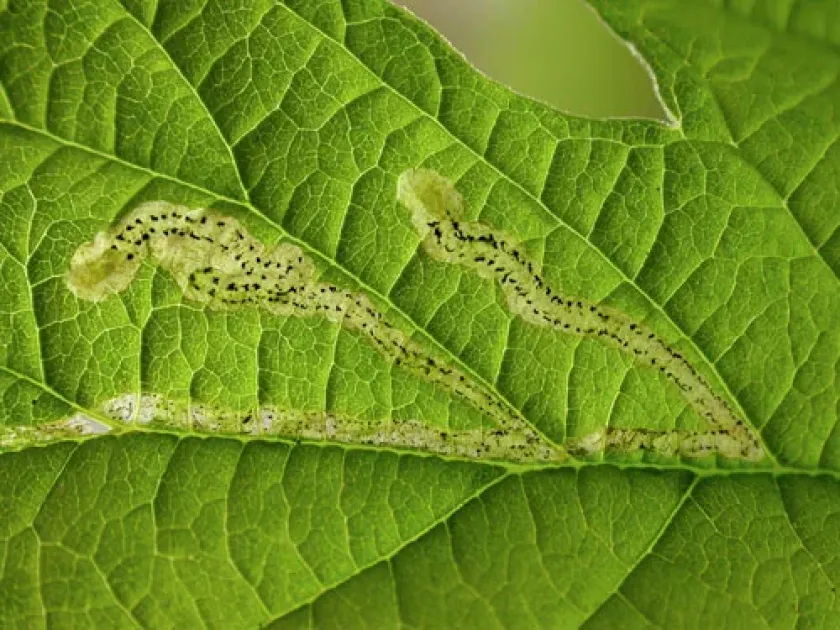
The damage is caused by larvae mining the leaves. They feed on the inner green tissue (parenchyma), leaving the upper and lower epidermis intact. This results in the formation of visible, light-colored, winding tracks or "mines" within the leaf blade.
Extensive mining leads to a reduction in the leaf surface area capable of photosynthesis. This stress hampers the plant's growth, stunts tillering, and can result in reduced grain filling. In severe cases, the leaves dry out prematurely, significantly impacting total crop yield.
Young plants are particularly vulnerable. Heavy infestation during the seedling stage can lead to the wilting and death of central leaves, effectively reducing the plant density in the field and weakening the entire stand of the cereal crop.
Furthermore, the damaged leaves are highly susceptible to secondary infections by pathogens, including various fungi and bacteria. These secondary invaders capitalize on the injured tissue, leading to accelerated plant senescence and further yield degradation.
Signs of infestation
The primary symptom of an infestation is the appearance of pale, snake-like tracks on the leaves. These mines are easily visible under direct sunlight and increase in length as the larva continues to feed inside the leaf tissue.
Upon closer examination, looking through the leaf against the light, one can often spot the larva itself or its dark excrement pellets inside the mine. This is a key diagnostic feature distinguishing this pest from herbicide damage or physiological leaf spots.
Over time, infested leaves lose their green color, turn yellow, and begin to wither from the tips. A field with a high population of cereal leaf miners will show widespread yellowing, which serves as a visible warning to farmers to initiate monitoring.
The leaves may curl, shrink, or deform as the infestation progresses. This deformation disrupts the normal physiological processes of the plant, especially during critical growth stages like the boot stage or ear formation, leading to smaller, lighter grain.
One might also observe small exit holes in the leaves, indicating that the larva has finished its feeding stage and has exited the mine to pupate. These holes confirm that the damage is complete and the current generation has matured.
Control measures
Integrated pest management begins with sound crop rotation. Avoiding consecutive planting of cereal crops in the same field disrupts the pest’s life cycle and significantly reduces the number of overwintering pupae available to emerge in the spring.
Proper tillage, especially deep plowing, is a highly effective control measure. It buries the plant residues and puparia deep into the soil, preventing the emerging adults from reaching the surface, thereby effectively controlling the population for the next season.
Agronomic practices that promote vigorous plant growth are essential. Optimal planting dates and balanced fertilization ensure that the crop develops quickly, increasing its natural compensatory ability to withstand or recover from minor leaf miner infestations.
When infestation levels exceed the economic threshold, chemical control is necessary. Systemic insecticides are the most effective choice, as they are absorbed by the plant and reach the larvae inside the leaf, where contact-only insecticides would be ineffective.
Monitoring using yellow sticky traps or pheromone traps helps in identifying the peak flight of adults. This allows for precise timing of chemical applications, targeting the most vulnerable stage of the pest's life cycle to ensure maximum protection.
Taxonomy
- Latin name
- Agromyza albipennis
- Order
- Diptera (flies)
- Family
- Agromyzidae
- EPPO code
- AGMYAL
Discussion
No discussions yet — be the first.