
Pseudonapomyza
Pseudonapomyza
Description
How to identify
Pseudonapomyza is a genus of leaf-mining flies belonging to the Agromyzidae family within the order Diptera. These are small insects, with adults typically measuring between 2 and 3 mm in length and exhibiting dark coloration.
The larvae of this pest are endophagous, living and feeding inside the leaf tissue. They are typically legless, white to pale yellow in color, and have a specialized head structure adapted for mining.
Identifying species within the genus is often challenging and frequently requires the examination of male genitalia under a microscope due to their morphological similarity.
The life cycle encompasses four stages: egg, three larval instars, pupa, and adult. Pupation commonly occurs within the leaf mine or occasionally in the soil, depending on the specific species.
Adult flies are diurnal, often feeding on plant fluids exuding from punctures made by the female's ovipositor, which also causes minor mechanical damage to the leaves.
What it damages
This pest primarily attacks cereal crops, including wheat, barley, maize, oats, and sorghum. It also commonly infests various wild grasses found in and around fields.
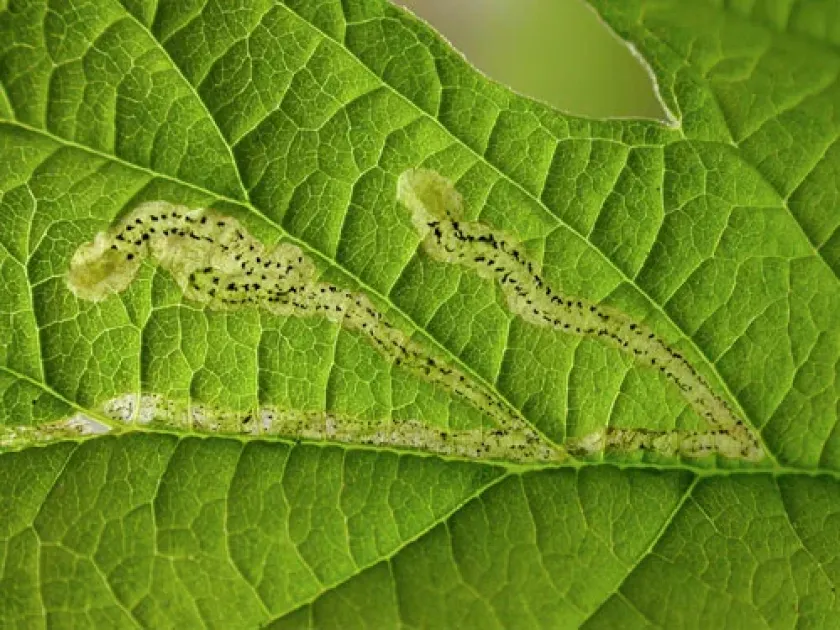
Larvae create winding galleries (mines) inside leaves, consuming the chlorophyll-rich parenchyma tissue, which disrupts the plant's photosynthetic capacity.
High infestation levels result in significant leaf area loss, which weakens the plant and leads to premature drying and wilting of the affected foliage.
Damage to seedlings during the early stages of vegetation is particularly critical, as it can cause stand reduction and stunted growth of the crop.
Severe infestations reduce both biomass production and the final yield, while simultaneously impacting grain quality and nutritional values.
Signs of infestation
The most distinctive symptom of infestation is the appearance of narrow, winding, white or pale trails (mines) on the leaf surface, which are easily visible upon field inspection.
Initial stages appear as small light-colored spots or short lines, which grow significantly in length as the larva matures inside the leaf.
The female's feeding and oviposition punctures often cause tiny necrotic spots, which can be seen as light speckling on the leaves.
In later stages of the mine, pupae may be visible as small, oval-shaped bumps or swellings within the leaf tissue.
Widespread infestation often causes the leaf margins to curl, yellow, and wither, giving the crop an overall chlorotic and unhealthy appearance.
Control measures
Strategic crop rotation is the primary preventive measure, as it disrupts the life cycle of the pest by removing host cereal crops from the field for consecutive seasons.
Deep plowing in the autumn is recommended to bury crop residues and pupae, effectively reducing the overwintering population in the soil.
Controlling grass weeds in and around fields is essential, as these act as secondary hosts and reservoirs for the pest throughout the growing season.
Chemical control involving systemic insecticides is often necessary when pest density exceeds economic thresholds, particularly during the peak flight of adults.
- Use of yellow sticky traps for monitoring populations.
- Rigorous weed management strategies.
- Optimal timing of planting to avoid peak pest activity.
Taxonomy
- Latin name
- Pseudonapomyza
- Order
- Diptera (flies)
- Family
- Agromyzidae
- EPPO code
- PSMZSP
Discussion
No discussions yet — be the first.