
Cereal root aphid
Protrama flavescens
Description
How to identify
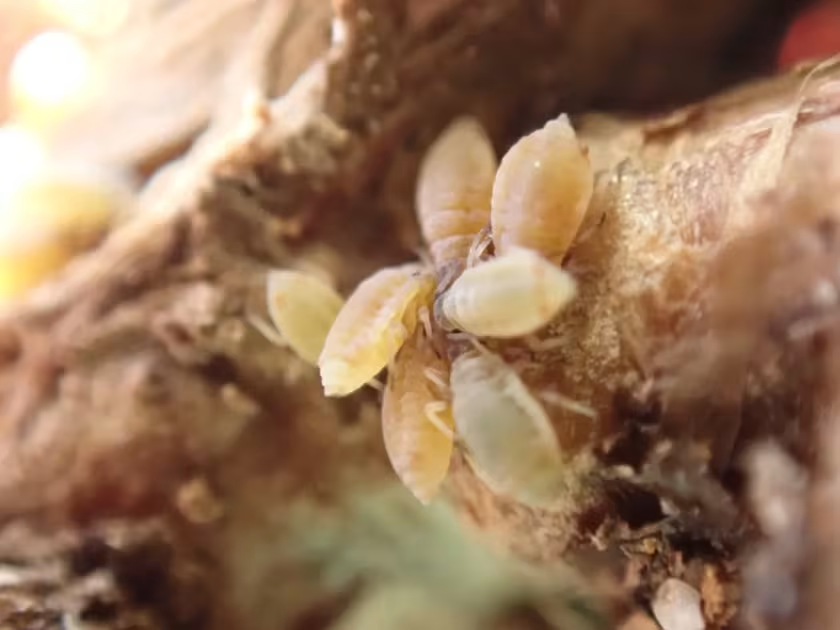
The cereal root aphid Protrama flavescens is a highly specialized insect species that lives exclusively in the root zone of plants. Adult individuals are relatively large for aphids, featuring a distinct coloration and long legs adapted for moving through soil voids.
This pest lives a cryptic lifestyle, rarely appearing on the above-ground parts of plants. The body of the imago is often covered with a waxy bloom, which protects the insect from excessive soil moisture and the influence of soil microorganisms.
Systematically, this species belongs to the family Lachnidae (Aphididae), order Hemiptera. The main difference from leaf-dwelling aphids is the absence or reduction of siphunculi, which is related to their subterranean lifestyle and specific feeding type.
The biology of Protrama flavescens is closely linked to ants, which often act as symbionts. Ants provide protection for the aphid colonies, and in return, they receive honeydew, which is the byproduct of the pest's metabolism.
Reproduction occurs in the soil at depths of up to 20 centimeters. Females are capable of laying eggs in the root zone or directly on plant roots, where they successfully overwinter until favorable temperatures return.
What it damages
The main food sources are various species of cereal grasses, both wild and cultivated. The aphid selects the most weakened plants with well-developed root systems, attaching itself to small rootlets to feed.
During mass outbreaks, this pest damages winter and spring cereal crops. Wheat, barley, and oat fields are most at risk during early vegetative phases when the root system has not yet strengthened.
In addition to cultivated crops, the species often concentrates on couch grass and other perennial cereal weeds. These weeds serve as infection reservoirs and shelters for the aphid population during the off-season.
Damage is caused by sucking nutrient sap from the root's vascular system. This leads to a disruption of the normal metabolic processes within the plant organism and a reduction in water transport efficiency.
The secretions of the aphids pose a particular danger, as they provoke the development of secondary fungal and bacterial infections in the root zone. This further suppresses plant growth and reduces winter hardiness.
When it appears
The period of greatest activity for the cereal root aphid occurs in spring, when the soil warms up to temperatures favorable for insect metabolism. At this time, a sharp increase in the size of the colonies is observed.
Summer heat, accompanied by the drying of the topsoil, forces the aphids to migrate deeper into the ground. During this period, insect activity on the surface of the roots temporarily decreases until autumn moisture returns.
In autumn, a second wave of activity is observed, associated with the colonization of winter crop root systems. During this period, the pest feeds actively, preparing for winter diapause.
The pest overwinters in the egg stage or as older instar larvae in the soil or on plant debris. Successful overwintering depends directly on the depth of soil freezing and the presence of protective conditions.
The total development cycle of one generation can take from two to three weeks depending on the temperature regime. Rapid generation turnover allows the population to reach economic threshold levels in a short time.
Signs of infestation
It is difficult to visually detect the presence of this pest because it does not appear on the leaves. The first sign is general plant suppression, which looks like a deficiency in moisture or mineral elements.
Plants infested with aphids start to lag in growth; their leaves may turn yellow or acquire a specific chlorotic tint. In advanced cases, premature wilting of the crops is observed.
When digging up a plant with a clod of earth, one can notice an accumulation of insects on the roots. A characteristic indicator of presence is the activity of ants around the base of the stem, even in the absence of visible pests on the leaves.
A whitish waxy bloom and sticky secretions can often be found on the roots, attracting soil fauna. These secretions prevent the roots from properly absorbing necessary micronutrients from the soil.
In field conditions, infestation sites often manifest as patches where the crops appear thin and weak. These zones expand rapidly if no measures are taken to localize the pest.
Control measures
The most important agrotechnical measure is the observance of crop rotation, excluding continuous planting of cereal crops. This breaks the food chain and reduces the number of pests in the soil.
Deep autumn plowing helps destroy a significant part of the population by moving eggs and larvae to the upper layers of the soil, where they die from frost and predators.
Weed control, especially of perennial rhizomatous species, radically reduces the aphid's food base. Regular mechanical processing of inter-row spaces disrupts ant nests and aphid colonies.
The use of insecticidal seed treatments allows for the protection of the plant's root system during the most vulnerable period after emergence. The systemic effect of the preparations guarantees prolonged protection.
Upon reaching the economic damage threshold, it is possible to use soil insecticides during planting or apply granular forms of preparations. The choice of method depends on the predicted pest population density.
Taxonomy
- Latin name
- Protrama flavescens
- Order
- Hemiptera (bugs, aphids, leafhoppers)
- Family
- Aphididae
- EPPO code
- PRORFL
Discussion
No discussions yet — be the first.