
Woolly alder aphid
Prociphilus tessellatus
Description
How to identify
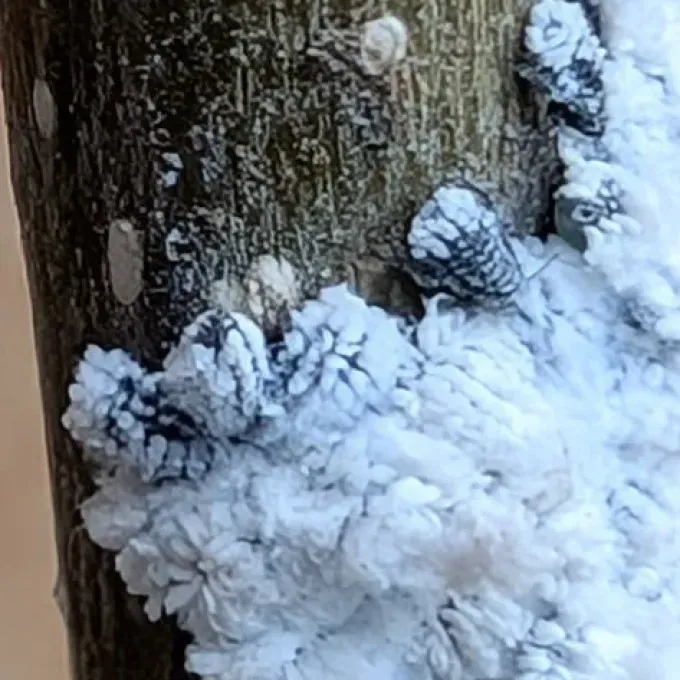
The woolly alder aphid (Prociphilus tessellatus) is a member of the Aphididae family, known for its unique appearance. It secretes a thick, white, waxy substance that covers its body and colony, resembling tufts of cotton.
The insects themselves have dark bodies, but these are rarely visible beneath the dense wax filaments. This waxy coating serves as a protective barrier against many insect predators and environmental stress.
This species is heteroecious, meaning it requires two different host plants to complete its life cycle. It alternates between maples and alders throughout the seasons.
On maple trees, early generations develop, while the summer generations are primarily found on the branches and trunks of alder trees.
Their appearance is quite distinct compared to other common aphid species, making them easy to identify during their peak activity periods on host plants.
What it damages
The primary hosts affected are maples (especially the silver maple) and alders. The aphids damage the plants by feeding on sap from the phloem and cambium tissues.
On maples, the feeding activity results in curled, distorted leaves and the formation of galls, which negatively impacts the tree's overall vigor and can lead to premature leaf drop.
On alders, large colonies often form on the bark. Constant feeding by thousands of individuals weakens the tree, making it more susceptible to other secondary diseases or stressors.
The excessive amount of honeydew secreted by the aphids promotes the growth of sooty mold, a fungus that covers the foliage and bark with a black, unsightly coating.
This heavy sooty mold layer reduces the tree's photosynthetic capability and significantly affects the aesthetic value of urban or garden landscapes.
When it appears
The life cycle begins in spring when overwintering eggs on maple bark hatch. The young aphids feed on the maple before producing winged migrants.
During late spring and summer, these winged individuals migrate to the alder, where they form multiple generations. The population density reaches its peak in mid-summer.
In autumn, sexual winged forms return to the maple tree. They mate and lay the eggs that will survive the winter, thus restarting the biological cycle.
Development is temperature-dependent, and mild, humid weather conditions can accelerate the population growth of the aphids on the alder host.
Monitoring for the presence of these insects is crucial during the transition months of spring and autumn to determine the risk level for the season.
Signs of infestation
The most obvious sign of an infestation is the presence of white, cotton-like masses on the undersides of leaves, branches, or along the tree trunk.
Sticky honeydew buildup on the foliage is another clear indicator, often accompanied by a shiny, wet appearance that later turns dark due to mold growth.
Increased ant activity around the tree is a secondary sign, as ants are attracted to the sugary honeydew produced by the aphids.
Deformed or curled leaves on maple trees during the early spring are typical markers that the colony has initiated its annual growth cycle.
- Cottony, white waxy tufts on branches
- Sticky honeydew on foliage
- Development of black sooty mold
- High ant traffic on the bark
Control measures
Systemic insecticides are the most effective method for controlling infestations, as they are translocated within the tree to target the sap-feeding insects.
For small, ornamental trees in home gardens, physically washing the aphids off with a high-pressure water stream can significantly reduce their numbers.
Encouraging natural predators, such as lady beetles, lacewings, and syrphid fly larvae, is an excellent biological approach to suppressing aphid colonies.
Cultural management involves preventing the close planting of maple and alder trees, which effectively disrupts the species' mandatory life cycle progression.
Early intervention through regular inspection during the late spring period is essential to prevent large-scale outbreaks and protect the health of your trees.
Taxonomy
- Latin name
- Prociphilus tessellatus
- Order
- Hemiptera (bugs, aphids, leafhoppers)
- Family
- Aphididae
- EPPO code
- PARPTE
Discussion
No discussions yet — be the first.