
Ash aphid
Prociphilus bumeliae
Description
How to identify
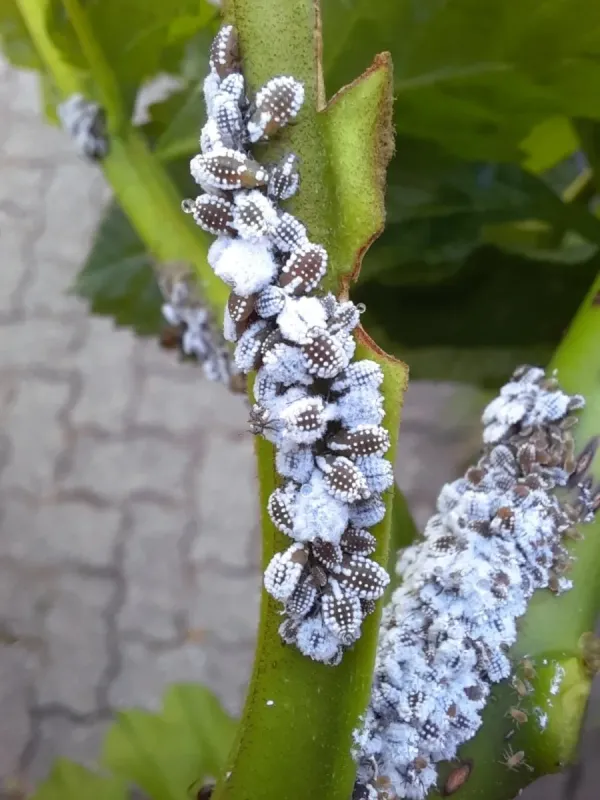
The ash aphid (Prociphilus bumeliae) is a specialized insect pest belonging to the Aphididae family, known for its distinct white waxy appearance on host plants.
Adult insects are small, but they aggregate in large colonies covered by a white, cotton-like substance, which protects them from environmental conditions and predators.
Their life cycle is complex, involving host alternation between ash trees (Fraxinus) and secondary herbaceous hosts, which allows them to survive different seasons.
During the spring and early summer, the aphid populations reproduce asexually, leading to rapid expansion of colonies on the young growth of the ash tree.
The appearance of winged individuals later in the season indicates the migratory phase, where they disperse to secondary hosts to lay overwintering eggs.
What it damages
The primary host, the common ash (Fraxinus excelsior), suffers significant damage as the aphids feed on the cell sap of young leaves and soft shoots.
This feeding behavior causes the foliage to twist, curl, and develop into characteristic distorted structures, which significantly reduces the tree's photosynthetic capacity.
The secretion of honeydew by the aphids coats the leaves and branches, creating a perfect substrate for the colonization of sooty mold fungi.
The presence of sooty mold darkens the leaves and inhibits their ability to breathe and process sunlight, leading to overall tree decline and stress.
Severe infestations can lead to premature leaf drop, stunted growth, and increased susceptibility to other environmental stressors and secondary pathogens.
Signs of infestation
The most prominent sign of infestation is the appearance of white, fluffy, wax-covered masses on the undersides of leaves or along the young stems.
Leaf curling and the formation of distorted leaf clusters are clear visual indicators that aphids have established colonies within the plant tissue.
Sticky residue (honeydew) found on branches and leaves below the aphid colonies is a telltale sign of heavy infestation and active feeding.
The presence of large trails of ants patrolling the tree is a strong secondary indicator, as ants actively farm the aphids for their honeydew.
Yellowing or browning of leaves that occurs out of season is often a result of the vascular damage caused by intense aphid feeding.
Control measures
Effective management focuses on monitoring the trees early in the season and intervening before the colonies become too well-established and produce winged migrants.
Systemic insecticides are generally the most effective way to combat these pests, as they circulate within the plant and target the aphids directly through feeding.
Promoting a healthy environment for natural predators like ladybugs, hoverflies, and lacewings is essential for long-term integrated pest management.
Pruning out heavily infested shoots in the early spring can help reduce the initial population density and slow the spread of the colony throughout the tree canopy.
- Regular inspections of ash tree canopies starting in early spring.
- Use of systemic insecticide treatments when thresholds are exceeded.
- Preservation of natural predator populations through reduced chemical use.
- Sanitary pruning of infested plant parts to limit colony growth.
Taxonomy
- Latin name
- Prociphilus bumeliae
- Order
- Hemiptera (bugs, aphids, leafhoppers)
- Family
- Aphididae
- EPPO code
- PROCBU
Discussion
No discussions yet — be the first.