
Prociphilus
Prociphilus
Description
How to identify
Prociphilus is a genus of insects from the order Hemiptera, belonging to the family Aphididae. These are specialized pests often leading a cryptic lifestyle.
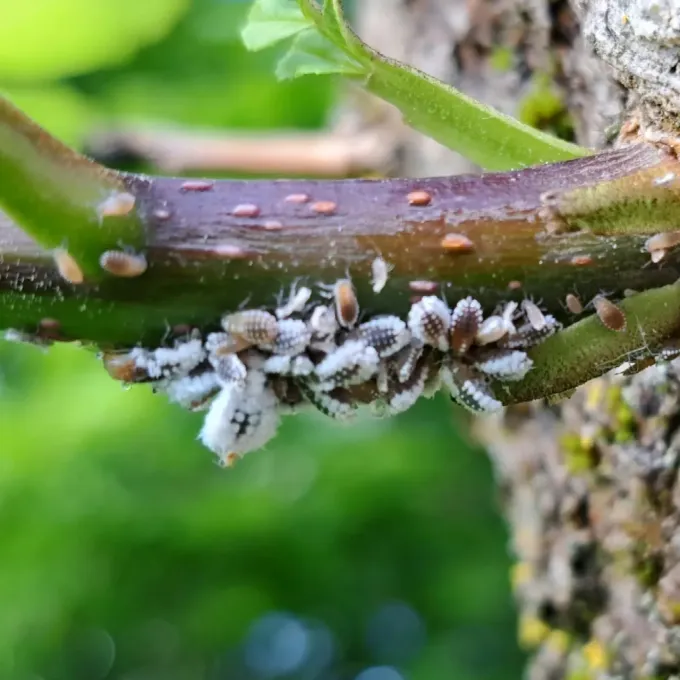
Outwardly, adults and nymphs resemble typical aphids but are often covered with a dense white waxy secretion, making their colonies look like cotton-like clusters on branches or roots.
The insect's life cycle is complex and typically involves host alternation (migration) between woody plants and herbaceous plants or root systems.
Reproduction occurs both sexually and asexually, allowing the species to rapidly increase its population under favorable weather conditions.
The most well-known representative is the ash leaf aphid, which significantly affects urban and forest plantations.
What it damages
The pest primarily attacks woody crops, including ash, maple, fir, as well as some types of conifers and fruit trees.
Many Prociphilus species are root aphids that feed on the sap of underground plant parts, which makes them difficult to detect at early stages.
Leaf-feeding forms cause leaf deformation, the formation of specific curls or galls, within which insects are protected from external factors.
Damage to the root system results in reduced overall tree resistance to drought, frost, and secondary infections.
Severe infestation leads to premature leaf drop, dieback of young shoots, and general suppression of plant vitality.
When it appears
Pest activity begins in early spring, when overwintering eggs hatch into nymphs that start feeding on buds and young leaves.
During the summer, part of the population migrates to secondary hosts, where several generations of pests develop.
The population peak usually occurs in the second half of summer, when conditions are most favorable for reproduction.
In autumn, there is a return migration to the primary hosts for laying overwintering eggs in the bark or shoot cracks.
Weather conditions, such as a moist and warm spring, promote mass reproduction and rapid colonization of areas.
Signs of infestation
One of the most obvious signs of infestation is the appearance of white, fluffy secretions, resembling mold or cotton, on the bark surface or the underside of leaves.
Leaves often show severe curling, yellowing, and premature drop, which noticeably distinguishes the affected tree from healthy ones.
In the case of root species, signs include general tree growth retardation and the appearance of chlorosis, even with sufficient watering.
The presence of a large number of ants around the tree base can indirectly indicate the presence of aphid colonies, with which they are in symbiosis.
When inspecting the root system in the soil, one can find clusters of aphids covered in white coating and characteristic mealy residue on fine rootlets.
Control measures
A comprehensive approach including agrotechnical and chemical measures is used to combat Prociphilus.
Spraying trees with systemic insecticides during the spring nymph emergence period is effective.
- Use of preparations based on imidacloprid or other neonicotinoids.
- Preventive sanitary pruning and destruction of heavily damaged branches.
- Attracting natural enemies: ladybugs, lacewings, and parasitic wasps.
- Drenching the root zone with insecticide solutions to eliminate soil-dwelling forms.
Regular monitoring of plantation health allows for the detection of the pest before mass reproduction begins.
Taxonomy
- Latin name
- Prociphilus
- Order
- Hemiptera (bugs, aphids, leafhoppers)
- Family
- Aphididae
- EPPO code
- PROCSP
Discussion
No discussions yet — be the first.