
Meadow nematode
Pratylenchus neglectus
Description
How to identify
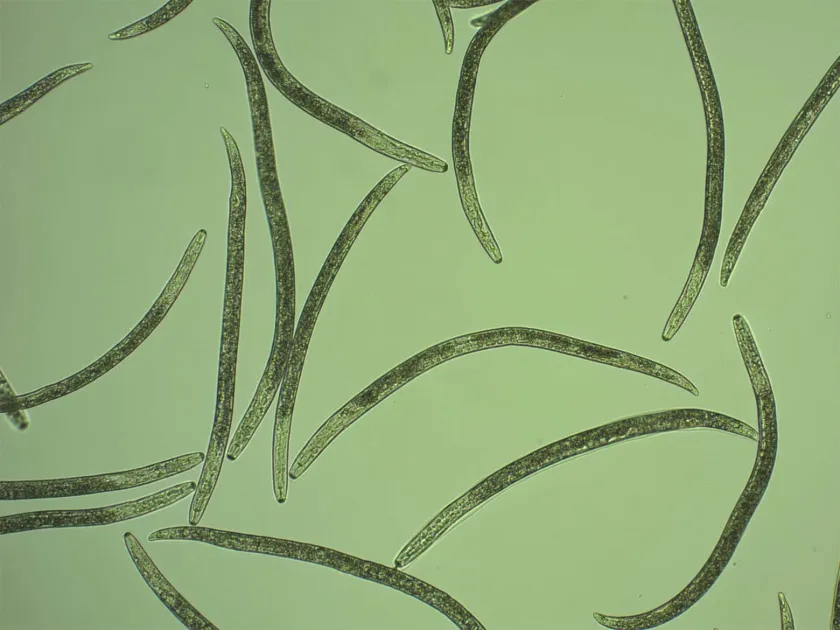
The meadow nematode (Pratylenchus neglectus) is a microscopic worm belonging to the family Pratylenchidae. It is classified as an endoparasite, as it completes its life cycle within the root tissues of host plants.
Measuring between 0.4 and 0.7 mm, these nematodes are slender and equipped with a strong stylet. This stylet is essential for their feeding mechanism, allowing them to penetrate and move through root cells while destroying them.
Systematically, they fall under the order Rhabditida. They are highly mobile within the rhizosphere and root cortex, making them difficult to locate without specific soil analysis techniques and microscopic observation.
Unlike many other nematodes that form galls or cysts, Pratylenchus neglectus remains migratory throughout its life. This ability to move within the plant tissue significantly enhances the damage caused to the host.
Their prevalence is global, and they are recognized as one of the most economically significant root-lesion nematodes, capable of surviving a wide range of temperate and subtropical soil conditions.
What it damages
This pest affects a broad range of agricultural crops, including small grains such as wheat, barley, and rye. Other important hosts include corn, potatoes, and several legume species, leading to severe yield reductions.
By feeding on the root cortex, the nematode causes necrotic lesions. These lesions disrupt the plant's ability to uptake water and nutrients, leading to stunted growth, wilting, and poor overall plant vigor.
Secondary infections are a major consequence of their activity. By creating open wounds in the roots, Pratylenchus neglectus facilitates the entry of soil-borne fungi and bacteria, leading to complex root rot issues.
Economic damage is often cumulative. Over time, the nematode population builds up in the soil, making it increasingly difficult to achieve profitable yields in susceptible fields without intervention.
In highly infested soils, the roots show signs of browning and decay, which can lead to root system failure, especially during periods of environmental stress like heat or drought.
When it appears
The life cycle of the meadow nematode includes eggs, four juvenile stages, and adults. They can reproduce either within the plant roots or in the surrounding soil, depending on the availability of nutrients.
Reproduction is temperature-dependent, with optimal activity occurring between 15°C and 25°C. Under favorable conditions, the nematode can complete several generations within a single growing season.
During cold winters or extremely dry periods, these nematodes enter a state of dormancy (anabiosis). This allow them to survive in the soil for significant periods until a suitable host root becomes available again.
The peak density of the population is usually observed when the host crop is actively growing, providing ample resources for rapid reproduction and migration into new root areas.
Long-distance dispersal is primarily human-mediated, occurring through the transport of infested soil on farm machinery, tools, or through moving contaminated plant material across fields.
Signs of infestation
Field symptoms often present as irregular patches of stunted, yellowing plants. These patches may mimic the appearance of nutrient deficiencies or general moisture stress, often leading to misdiagnosis.
Upon inspecting the roots, one can observe brown or black necrotic lesions. In severe cases, the entire root system may appear reduced, with missing fine feeder roots and lateral branching.
Plants affected by the meadow nematode are often easily pulled from the soil, confirming that the structural integrity of the roots has been compromised by the parasite's feeding and subsequent rot.
Because these signs are common to many soil-borne diseases, confirmation requires quantitative analysis. Lab specialists extract nematodes from soil or root samples to determine the population density per gram of root or kilogram of soil.
Early identification of these signs is vital, as waiting for visual field symptoms often means that significant yield loss has already occurred by the time the problem is identified.
Control measures
Management of the meadow nematode requires an integrated pest management (IPM) strategy because there is no single "silver bullet" to eradicate them from the field completely.
- Crop rotation using non-host or resistant crops to starve the nematode population over time.
- Strict weed control, as many common weeds serve as reservoirs for the nematode during the off-season.
- Using clean, certified planting material to avoid introducing the pest into new areas.
- Soil amendments that improve soil health and increase the population of beneficial microbes.
- Bio-fumigation using specific cover crops that release nematicidal compounds upon incorporation into the soil.
Chemical control with nematicides can be effective but is restricted in many regions due to environmental regulations. These are typically applied as soil treatments before planting.
Biological control methods are gaining popularity, using beneficial fungi or bacteria that parasitize nematode eggs. These agents help suppress population growth without the negative impacts of traditional synthetic pesticides.
Good sanitation practices are crucial. Cleaning soil off tractors and equipment after working in infested zones prevents the accidental spread of nematodes to cleaner parts of the farm.
Taxonomy
- Latin name
- Pratylenchus neglectus
- Order
- Nematodes
- Family
- Pratylenchidae
- EPPO code
- PRATNE
Discussion
No discussions yet — be the first.