
Forest dung fly
Polietes lardaria
Description
How to identify
The Forest dung fly, scientifically known as Polietes lardaria, is a member of the Muscidae family. It is often found in wooded areas and agricultural settings where organic decomposition occurs.
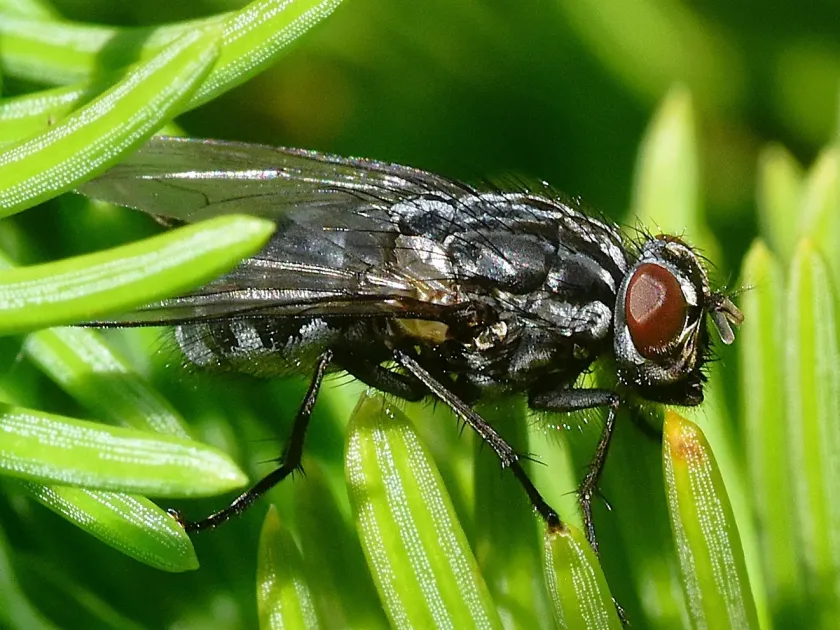
Adult flies are similar in appearance to common house flies, characterized by a greyish body with distinct dark stripes on the thorax. Their bodies are covered in fine, bristly hairs.
Larvae of this species are legless and thrive in decaying organic matter, such as manure or compost. They require a moist environment to complete their development stages successfully.
Identifying the species often involves examining wing venation and abdominal structure. Unlike some other flies, they are particularly attracted to decaying vegetable and animal matter.
The mouthparts of the adult fly are adapted for sponging up liquid nutrients, which is a critical trait when considering how they spread plant pathogens across fields.
What it damages
Polietes lardaria does not feed directly on plant tissues in a way that destroys leaves or stems. However, its economic impact comes from its role as a vector for various plant diseases.
As the flies move between decaying manure and healthy crops, they transfer bacteria and fungal spores on their legs and mouthparts. This frequently triggers outbreaks of rot in vegetable crops.
Greenhouse operations are particularly vulnerable, as the flies contaminate fruits and leaves with excrement, rendering the produce unmarketable due to hygiene regulations.
In addition to physical contamination, the bacteria introduced by the flies can compromise the plant's vascular system, leading to wilting and reduced yield quality.
The fly's presence serves as an indicator of poor sanitation, and their movement facilitates the rapid spread of secondary infections across a field or glasshouse.
When it appears
The activity of Polietes lardaria begins in late spring, as temperatures rise consistently. The population peak usually occurs during the warm summer months of July and August.
Their lifecycle is temperature-dependent. During optimal conditions, several generations can be produced within a single growing season, allowing the population to explode quickly.
Development from egg to adult takes place entirely within organic substrate. Once the environment dries out, the development cycle is interrupted, which is a natural limiting factor.
As autumn approaches and temperatures drop, adult flies become less active. They overwinter in protected locations or as pupae deep within the soil or composting matter.
Early spring monitoring is essential, as the first generation of adults emerges from overwintering sites to begin the cycle anew in the warming environment.
Signs of infestation
The most obvious sign of infestation is the physical presence of adult flies clustering around manure piles, compost heaps, or waste disposal sites on the farm.
Small, dark fecal spots appearing on the leaves or fruits of crops are a definitive sign that these flies have been active in the area and have visited the plants.
Localized patches of rot or fungal development on fruit near the ground can often be traced back to contamination by flies arriving from decaying organic sources.
An increase in the number of flies visiting livestock or standing near animal housing areas suggests a significant population density that could eventually impact nearby crop fields.
Regular visual checks of irrigation drainage or organic waste management areas help identify potential breeding grounds before an infestation reaches critical levels.
Control measures
Strict sanitation is the most effective defense. Removing manure and other organic waste promptly prevents the flies from finding suitable breeding sites on your property.
Utilizing thermophilic composting techniques, where temperatures within the pile reach 60°C or higher, effectively kills the eggs and larvae of the Forest dung fly.
In greenhouses, installing fine mesh screens on all vents and doors is crucial to physically exclude the flies and protect the sensitive vegetable crops inside.
Yellow sticky traps are highly effective for both monitoring the population size and capturing adult flies to prevent them from contaminating the harvest.
When chemical control is necessary, use targeted insecticides in areas where flies congregate, ensuring no drift occurs onto the edible parts of the crops.
Taxonomy
- Latin name
- Polietes lardaria
- Order
- Diptera (flies)
- Family
- Muscidae
- EPPO code
- PLIELA
Discussion
No discussions yet — be the first.