
Long-horned springtail
Pogonognathellus longicornis
Description
How to identify
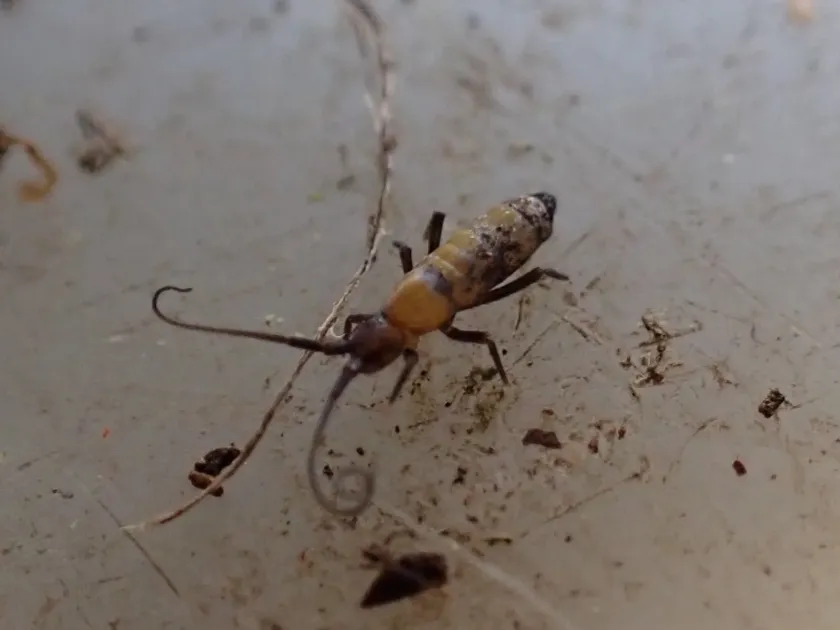
The long-horned springtail (Pogonognathellus longicornis) belongs to the order Collembola, family Tomoceridae. This small arthropod possesses a characteristic jumping organ called the furcula located on the abdomen.
Adult specimens measure between 3–5 mm. The species is easily identified by its elongated body and exceptionally long, well-developed antennae, which are its most prominent morphological feature.
Their coloration ranges from grayish to brownish, often with a metallic sheen caused by the dense layer of scales covering the body.
These springtails thrive in damp, shaded environments. In agricultural settings, they are commonly found in the upper soil layers, especially where organic matter is abundant.
Their biology is closely linked to soil fungi, which serve as their primary food source, though they may feed on living plant tissues when populations become excessive.
What it damages
This pest is most dangerous to young seedlings and transplants in greenhouses or environments with high soil moisture levels.
Springtails feed on delicate root hairs and the base of the stems, leading to stunted growth or, in severe cases, the complete death of the plant.
They have a preference for seeds high in starch and sugar, often consuming them during germination before the sprout emerges from the soil.
Beyond direct feeding damage, these insects are frequent vectors for pathogenic fungi spores, contributing to root rots and the "damping-off" disease of seedlings.
Economic impact is most significant in nursery production, where high planting density and high moisture create ideal conditions for pest outbreaks.
When it appears
The activity of the long-horned springtail occurs throughout the growing season, with peak population levels usually observed during wet spring months.
As temperatures drop and rainfall increases in the autumn, the pest becomes active again, aggregating in decomposing plant material for both food and overwintering.
In greenhouse settings, where humidity and temperature remain consistent, the springtail's life cycle continues uninterrupted throughout the year.
Migration occurs both horizontally through the soil and vertically in response to water table levels and irrigation practices.
The speed of generation development is strictly temperature-dependent; in optimal conditions, the life cycle from egg to adult is completed within 3–4 weeks.
Signs of infestation
The first sign of an infestation is the presence of tiny feeding holes on the cotyledons or the crown area of young seedlings.
Upon inspecting the soil surface after heavy irrigation, one may notice large numbers of small, jumping insects, which confirms the presence of an infestation.
Sudden cessation of plant growth and yellowing of foliage in young plants without apparent cause often points to root damage by springtails.
The presence of mold on the soil surface or the failure of seeds to emerge are strong indicators of high springtail activity within the substrate.
Close inspection of the root ball often reveals clusters of adult springtails and their scales concentrated in the rhizosphere.
Control measures
The most important control method is strict irrigation management; avoiding waterlogged substrate effectively limits the potential for population growth.
It is essential to disinfect soil mixtures before planting by steam sterilization or freezing to eliminate any eggs or larvae present in the substrate.
In cases of high pest density, the application of registered insecticides with contact or systemic action is necessary to protect young crops.
- Consistent removal of plant debris from the growing area.
- Surface mulching with sand to reduce accessible moisture.
- Monitoring of adult populations using yellow sticky cards.
Biological control options include the use of entomopathogenic nematodes or fungal-based biopesticides like Beauveria bassiana to suppress springtail numbers.
Taxonomy
- Latin name
- Pogonognathellus longicornis
- Family
- Tomoceridae
- EPPO code
- POGGLO
Discussion
No discussions yet — be the first.