
Glossy ibis
Plegadis falcinellus
Description
How to identify
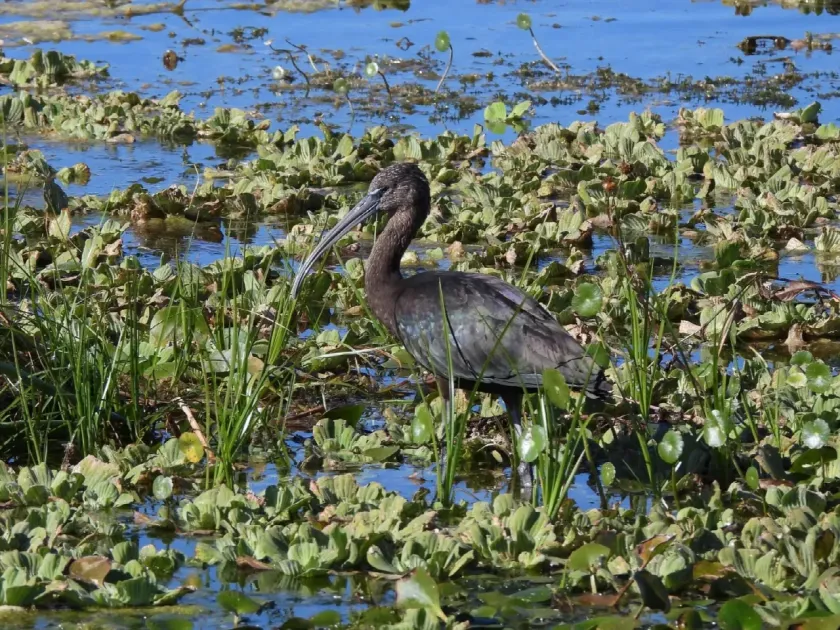
The Glossy ibis is a water bird belonging to the Threskiornithidae family. It is easily recognized by its long, thin, and characteristically decurved bill, which it uses to probe the mud and soil for prey.
Adult birds exhibit deep, dark brown plumage with an iridescent metallic sheen, appearing green or bronze under direct sunlight, which makes them look dark from a distance.
These birds are highly gregarious, often nesting in dense reed beds and foraging in large flocks. Their physical structure, including long legs, allows them to navigate shallow wetlands and flooded agricultural fields with ease.
With a body length of approximately 65 centimeters and a wingspan of up to one meter, the Glossy ibis is a conspicuous inhabitant of wetland agricultural landscapes.
Their flight is direct and purposeful, with rhythmic wingbeats, frequently observed when flocks move between their roosting sites and their chosen feeding grounds.
What it damages
The Glossy ibis causes significant agricultural damage, particularly in rice paddies. The main issue is the mechanical destruction of rice seedlings caused by the birds' trampling while foraging.
During their feeding activities, they often pull up or bury young sprouts. This behavior can result in a thinning of the crop stand, necessitating expensive replanting measures in affected areas.
By probing the saturated soil with their bills and walking on the soft substrate, they can disrupt the soil structure, which negatively affects the development of the rice plants' root systems.
Mass foraging by a large flock can lead to substantial yield losses in a very short period, making the species a concern for commercial rice farmers during critical growth stages.
While their primary diet consists of aquatic invertebrates, their presence in large numbers during the seedling stage makes them a notable pest in rice production regions.
When it appears
The presence of the Glossy ibis in agricultural fields is closely tied to the irrigation cycle of rice fields, which provides an optimal environment for their foraging behavior.
The most vulnerable period is during the early stage of rice seedling emergence, when the fields are flooded and the young plants are delicate and easily damaged.
Activity remains high throughout the summer months as the birds continue to forage for their developing chicks, maintaining a consistent pressure on agricultural lands.
As the season progresses toward autumn, the birds begin to aggregate into larger flocks, increasing the potential impact on specific fields before they depart for their wintering grounds.
Environmental factors, such as water depth in the paddies, dictate the length of their stay and the intensity of their foraging on any given plot of land.
Signs of infestation
Identification of their presence includes distinct, deep footprints in the mud, alongside arrays of small, puncture-like probe holes made by their bills while hunting for prey.
The most obvious visual sign is the presence of dark, ibis-shaped birds in the fields, typically moving in coordinated groups or flocks during the day.
Damage signs manifest as areas of flattened or missing vegetation, where the flock has spent significant time foraging in the moist soil of the rice paddies.
The discovery of moulted feathers near the edges of the fields and concentrated droppings are reliable indicators of regular bird activity in that specific location.
A sudden, patchy reduction in rice seedling density, often occurring after reports of large bird flocks, confirms the impact of the Glossy ibis on the crop.
Control measures
Managing the impact of the Glossy ibis requires a combination of deterrent strategies designed to keep the birds away from sensitive agricultural areas.
- Deployment of acoustic deterrents, such as gas cannons or sound systems playing bird alarm calls.
- Installation of visual repellents, including kites or silhouettes shaped like raptors to discourage landing.
- Management of water levels in rice paddies to make the fields less attractive for probing and wading.
- Use of reflective tapes or flashing lights around the field perimeter to disorient the birds.
- Implementation of field monitoring and active patrol schedules to prevent large flocks from establishing a feeding routine.
Taxonomy
- Latin name
- Plegadis falcinellus
- Family
- Threskiornithidae
- EPPO code
- PLEGFA
Discussion
No discussions yet — be the first.