
Beet lace bug
Piesma maculatum
Description
How to identify
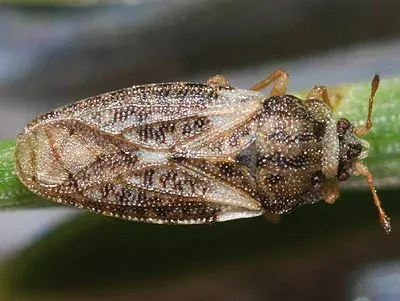
The beet lace bug (Piesma maculatum) is a small insect belonging to the family Piesmidae. Adult bugs measure between 2.5 and 3.5 mm and are distinguished by the delicate, lace-like pattern on their wings and pronotum.
Their coloration typically ranges from yellowish-grey to dark brown, often featuring mottled patterns that provide excellent camouflage against soil and plant debris. The head and pronotum are covered in fine, hair-like projections.
Nymphs resemble smaller, wingless versions of adults. They undergo several molting stages, gradually increasing in size and developing wing pads as they reach maturity.
They overwinter as adults, primarily seeking shelter under plant residues, in forest belts, or in perennial grass fields. They emerge in the spring once temperatures consistently exceed +10°C.
Females lay eggs on the underside of host plant leaves. A high reproductive rate allows for multiple generations per year, depending on the environmental conditions and the availability of host plants.
What it damages
The primary hosts for the beet lace bug are plants within the Chenopodiaceae family, most notably sugar, fodder, and garden beets. They also frequently inhabit weeds like goosefoot.
Both adults and nymphs feed by piercing the plant epidermis and sucking sap. During feeding, they inject toxic saliva, which triggers pathological changes in the plant tissue.
Severe infestations on young seedlings often result in total crop failure. Surviving plants suffer from stunted growth, reduced leaf mass, and a significant decrease in root development.
The pest is a known vector of the beet mosaic virus. This viral transmission causes leaf curling, yellowing, and severe plant deformity, which drastically reduces the photosynthetic capacity and sugar content of the crop.
Overall losses in yield and sugar quality can reach 40% in heavy infestation scenarios, making this insect a serious economic threat to beet production.
When it appears
The activity cycle begins in early spring as soon as the weather warms. Overwintered adults quickly migrate to emerging beet crops to feed and lay eggs.
Nymph development typically peaks in late spring and early summer, which coincides with the most sensitive growth stage of the beet crop. Monitoring during this period is critical for management.
Under favorable, warm conditions, the beet lace bug can complete two to three generations per growing season, leading to persistent pressure on the crops.
As autumn approaches and temperatures drop, adults seek out protected overwintering sites, often moving toward field edges, hedgerows, and uncultivated areas.
Environmental factors play a major role in population dynamics; dry and hot summer months often accelerate the life cycle and contribute to population spikes, while cold springs may delay development.
Signs of infestation
The first visual signs of infestation are small, light-colored spots or speckles on the leaves, caused by the insects' piercing-sucking feeding habits.
In cases of viral transmission, the leaves exhibit characteristic curling or crinkling, often accompanied by vein clearing. This mosaic-like pattern is a definitive indicator of the pest's presence.
Infestations are often patchy across a field. A close inspection of the leaf undersides reveals the presence of both adults and nymphs, as well as their characteristic black fecal spots.
Seedlings may wilt or die entirely, leading to gaps in the crop stand that require reseeding. Overall plant vitality is noticeably lower in affected areas compared to healthy zones.
- Presence of pale spots or mottling on leaves.
- Leaf curling, crinkling, and deformation.
- Stunted plant growth and reduced vigor.
- Presence of insects on the underside of leaves.
Control measures
Effective management begins with good agricultural practices, including crop rotation and ensuring that beet fields are not located adjacent to previous years' beet crops or perennial grass reservoirs.
Controlling weeds of the Chenopodiaceae family, especially in field margins, is vital to eliminating intermediate hosts and reducing the local bug population.
Chemical control using systemic insecticides is recommended once economic thresholds are reached. Early detection allows for targeted treatments that minimize the need for wide-scale field application.
Using systemic seed treatments provides crucial protection during the early emergence phase, which is when the crop is most susceptible to direct feeding and early viral infection.
Regular field scouting, particularly of the field edges near potential overwintering sites, helps agronomists detect the arrival of the pest early and implement control measures before a widespread outbreak occurs.
Taxonomy
- Latin name
- Piesma maculatum
- Order
- Hemiptera (bugs, aphids, leafhoppers)
- Family
- Piesmatidae
- EPPO code
- PIESMA
Discussion
No discussions yet — be the first.