
Beet lace bug
Parapiesma kochiae
Description
How to identify
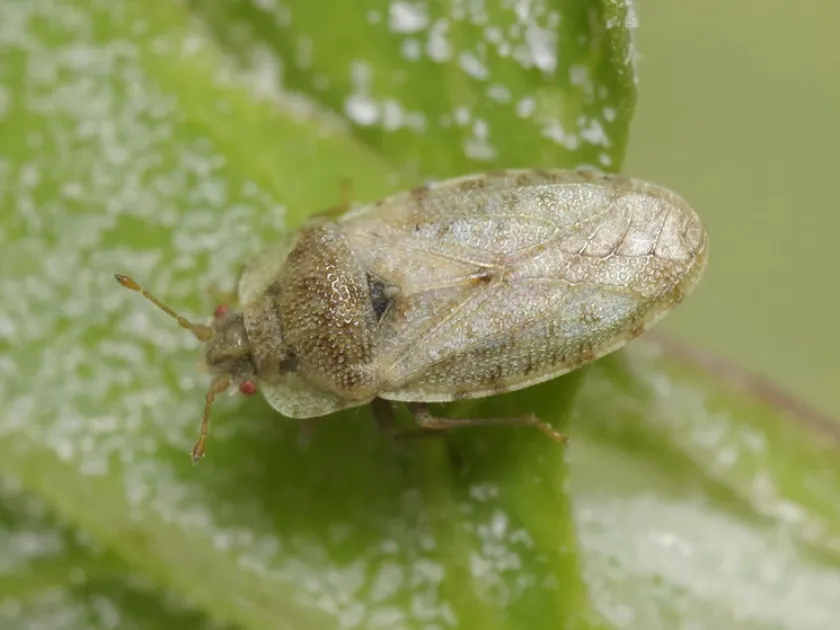
The beet lace bug (Parapiesma kochiae) belongs to the order Hemiptera and the family Tingidae. These insects are easily identified by their small size, typically 2.5–3 mm, and their distinct, reticulated (lace-like) wing covers.
Their coloration ranges from greyish-brown to almost black, which allows them to camouflage effectively against soil particles and plant debris during their overwintering period.
Nymphs are smaller than adults and wingless, often residing in the same locations as adults. Both stages share similar feeding habits, making the entire mobile population a threat to young crops.
The mouthparts are of the piercing-sucking type, specialized for tapping into the vascular system of the leaves to extract vital plant fluids, which directly impacts plant growth.
Adults overwinter in protected sites, such as leaf litter, soil cracks, or beneath weeds, emerging as soon as spring temperatures allow for active metabolism.
What it damages
This species primarily targets sugar, table, and fodder beets. It is considered a significant pest in regions where these crops are grown in close proximity to host weeds.
Weeds from the Amaranthaceae family, particularly Chenopodium album (common lambsquarters), serve as the primary reservoir for these bugs, allowing them to build up populations before attacking commercial crops.
Feeding causes severe physiological stress to the young beet plants, often resulting in stunted growth, leaf deformation, and, in cases of extreme infestation, total plant mortality.
Both adults and nymphs cause damage by depleting the plant's nutrient reserves, leading to chlorosis and the development of necrotic spots on the leaves.
Beyond physical damage, the beet lace bug is known to transmit various plant diseases, making it a critical pest for overall crop health management in affected regions.
When it appears
The insects become active in early spring when temperatures reach approximately 10–12°C. They quickly migrate from overwintering sites to the emerging beet seedlings.
The pest completes several generations during the summer, with the life cycle duration highly dependent on local weather conditions, being significantly shorter during hot and dry spells.
The most critical window for crop protection is the seedling stage. If infestation occurs during this period, the plants have limited capacity to recover, leading to reduced field stand density.
By late autumn, the adults seek hibernation sites to escape the impending cold. This transition period is marked by a gradual decline in visible activity on the leaves.
Field monitoring is essential throughout the late spring to track the movement of the bugs from weed patches into the beet rows, allowing for targeted intervention.
Signs of infestation
Initial signs of infestation appear as minute, pale spots on the cotyledons and leaves, which progressively merge into larger chlorotic areas, reducing the photosynthetic efficiency of the plant.
The leaves eventually become curled, stunted, and distorted, often referred to as "leaf curling," which is a hallmark symptom of heavy lace bug activity.
- Whitish, speckled spots on the undersides of leaves.
- Noticeable crinkling and curling of new foliage.
- General chlorosis and lack of vigor in seedling rows.
- Direct observation of small bugs in the leaf axils.
As the damage progresses, the lower leaves may dry out prematurely, forcing the plant to prioritize survival over the development of the storage root, which results in significant yield loss.
If not managed, infested fields show irregular growth patterns, with stunted plants appearing in patches throughout the crop rows.
Control measures
Cultural control practices, such as deep autumn tillage, are highly effective in destroying overwintering habitats and reducing the population carry-over into the next season.
Rigorous weed management, especially targeting species like Chenopodium and Atriplex around field borders, is crucial to minimize the initial pest source.
Crop rotation and spatial separation of beet fields from areas with high weed density can significantly delay the arrival and colonization of the bugs.
Chemical control involving systemic or contact insecticides is recommended when population thresholds are exceeded, typically during the 2-4 true leaf stage.
It is advised to rotate insecticides with different modes of action to prevent the development of resistance within the lace bug population, ensuring long-term efficacy.
Taxonomy
- Latin name
- Parapiesma kochiae
- Order
- Hemiptera (bugs, aphids, leafhoppers)
- Family
- Piesmatidae
- EPPO code
- PARWKO
Discussion
No discussions yet — be the first.