
Pine gall mite
Phytoptus pini
Description
How to identify
The Pine gall mite (Phytoptus pini) is a microscopic pest belonging to the Eriophyidae family, commonly known as four-legged mites. These organisms are invisible to the naked eye, requiring high-magnification microscopy for accurate identification.
They possess an elongated, worm-like body, usually cream or yellowish in color. Unlike spider mites, these pests have only two pairs of legs, which are used for slow movement along the surface of pine needles and buds.
These mites are specialized pests, living their entire life cycle on pine trees. They are protected by the physical environment of the tree, hiding beneath the scales of buds and at the base of needle clusters to survive adverse conditions.
The life cycle is closely synchronized with the growth of the host tree. Mated females overwinter in sheltered positions, such as under bud scales, emerging in spring when temperatures rise to resume feeding and egg-laying.
High reproductive rates allow them to establish large populations within a single growing season. Their ability to remain hidden makes them particularly difficult to detect until significant plant damage has already occurred.
What it damages
The primary host for Phytoptus pini is the pine species, particularly Scots pine (Pinus sylvestris). While established trees can tolerate some level of infestation, young trees and nursery stock are highly susceptible to damage.
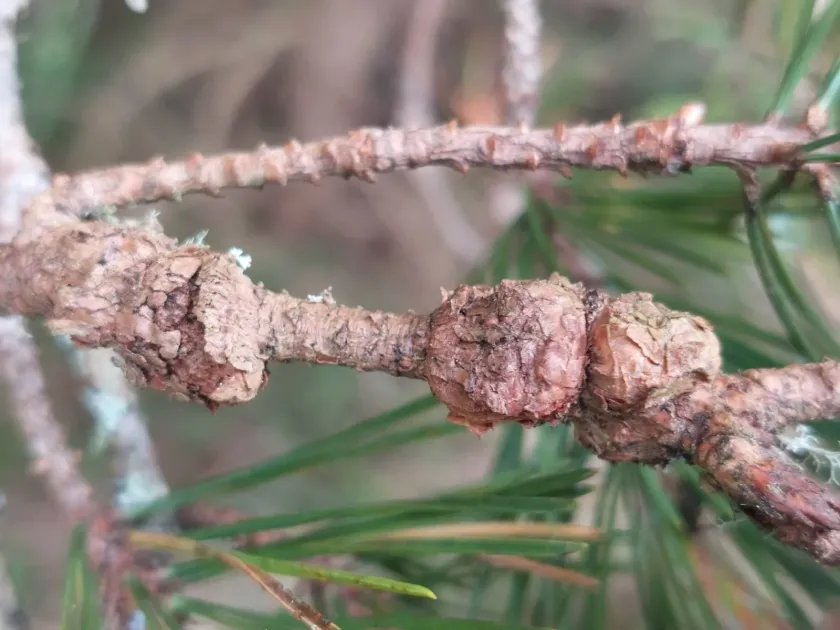
Damage occurs when mites inject salivary enzymes into the needle tissues while feeding. This causes a physiological disruption that induces abnormal cell growth, resulting in the formation of galls or needle swelling.
Infested needles lose their ornamental value and structural integrity. They often become distorted, twisted, or stunted, which disrupts the tree’s photosynthetic capacity and weakens its overall physiological health.
In ornamental settings, the primary concern is the loss of aesthetic appeal. The disfigurement caused by these mites can render nursery stock unsalable, as the needles appear yellowed, sparse, and generally sickly.
Severe infestations lead to premature needle drop and, in some cases, the death of individual branches. While the mite rarely kills a mature tree directly, it significantly increases the tree's vulnerability to secondary environmental stressors.
Signs of infestation
The earliest symptom is often a subtle discoloration of the needles on young shoots. They may look pale, yellowed, or brownish, which can be easily confused with nutrient deficiencies or drought stress.
Look for morphological changes in the needles. Any twisting, curling, or thickening at the base of the needle bundle is a strong indicator of mite activity and gall formation caused by their feeding.
During the growing season, heavily infested shoots may appear stunted or "stubby." The needles may look glued together or covered in a fine, debris-like substance, which includes the mites' cast skins and excrement.
A thinning crown, particularly on younger branches, is another hallmark sign. As the infestation progresses, needles will begin to drop prematurely, starting from the base of the shoots and moving upwards.
Inspection with a hand lens might reveal microscopic colonies at the base of the needles. If the needles are misshapen and the tree is losing its vibrant green color, it is time to investigate for potential mite infestation.
Control measures
Control of the Pine gall mite is challenging due to its protected location within bud scales. Success depends on the timely application of systemic or contact acaricides during periods of mite activity.
Applications should begin in early spring as temperatures rise, targeting overwintered females before they start laying eggs. Repeated treatments throughout the summer may be necessary to target subsequent generations.
Cultural control is essential. Regularly inspect your trees and promptly prune and destroy heavily infested branches. This mechanical removal reduces the overall mite population and prevents the spread to healthy parts of the tree.
Maintain tree vigor through proper horticultural practices, such as consistent watering and mulching. A healthy, stress-free tree is naturally more resilient to mite damage and better able to recover from infestations.
- Application of specialized acaricides.
- Sanitary pruning of infested shoots.
- Regular crown monitoring during the growing season.
- Proper fertilization to support overall tree immunity.
Taxonomy
- Latin name
- Phytoptus pini
- Order
- Mites
- Family
- Phytoptidae
- EPPO code
- PHTPPI
Discussion
No discussions yet — be the first.