
Ranunculus leaf miner
Phytomyza ranunculi
Description
How to identify
The Ranunculus leaf miner, scientifically known as Phytomyza ranunculi, belongs to the family Agromyzidae within the order Diptera.
These flies are small, typically measuring 2–3 millimeters in length, with a grayish or brownish body coloration that provides camouflage.
The life cycle encompasses four distinct stages: egg, larva, pupa, and adult, with the larval stage causing primary damage to host plants.
Adults are elusive but can often be spotted on the foliage of host plants during warm, sunny weather, actively seeking oviposition sites.
The female uses a specialized organ to insert eggs directly into the leaf parenchyma, ensuring the larvae have immediate access to food upon hatching.
What it damages
The pest primarily infests plants in the Ranunculaceae family, with various buttercup species being the most susceptible hosts.
As the larvae emerge, they tunnel between the upper and lower leaf surfaces, consuming the plant's internal tissues while leaving the epidermis intact.
This feeding behavior creates visible tracks, commonly referred to as mines, which disrupt the plant's photosynthetic capacity.
Weakened leaves are more prone to secondary infections and dehydration, which can lead to premature wilting and overall plant decline.
In ornamental gardens, the aesthetic impact is significant as leaves become disfigured, reducing the visual appeal of the planting beds.
When it appears
Adult activity begins in late spring, corresponding with the early growth phase of host plants as temperatures reach optimal levels.
Peak infestation usually occurs during the summer months when multiple generations can overlap, leading to high population densities.
The pest's developmental rate is highly temperature-dependent, allowing for rapid generation turnover during prolonged warm periods.
By autumn, the flies enter a dormant pupal stage, often remaining in the soil or protected debris through the winter months.
Early season monitoring is crucial, as the first generation of adults establishes the population pressure for the remainder of the growing season.
Signs of infestation
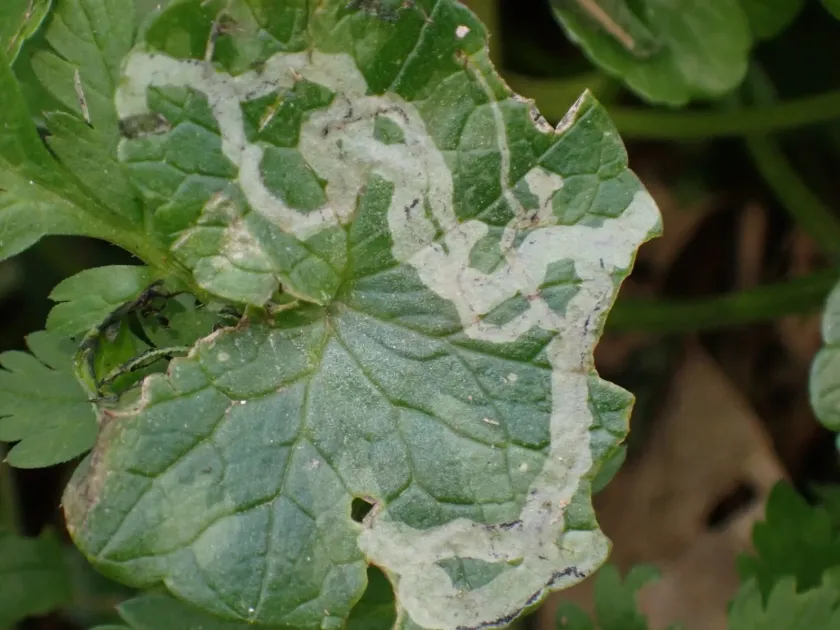
The most diagnostic sign is the appearance of whitish, winding, or serpentine tracks on the leaves of the affected plants.
These mines are thin initially but widen significantly as the larva grows, sometimes forming intricate patterns across the leaf surface.
Dark fecal deposits, known as frass, are frequently visible inside the mines as small, dotted streaks, confirming the presence of the larva.
Severely infested leaves may curl, turn brown, and eventually wither as the internal tissues are destroyed by the feeding activity.
Careful inspection of the leaf underside or holding the leaf against the light can reveal the larvae or the puparia tucked within the tissue.
Control measures
Cultural control is essential, focusing on the removal and destruction of infested foliage to break the pest's reproductive cycle.
Deep cultivation of the soil around host plants in late autumn can expose pupae to predators and adverse weather conditions, reducing winter survival.
Yellow sticky traps can be deployed in the garden to monitor adult activity and capture flying insects before they can lay eggs.
If chemical intervention is necessary, systemic insecticides are the most effective, as they are absorbed by the plant to target larvae feeding inside the leaves.
- Regular sanitation of garden beds to remove debris.
- Crop rotation to reduce host plant proximity.
- Biological control using parasitic wasps if applicable.
Taxonomy
- Latin name
- Phytomyza ranunculi
- Order
- Diptera (flies)
- Family
- Agromyzidae
- EPPO code
- PHYYRA
Discussion
No discussions yet — be the first.