
Columbine leaf miner
Phytomyza minuscula
Description
How to identify
The Columbine leaf miner (Phytomyza minuscula) is a fly species belonging to the family Agromyzidae. It is a tiny dipteran pest that is most recognizable by its larvae's unique feeding patterns within the leaves of its host plant.
Adult flies are very small, typically measuring 2–3 mm in length, and are often overlooked by gardeners because of their inconspicuous appearance and rapid flight.
The life cycle consists of four distinct stages: egg, larva, pupa, and adult. The larval stage is responsible for the characteristic damage that distinguishes this pest from other leaf miners.
Pupation usually occurs either within the leaf mines or in the soil near the host plant, allowing the insect to survive winter dormancy effectively.
Their ability to produce multiple generations per season makes them a persistent threat to Aquilegia collections throughout the spring and summer months.
What it damages
The primary host for this pest is the Columbine (Aquilegia) plant. It focuses its feeding activity on the foliage, significantly impacting the plant's photosynthesis and visual appeal.
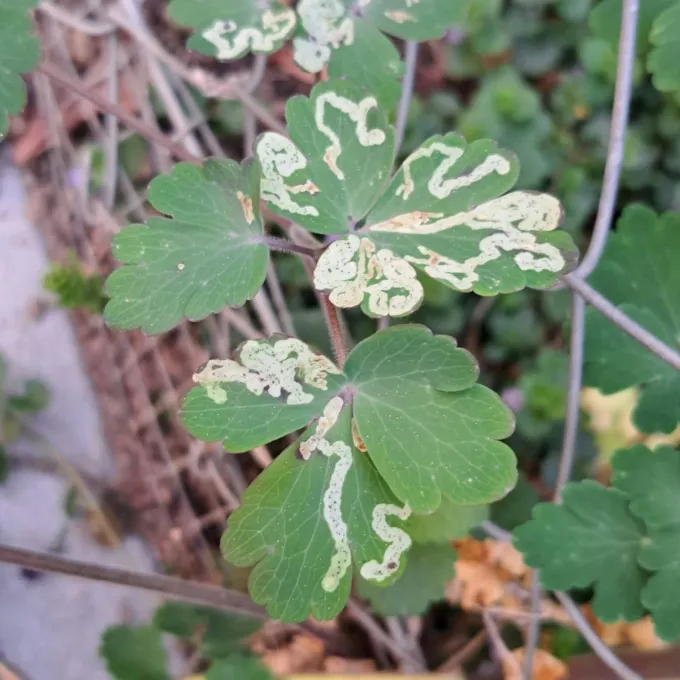
Larvae consume the mesophyll (inner tissue) of the leaf while leaving the upper and lower epidermal layers intact, which creates the distinctive "mine" pattern.
In cases of heavy infestation, leaves become riddled with tangled, white, serpentine mines. This eventually leads to premature yellowing and drying of the foliage.
While the root system and flowers remain largely unaffected, the destruction of the leaf surface creates a stressful environment that weakens the entire plant.
In nursery settings, affected plants lose their commercial value quickly, necessitating aggressive management to prevent the spread of the miner to healthy stock.
When it appears
The emergence of adults begins in late spring, often coinciding with the early growth stages of the Columbine plants.
The most active period for larval damage occurs during the peak vegetative growth phase, typically from late May through July, depending on the local climate.
Warmer temperatures accelerate the insect's life cycle, allowing it to complete several overlapping generations within a single growing season.
By late autumn, the pupae enter diapause, overwintering in the soil or in leaf litter, which allows the species to re-emerge the following spring.
Early spring monitoring is crucial for detecting the first signs of activity, as controlling the first generation significantly reduces the population pressure later in the year.
Signs of infestation
The most visible indicator of infestation is the presence of winding, pale-colored tracks or "mines" running through the leaf blades.
As the larva grows, the mine increases in width, often starting as a fine thread and broadening into a noticeable white or silvery path.
Small dark spots, which are the larvae's frass (excrement), can usually be found within the mines, helping to confirm that the damage is caused by a miner fly.
Leaves that are heavily infested may eventually twist, shrivel, or turn brown prematurely, giving the plant a scorched or unhealthy appearance.
Microscopic punctures on the underside of the leaf indicate where the female has laid her eggs, and these can be seen during careful inspection of the foliage.
Control measures
Cultural control is the most effective first line of defense; removing and destroying infested leaves as soon as they are spotted prevents the larvae from completing their life cycle.
Good garden sanitation, such as clearing away debris and soil tillage in the fall, helps disrupt the overwintering pupae and reduces the next year's population.
When infestation levels exceed acceptable thresholds, systemic insecticides can be applied to target the larvae hidden within the leaf tissue.
- Regular inspection and manual removal of infested foliage.
- Use of systemic insecticides (e.g., abamectin or imidacloprid).
- Encouraging natural predators like parasitic wasps that target leaf miners.
- Placing yellow sticky traps to capture adult flies during peak activity.
Always ensure that insecticide applications are done when pollinators are not active and follow the local safety guidelines for pesticide use in ornamental gardens.
Taxonomy
- Latin name
- Phytomyza minuscula
- Order
- Diptera (flies)
- Family
- Agromyzidae
- EPPO code
- PHYYMI
Discussion
No discussions yet — be the first.