
Chrysanthemum leaf miner
Phytomyza marginella
Description
How to identify
The Chrysanthemum leaf miner (Phytomyza marginella) is a member of the Agromyzidae family, known for its larvae's tendency to burrow into leaf tissues.
Adult flies are small, typically measuring 2–3 mm, with a dark appearance. They are often seen resting on the undersides of leaves or visiting flowers for nectar.
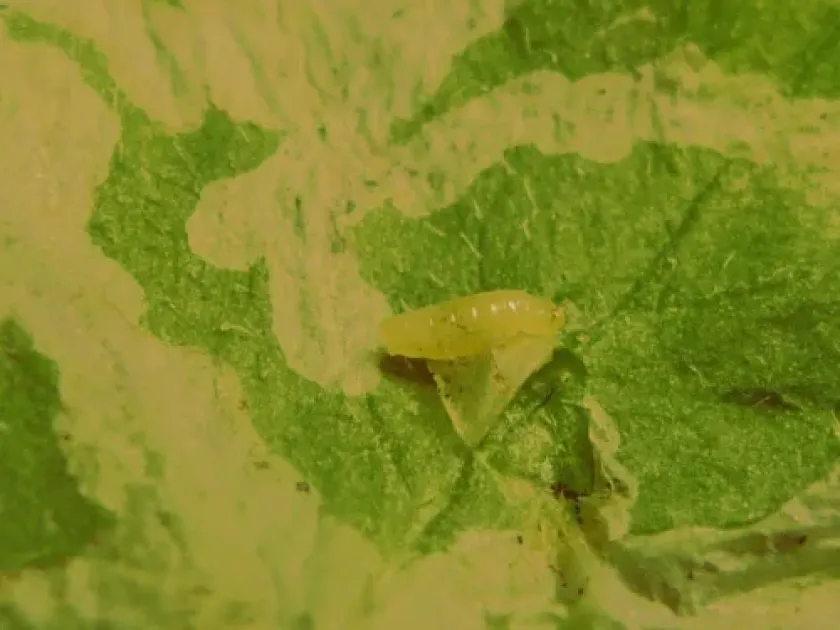
The larvae are small, legless, and yellowish-white in color, specifically adapted to survive within the protective environment of a plant's leaf mesophyll layer.
The life cycle involves an egg stage, three larval stages, a pupal stage, and an adult stage, with developmental speed heavily dictated by ambient temperature.
Pupation frequently occurs at the end of the mine or within the soil, depending on environmental conditions, making them resilient to minor external changes.
What it damages
This pest primarily attacks plants belonging to the Asteraceae family, with chrysanthemums being the most frequent and severely affected hosts.
Adult flies create small punctures on the leaf surface to feed on plant sap, which serves as a nutrient source for egg production and general maintenance.
Larval feeding creates distinct, winding, light-colored tunnels (mines) as they consume the internal leaf tissues, leaving the outer cuticle intact.
Significant infestations result in extensive leaf necrosis, reducing the plant's photosynthetic capacity and leading to lower vigor and stunted development.
The aesthetic value of ornamental plants is severely diminished, which is particularly critical for floricultural businesses and landscape gardening.
When it appears
Adult fly activity generally begins in the spring as temperatures rise, signaling the start of the breeding season for the first generation of the year.
The peak of infestation usually occurs during the warm summer months when multiple overlapping generations can lead to rapid population explosions.
In greenhouses and indoor controlled environments, the pest can remain active throughout the entire year, posing a continuous threat to year-round production.
During the autumn, activity slows down as temperatures drop, although survival may continue in protected environments until deep winter sets in.
Early-season monitoring is essential to detect the arrival of the first adults, as preventing the initial colonization is much easier than treating an established outbreak.
Signs of infestation
The most recognizable symptom is the appearance of small, white stippling marks on the foliage, which are the feeding and egg-laying punctures made by adults.
These marks are followed by the characteristic serpentine mines that start narrow and expand as the larva matures and feeds more aggressively.
If held up to the light, the larvae may be visible at the terminal end of the mines, while dark, granular frass (excrement) is often visible inside the trails.
- Winding, white-to-brownish trails visible on the leaf surface.
- Chlorotic or necrotic patches appearing around the older feeding tunnels.
- Increased susceptibility to secondary pathogens following cuticle breach.
- Wilting or premature senescence of lower foliage in heavy infestations.
Regular inspection of the lower canopy is recommended, as this is often where the first signs of infestation are overlooked by growers.
Control measures
Cultural control remains the primary strategy, involving the careful removal and destruction of infested foliage to break the pest's reproductive cycle.
Yellow sticky traps are an effective tool for monitoring adult fly populations and can also serve as a method for mass trapping in smaller environments.
Biological control agents, particularly parasitic wasps that target leaf miner larvae, are highly effective and commonly used in integrated pest management (IPM) programs.
Chemical control should rely on systemic insecticides that can reach the larvae hidden within the leaf, ensuring thorough coverage and targeted application.
Implementing strict quarantine measures for new plant material is vital to prevent the introduction of this pest into clean, uninfested greenhouse blocks.
Taxonomy
- Latin name
- Phytomyza marginella
- Order
- Diptera (flies)
- Family
- Agromyzidae
- EPPO code
- PHYYMA
Discussion
No discussions yet — be the first.