
Honeysuckle leaf miner
Phytomyza lonicerae
Description
How to identify
The honeysuckle leaf miner (Phytomyza lonicerae) is a small dipteran insect belonging to the family Agromyzidae. It is a specialized pest that specifically targets plants of the Lonicera genus.
Adult flies are tiny, typically measuring 2–3 mm in length. The larvae are the stage that causes visible damage, as they feed on the internal tissues of the host leaves throughout their development.
The life cycle includes eggs, larvae, pupae, and adults. The female uses her ovipositor to insert eggs into the leaf epidermis, which leads to the formation of mines as the larvae hatch and start feeding.
Pupation often occurs in the soil or within fallen leaf debris, which serves as an overwintering strategy for the species to survive colder months.
Depending on the climatic conditions, this pest can complete multiple generations within a single growing season, leading to potential population explosions if left unchecked.
What it damages
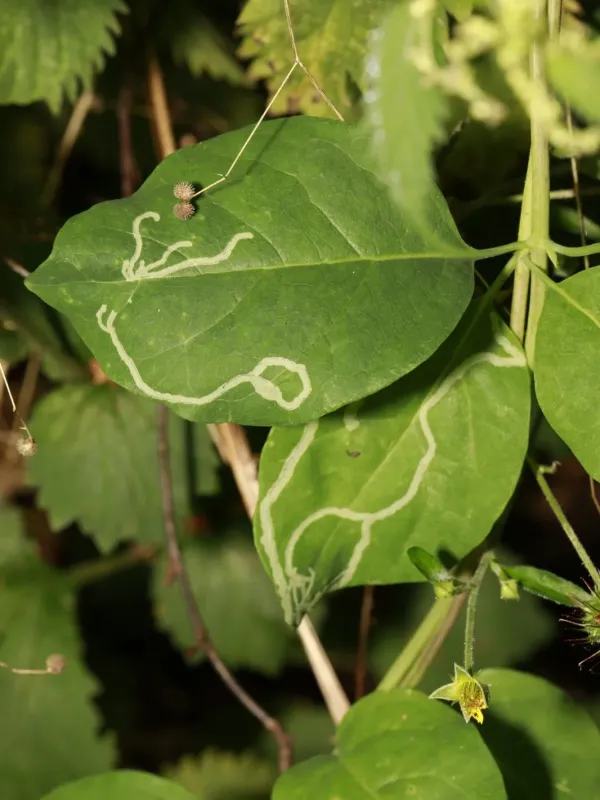
The primary impact of the honeysuckle leaf miner is the structural and physiological degradation of the host's foliage. Larvae feed on the leaf parenchyma, creating characteristic light-colored tunnels.
Large-scale infestation significantly impairs the plant's photosynthetic capacity. As a result, the vitality of the bush decreases, leading to stunted growth and reduced fruit yield in edible varieties.
In addition to physiological stress, the foliage loses its aesthetic value. Infested leaves often exhibit chlorosis, curling, and necrotic patches as the mines dry out.
Heavy damage frequently results in premature leaf drop, which deprives the plant of necessary nutrients and energy reserves before the onset of dormancy.
Nursery plants and young saplings are particularly vulnerable, as the leaf miner damage can severely hamper their development and marketability.
When it appears
The first flight of adults typically begins in late spring or early summer, synchronized with the onset of favorable warm temperatures.
The larval activity, which causes the visible mines, is most pronounced during the summer months when the growth of multiple generations overlaps.
During the peak of the season, infested leaves become increasingly covered with winding tunnels, making the damage more visible and severe.
As autumn approaches, larval development slows down, and the insects transition into the pupal stage to prepare for wintering in the soil or leaf litter.
Early monitoring in the spring, as soon as the first leaves unfold, is critical to detecting initial colonization and preventing widespread infestation.
Signs of infestation
The most reliable indicator of a honeysuckle leaf miner presence is the emergence of distinct, winding, light-colored lines on the surface of the leaves.
- Visible serpentine mines that expand as the larva grows.
- Tiny black specks within the tunnels, which are larval frass (excrement).
- Yellowing and drying of the leaf tissue surrounding the mines.
- Distorted or curled leaves in areas with heavy mining.
- Premature senescence and early leaf fall during the growing season.
Control measures
Cultural practices are the first line of defense; removing and destroying fallen leaves in the autumn is essential to eliminate pupae overwintering in the garden.
Cultivating or hoeing the soil beneath the honeysuckle bushes in spring can disturb and destroy overwintering pupae located in the top layer of the earth.
Biological control agents, including specific parasitic wasps that prey on mining larvae, can help keep populations in check naturally in balanced ecosystems.
If chemical intervention is necessary, systemic insecticides are generally required to reach the larvae protected within the leaf tissue.
Always inspect plants regularly for initial signs of mining; picking off and destroying the first few affected leaves can sometimes be enough to halt a small infestation.
Taxonomy
- Latin name
- Phytomyza lonicerae
- Order
- Diptera (flies)
- Family
- Agromyzidae
- EPPO code
- NAPOXY
Discussion
No discussions yet — be the first.