
Holly leaf miner
Phytomyza ilicis
Description
How to identify
The holly leaf miner is a small dipteran insect belonging to the family Agromyzidae. Adult flies are approximately 3 millimeters long, typically dark in color with distinctive yellow markings on their legs and head.
The larvae are white, legless, and worm-like, spending their entire development phase inside the leaf tissue. This hidden lifestyle makes them difficult to detect until significant damage has already occurred.
The species has a univoltine life cycle, meaning there is only one generation per year. This predictable cycle is a crucial aspect of managing the pest, as the timing of treatments depends on the life stage of the insect.
Pupation occurs inside the mine within the leaf. The insects overwinter in this stage, remaining inside the foliage until they emerge as adults in the spring, coinciding with the flowering of the host plants.
Adults are rarely seen by gardeners due to their small size and rapid movement. Therefore, identification is primarily based on the visual evidence left by the larvae in the foliage.
What it damages
The primary host for this pest is the English holly (Ilex aquifolium) and its cultivars. It is highly host-specific and is rarely found on other plant species within the garden environment.
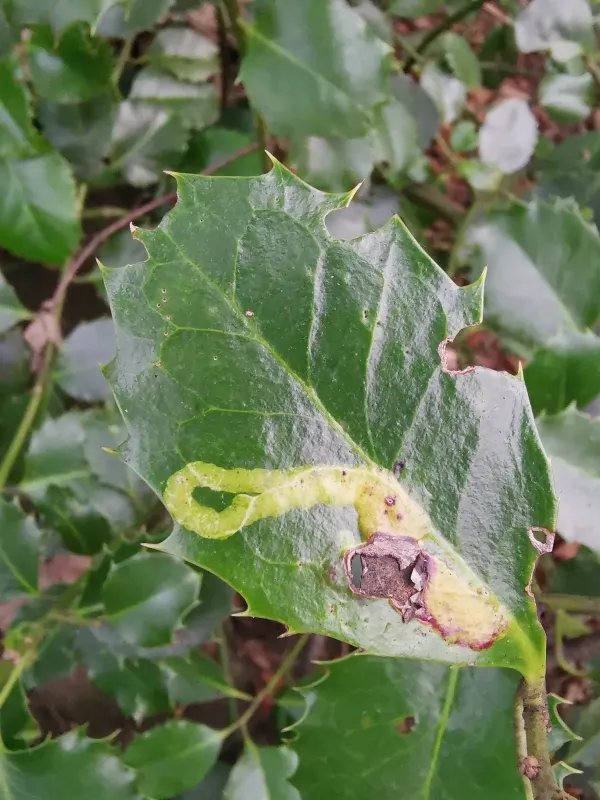
The larvae feed on the internal parenchyma of the leaves, creating characteristic wandering tunnels or "mines". These mines appear as narrow trails at first but widen into larger, blotch-like spots as the larva matures.
Severe infestations cause extensive chlorosis, reducing the plant's ability to perform photosynthesis efficiently. This leads to premature leaf drop and a thin, sparse canopy that diminishes the holly's aesthetic value.
Weakened plants are significantly more vulnerable to secondary stressors, such as fungal pathogens, harsh winters, or drought conditions. Long-term infestation can stunt growth and significantly reduce the lifespan of individual branches.
For ornamental gardens and nurseries, the presence of these mines is highly undesirable. The visual damage can ruin the uniform, dark green glossy appearance that makes holly such a prized landscape plant.
Signs of infestation
The earliest signs of infestation appear in late spring as tiny, almost invisible pinprick spots on new leaves, which are the sites where females laid their eggs.
As the larvae emerge and begin feeding, these marks develop into pale, serpentine trails. Over the summer months, these trails widen and transition into yellowish-brown, irregular blotches on the leaf surface.
Inspecting the underside of the leaf often reveals slight swellings or blisters, indicating the location of the feeding larvae. These blisters are a definitive sign that an active infestation is occurring.
By late summer and autumn, the mines become very obvious. In heavily infested plants, the foliage may look mottled or bronzed, severely impacting the evergreen nature of the shrub.
Exit holes found on the leaves in early spring are clear indicators that the adult flies have successfully emerged, signaling that the next cycle of infestation is about to begin.
Control measures
Physical removal is the most environmentally friendly and effective control method for small holly specimens. Collecting and destroying infested leaves in the winter prevents the larvae from completing their cycle.
Yellow sticky traps can be used in the spring to monitor and reduce the population of adult flies. Placing them near the foliage during the peak flight period helps break the egg-laying cycle.
Systemic insecticides are the most effective chemical approach. Applying these products when the larvae are young and just beginning to mine ensures that the chemicals are absorbed by the plant tissue to kill the pest.
Maintaining plant vigor through adequate watering and balanced fertilization helps holly resist pest attacks. A healthy plant can withstand a certain degree of infestation without losing its structural integrity.
- Regular monitoring of new foliage during the spring.
- Pruning and destroying heavily damaged branches in late winter.
- Using biological controls, such as beneficial nematodes, in specific conditions.
- Ensuring proper spacing to improve airflow around the foliage.
Taxonomy
- Latin name
- Phytomyza ilicis
- Order
- Diptera (flies)
- Family
- Agromyzidae
- EPPO code
- PHYYIC
Discussion
No discussions yet — be the first.