
Holly leaf miner
Phytomyza ilicicola
Description
How to identify
The Holly leaf miner (Phytomyza ilicicola) is a dipteran insect belonging to the family Agromyzidae. It is a highly specialized pest that exclusively targets various species of holly (Ilex).
Adult flies are small, dark-colored, and typically emerge in the spring. The damage is primarily caused by the larvae, which live and feed exclusively within the leaf tissue.
The life cycle involves an egg stage, three larval instars, a pupal stage, and the adult fly. Most of the development occurs inside the leaf, protected from external factors.
Pupation usually occurs within the leaf, where the insect remains throughout the winter until the next spring season, ensuring its survival during cold temperatures.
Understanding the synchronization between the fly's emergence and the development of new holly leaves is crucial for effective monitoring and pest management.
What it damages
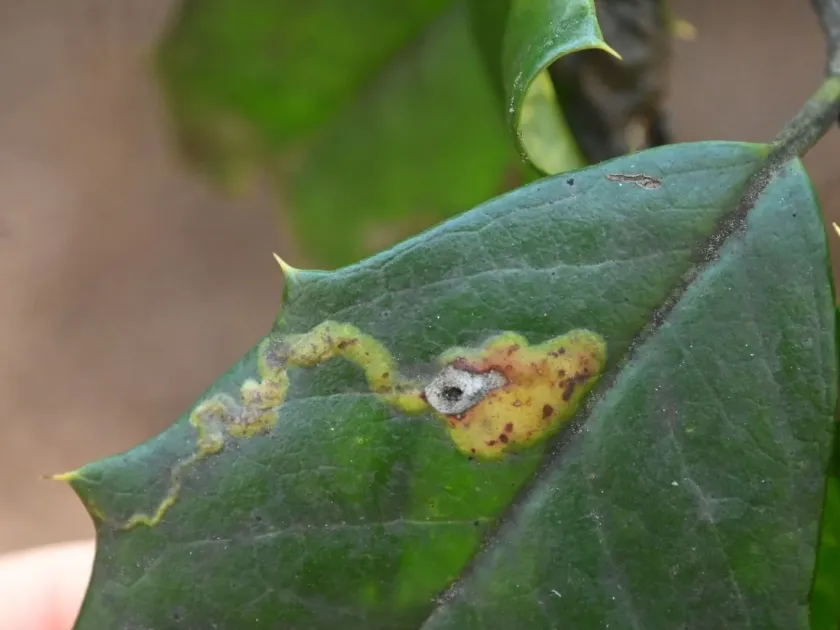
Larvae feed on the mesophyll of the leaves, creating distinct tunnels or "mines". This mining activity disrupts the photosynthesis process and weakens the plant's vigor.
Initially, the damage appears as small, serpentine tracks. As the larva grows, the mine broadens into a blotch or irregular shape, which is highly visible on the dark green holly leaves.
Severe infestations can lead to premature leaf drop, which significantly impacts the aesthetic appeal of the holly shrub and reduces its overall health.
In nursery environments, even minor damage can render a plant unsalable, making the holly leaf miner a significant economic pest for ornamental horticulture.
Repeated yearly infestations can stunt the growth of young shrubs, leading to sparse foliage and a decline in the plant's ability to produce new growth.
When it appears
The adult flies emerge in the spring, usually matching the period when new holly leaves are beginning to develop and expand, providing fresh sites for egg-laying.
After mating, females insert eggs into the leaf tissue. The larvae hatch and begin mining almost immediately, continuing their growth throughout the spring and summer.
By late summer or autumn, the larvae complete their feeding and pupate inside the mine. The pupa stays dormant inside the leaf for the duration of the winter.
Monitoring for adults should start as soon as the first new leaves appear on the holly, as this is when the protection measures are most critical.
Local temperature variations may influence the exact timing of adult emergence, making it necessary to observe the plant phenology in your specific area.
Signs of infestation
The primary symptom is the presence of winding, light-colored lines on the leaf surface. These lines become more prominent and change color as the leaf tissue dies.
A telltale sign of the Holly leaf miner is the presence of small, dark particles inside the tunnels, which are the excrement (frass) deposited by the feeding larvae.
Advanced infestations often show large, brown, necrotic patches on the leaves. These areas can become brittle and may eventually tear or fall off.
If you hold an infested leaf up to the light, you can clearly see the tunnels and the developing larva or pupa inside the leaf structure.
- Winding light-colored tunnels on leaves.
- Presence of dark frass spots inside the leaf mines.
- Yellowing and premature leaf abscission.
- Blotch-like necrotic spots on the leaf blade.
Control measures
Sanitation is a fundamental control measure. Collecting and destroying fallen leaves during winter can remove a significant portion of the overwintering pupae.
For chemical control, systemic insecticides are the most effective choice. These treatments are absorbed by the plant and kill the larvae hidden inside the leaf mines.
Applications should be timed to coincide with the egg-laying period in the spring to prevent larvae from establishing themselves within the leaf tissue.
Using yellow sticky traps can help detect the presence of adult flies and pinpoint the optimal timing for spray applications to maximize control effectiveness.
Maintaining plant health through proper watering and fertilization can help holly shrubs better withstand pest pressure and recover from leaf loss.
Taxonomy
- Latin name
- Phytomyza ilicicola
- Order
- Diptera (flies)
- Family
- Agromyzidae
- EPPO code
- PHYYIL
Discussion
No discussions yet — be the first.