
Pea leaf miner
Phytomyza horticola
Description
How to identify
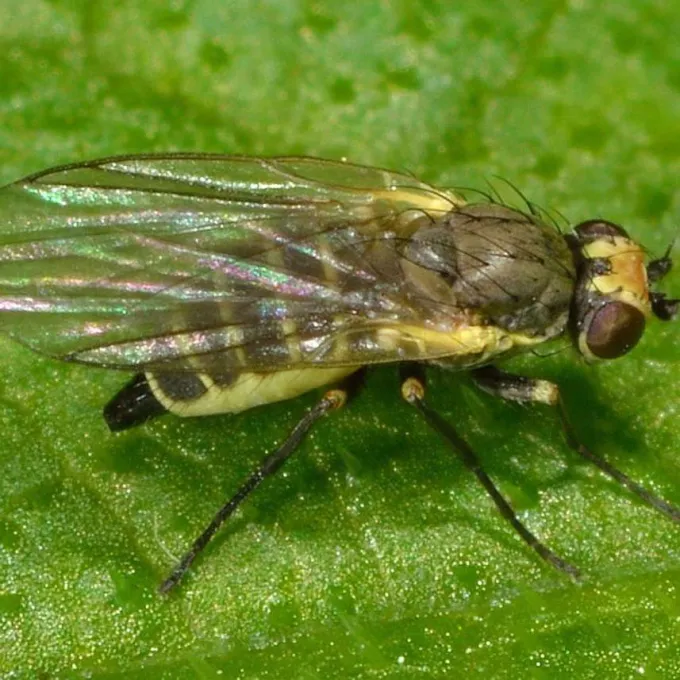
The pea leaf miner (Phytomyza horticola) is a small dipteran insect belonging to the Agromyzidae family. The adult fly is typically 2–3 mm long, with a dark gray body and yellow markings on the thorax.
The larva is the destructive stage of the life cycle. It is a legless, translucent white maggot that spends its entire developmental period mining within the leaf tissue.
The life cycle encompasses four stages: egg, larva, pupa, and adult. Development is highly temperature-dependent, allowing for multiple generations per year in warm climates.
Pupation usually occurs within the leaf mine or occasionally in the top layer of the soil. This allows the pest to survive between seasons effectively.
Rapid generation turnover is the key factor that makes this species a significant threat to greenhouse vegetable production.
What it damages
This pest attacks a wide range of host plants, including members of the Solanaceae (tomatoes, peppers, eggplants), Fabaceae (peas, beans), and Brassicaceae families.
Commercial greenhouses often experience severe outbreaks where the controlled environment favors the constant activity of the pest throughout the year.
Feeding damage disrupts the photosynthesis process as the larvae consume the leaf's mesophyll, leading to reduced plant vigor and stunted growth.
In severe infestations, the foliage becomes necrotic and drops prematurely, which directly limits the plant's ability to produce high-quality fruits.
Economic losses are compounded by the fact that infested plants are more susceptible to opportunistic fungal and bacterial pathogens that enter through feeding punctures.
Signs of infestation
The most diagnostic sign is the formation of irregular, winding, whitish trails on the leaf surface, which are created by the larvae feeding inside the lamina.
These trails, known as mines, start narrow and widen as the larva grows, often showing a line of dark fecal pellets inside the track.
Heavily infested leaves show signs of chlorosis, curling, and eventual necrosis, leading to a mottled appearance of the entire plant canopy.
Punctures made by adult females for feeding and oviposition appear as tiny, pale dots on the surface of the leaves, which can lead to localized tissue death.
- Visible serpentine mines on leaves
- Yellowing of leaf tissue (chlorosis)
- Stunting of plant growth
- Premature leaf drop
Control measures
Cultural practices are the first line of defense, specifically the removal of alternative host weeds from around the greenhouse or field boundaries.
Yellow sticky traps are highly recommended for monitoring adult populations and can help reduce the number of egg-laying females when placed strategically.
Chemical control should be employed with caution, focusing on systemic insecticides that reach the larvae within the leaves while adhering to pre-harvest safety intervals.
Biological control using parasitic wasps (parasitoids) is an effective and environmentally friendly strategy, particularly in protected agricultural settings.
Proper field sanitation, including the destruction of crop debris and deep plowing, helps eliminate pupae and breaks the lifecycle for the next season.
Taxonomy
- Latin name
- Phytomyza horticola
- Order
- Diptera (flies)
- Family
- Agromyzidae
- EPPO code
- PHYYHO
Discussion
No discussions yet — be the first.