
Parsley mining fly
Phytomyza chaerophylli
Description
How to identify
The parsley mining fly (Phytomyza chaerophylli) is a small dipteran insect belonging to the family Agromyzidae. The adults are typically dark-colored flies, measuring about 2–3 mm in length, often difficult to spot in dense foliage.
The life cycle involves four stages: egg, larva, pupa, and adult. Females use their ovipositor to insert eggs directly into the leaf tissue of host plants, predominantly members of the Apiaceae family.
Larvae are legless, whitish maggots that reside and feed entirely within the leaf parenchyma. Their anatomy is specifically evolved for life inside the host's internal tissues, protecting them from many external environmental factors.
This species is highly adapted to temperate climates, allowing it to complete several generations during a single growing season depending on temperature conditions.
Pupation typically occurs either within the leaf mine or within the top layer of the soil, providing the insect with various survival strategies throughout the year.
What it damages
The primary hosts for Phytomyza chaerophylli are members of the Apiaceae family, including carrots, parsley, celery, parsnips, and chervil. These crops are highly susceptible to mining damage.
The damage is caused primarily by the larvae, which create winding tunnels (mines) as they consume the leaf tissue between the epidermal layers. This destruction of chlorophyll-rich tissue significantly impairs the plant's ability to photosynthesize.
In severe infestations, the leaves become discolored, wither, and die prematurely. This results in reduced vigor and stunted growth of the entire plant, affecting both foliage yield and root development.
For leafy vegetables like parsley and celery, the damage is particularly critical as it ruins the aesthetic and commercial value of the product, making it unfit for sale.
High infestation levels in root crops like carrots can lead to a significant decrease in total harvest, as the plant directs energy to leaf recovery rather than storage roots.
Signs of infestation
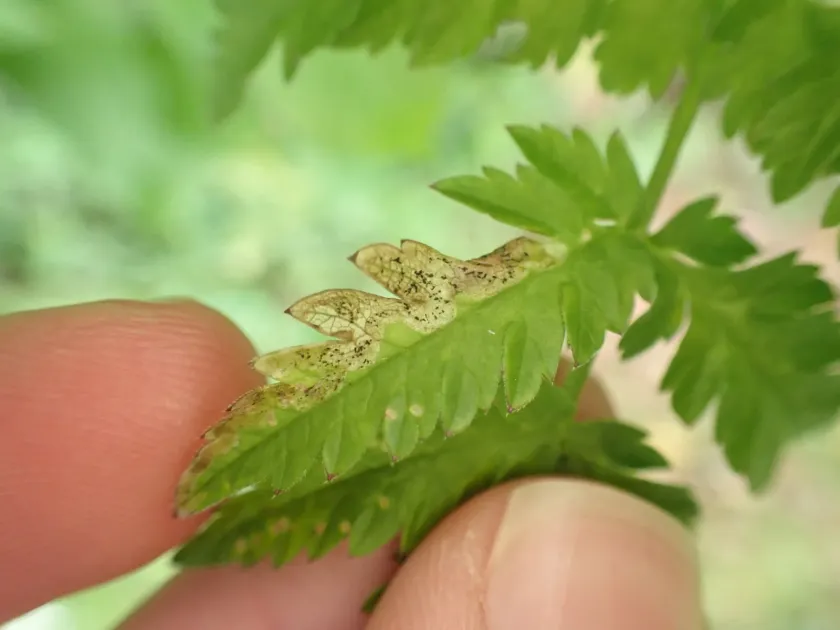
The first symptoms of infection are small white pinpricks on the leaves caused by female feeding and oviposition. Soon after, thin, pale, winding lines begin to radiate from these points.
These tunnels (mines) widen as the larva grows, often changing from white to brown as the leaf tissue around the mine necrotizes and dries out. Sometimes these mines coalesce, creating large, distorted blotches.
Small black fecal pellets left by the larvae can often be observed inside the mines, providing a clear diagnostic feature of Agromyzidae activity.
If held up to sunlight, the larvae themselves can often be seen moving within the clear sections of the leaf mine. Heavy damage leads to leaf curling, brittleness, and eventual drying of the foliage.
Extensive mining creates a mottled appearance on the leaves, which is often the point at which growers notice the infestation and begin to assess the need for control measures.
Control measures
Integrated pest management starts with sound agronomic practices, such as strict crop rotation. Avoiding the planting of Apiaceae crops in the same location for at least 3 years reduces pest pressure significantly.
Effective weed control is essential, as wild relatives like Chaerophyllum species act as major reservoirs for the flies during the early and late parts of the season.
Deep autumn plowing of fields can help expose and destroy overwintering pupae in the soil, effectively reducing the initial population of flies for the following spring.
When monitoring indicates a high population density, systemic insecticides may be required. These must be applied according to local regulations, paying close attention to pre-harvest intervals.
- Use yellow sticky traps for monitoring fly activity and population spikes.
- Prompt removal and destruction of crop residues after harvest to prevent further spread.
- Encouraging natural predators or using biological controls where appropriate.
Taxonomy
- Latin name
- Phytomyza chaerophylli
- Order
- Diptera (flies)
- Family
- Agromyzidae
- EPPO code
- PHYYCH
Discussion
No discussions yet — be the first.