
Cambium fly
Phytobia cambii
Description
How to identify
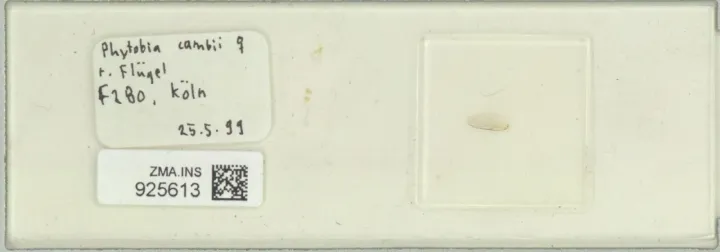
The cambium fly (Phytobia cambii) belongs to the Agromyzidae family within the order Diptera. These small flies are barely noticeable in their adult stage, yet their larvae cause significant economic damage to wood quality.
The adult insect is dark-colored and measures only a few millimeters in length. The larvae are the primary cause of concern, as they lead a concealed life developing directly under the bark within the active cambium layer.
The life cycle is closely linked to the phenology of host trees. Females lay their eggs into the soft bark tissue, choosing young sections of the trunk where the cambium is most active and nutrient-rich.
Upon hatching, the larvae begin mining winding tunnels within the cambium layer. As they feed, they move downwards along the trunk, creating characteristic channels that eventually heal over, resulting in wood discoloration.
After completing their development, the larvae create an exit hole in the bark to drop into the forest floor, where they pupate in the soil to complete the life cycle.
What it damages
The main hosts of the cambium fly include various hardwood species such as oak, maple, ash, and linden. Damage is most critical for young trees and saplings, which are more vulnerable to structural issues.
Larval feeding on the cambium causes local disruptions in wood formation. This does not immediately kill the tree but significantly reduces the commercial value of the timber produced by the plant.
Damaged wood often features dark inclusions or streaks known as pith flecks, which make the wood aesthetically unappealing and structurally compromised for high-quality manufacturing.
The tunnels created by the larvae provide entry points for secondary pests and pathogenic fungi, which can penetrate deep into the trunk, leading to decay and overall tree weakness.
Although mature trees can often tolerate infestation without mortality, widespread colonization by this pest leads to significant financial losses in timber-producing regions.
Signs of infestation
The primary sign of infestation is the presence of dark "pith flecks" visible on longitudinal or radial sections of the trunk, representing the scars of the healed larval tunnels.
Careful inspection of the bark surface on young trees may reveal minute exit holes, which are left behind when the larvae drop to the ground to pupate during the late summer months.
A reduction in the radial growth rate of the tree can sometimes serve as an indirect indicator of intense larval activity, as resources are diverted to cope with the damage.
During the spring flight period (May-June), adult flies may be spotted in the canopy, signaling the need for monitoring or protective measures in nurseries or young plantations.
Forest pathologists typically determine the level of infestation through wood sampling or by using adhesive traps to monitor adult population levels in sensitive areas.
Control measures
Protecting trees from the cambium fly is difficult due to the larvae's protected lifestyle under the bark; therefore, forest management focuses on preventive and silvicultural strategies.
In forest nurseries, systemic insecticides may be applied during the peak flight of adults to prevent females from laying eggs on the stems of young, vulnerable trees.
Sanitation is a critical agronomic practice, involving the timely removal of heavily infested or weakened trees that serve as reservoirs for the pest, thereby reducing the local population.
Biological control methods targeting Diptera species or supporting natural predators can be effectively utilized in plantation settings to keep populations below the economic threshold.
- Maintaining optimal growth conditions for forest stands.
- Regular monitoring of adult fly populations via traps.
- Conducting timely sanitary logging of infected trees.
- Selecting tree species or clones resistant to infestation.
Taxonomy
- Latin name
- Phytobia cambii
- Order
- Diptera (flies)
- Family
- Agromyzidae
- EPPO code
- PHYBCA
Discussion
No discussions yet — be the first.