
Birch cambium miner
Phytobia betulae
Description
How to identify
The birch cambium miner (Phytobia betulae) is a species of dipteran insect in the family Agromyzidae. While the adults are small and typically harmless, the larvae represent a significant concern for the timber industry.
Unlike leaf-mining flies, the larvae of this species develop within the cambial layer of birch stems and branches. This endophytophagous habit makes them particularly difficult to detect in living trees.
The larvae are cylindrical and creamy-white, perfectly adapted to live and feed within the vascular tissue of the host plant. They move slowly, creating tunnels that persist for a long time.
Detection is largely retrospective, as the damage becomes apparent only when logs are processed into lumber or veneer. There are few external indicators of a current infestation on a healthy-looking tree.
The life cycle involves the adult stage emerging in spring to mate and lay eggs in the bark of suitable birch trees, restarting the infestation process for the next generation.
What it damages
The primary host for this pest is the birch tree (Betula species). The larvae feed on the cambium and the developing xylem, causing the formation of distinct streaks in the wood.
This damage manifests as brown, tunnel-like spots on the wood surface, which significantly degrades the quality and value of the timber. It is specifically problematic for the production of high-grade birch veneer.
Besides wood quality issues, the activity of the larvae can weaken the tree's health, as the damage to the cambium disrupts the normal transport of nutrients and water.
While the tree may survive the infestation, it becomes more susceptible to other secondary pests and pathogens that exploit the weakened state of the wood.
In silviculture, the economic impact is substantial due to the rejection of affected logs during quality grading, leading to lower profitability for forestry enterprises.
When it appears
Adult flies emerge in the spring, generally during the peak sap-flow period of birch trees, which provides the necessary moisture conditions for the adults and initial larval success.
Eggs are deposited under the bark of young, developing stems. Larval development begins shortly thereafter and continues throughout the summer months as they feed on the cambium.
The larvae continue their activity into the autumn, expanding their mines as they slowly grow and progress along the trunk of the host tree.
Overwintering occurs either as a larva within the wood or after descending to the soil to pupate. The exact timing of these phases depends heavily on local climate conditions.
The cycle is completed in the following spring, when the next generation of adults emerges to repeat the process, making it an annual or biennial cycle depending on regional temperatures.
Signs of infestation
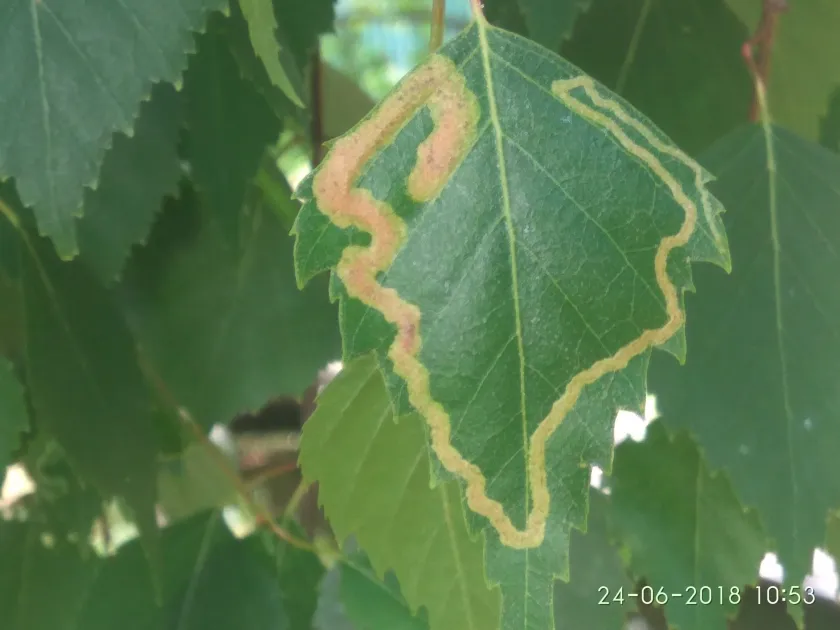
The most reliable sign of an infestation is the presence of brown, meandering galleries visible on the cross-section of freshly cut birch logs.
On the exterior of the bark, signs are minimal; occasionally, minor scarring may occur at the site of oviposition, but these are often overgrown by the bark's natural development.
Reduced vigor and slowed annual radial growth can sometimes be observed in trees that have been under attack by Phytobia betulae for several consecutive seasons.
In cases of severe infestation, the bark might show localized deformities or abnormal tissue swelling as the tree attempts to compartmentalize the damage caused by the mining larvae.
- Brown streaks and galleries on sawn timber surfaces.
- Decreased annual diameter growth.
- Internal wood discoloration.
Control measures
Direct control of larvae inside the tree is not feasible, making forest management and sanitation the primary tools for mitigating the impact of this pest.
Removing infested trees during routine thinning and sanitary cutting helps reduce the overall population density of the birch cambium miner within the stand.
Maintaining high tree vigor through proper silvicultural practices, such as adequate thinning and preventing soil compaction, increases the tree's natural resistance.
Chemical control, if necessary, must be timed precisely with the emergence of adult flies to prevent them from successfully laying eggs on the birch bark.
Promoting diverse and mixed-species forest stands can decrease the likelihood of large-scale outbreaks, as host-specific pests often find it harder to spread efficiently in non-monoculture environments.
Taxonomy
- Latin name
- Phytobia betulae
- Order
- Diptera (flies)
- Family
- Agromyzidae
- EPPO code
- PHYBBE
Discussion
No discussions yet — be the first.