
Plane leafminer
Phyllonorycter platani
Description
How to identify
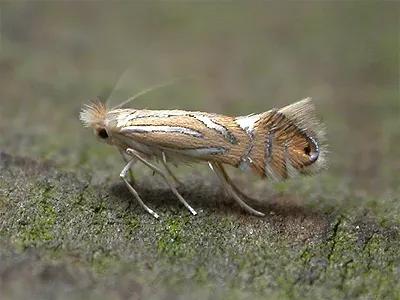
The plane leafminer (Phyllonorycter platani) is a small moth species belonging to the family Gracillariidae. These moths are characterized by their tiny size, usually having a wingspan of only 7 to 9 mm.
The forewings are typically metallic golden-brown with distinct white streaks or patches, providing camouflage against the bark of plane trees. The hindwings are narrow and heavily fringed with long hairs.
Larvae of the plane leafminer are highly specialized. They have flattened, pale bodies which allow them to move and feed within the mesophyll layer of the host leaves.
Pupation occurs inside the mine, where the larva spins a white or yellowish silk cocoon. This protects the pupa from predators and unfavorable environmental conditions.
The life cycle consists of four distinct stages: egg, larva, pupa, and adult. Depending on the climate, the species may undergo several generations in a single year.
What it damages
The primary host for this pest is the plane tree (Platanus), specifically the London plane tree. The damage is restricted to the leaves of the tree.
Feeding larvae create mines in the leaf tissue, which destroys the photosynthetic parenchyma. This leads to a loss of chlorophyll and reduced energy production for the tree.
When infestation levels are high, a significant portion of the leaf surface is consumed. This causes the tree to lose its canopy vitality, leading to premature leaf shedding.
While mature trees can often survive infestations, the cumulative stress of recurring attacks makes them vulnerable to secondary pests and fungal diseases.
For young saplings, the plane leafminer can be a major threat, potentially stunting growth and reducing the overall health of the tree during its formative years.
When it appears
Adult moths emerge in early spring, synchronized with the bud break of the host plane trees. Females deposit eggs on the undersides of the developing leaves.
Peak moth activity typically occurs during late spring and throughout the summer months. Multiple, overlapping generations are common in warmer regions.
The larval stage is the most active feeding period, lasting several weeks per generation. As summer progresses, the cumulative number of mines per leaf increases significantly.
The species survives the winter as a pupa, hiding within the fallen leaf litter or in the crevices of the tree bark, waiting for the return of favorable temperatures.
Monitoring for adult flight activity using pheromone traps is the most accurate way to predict the onset of each generation in local environments.
Signs of infestation
The most visible symptom of infestation is the presence of pale, blotchy mines on the leaves. These often begin as small lines and grow into larger, brownish irregular shapes.
As the infestation progresses, leaves show signs of puckering or distortion. In severe cases, the entire leaf may shrivel and turn brown prematurely.
If you inspect the underside of a damaged leaf, you can often see the small, translucent skin of the mine and potentially the larva or its frass inside.
A yellowing canopy in mid-summer that resembles early autumn color is a classic sign of high leafminer population density in plane tree plantations.
- Silvery-white patches on leaves.
- Leaf distortion and curling at the edges.
- Premature leaf drop in July or August.
- Visibility of tiny moths on leaves.
Control measures
Sanitation is a critical step in managing the plane leafminer. Clearing away and destroying fallen leaves in autumn removes the overwintering pupae from the site.
Systemic insecticides are effective when applied during the early stages of larval development. These treatments move into the leaf tissue to reach the feeding larvae.
Biological control using parasitoid wasps is an important component of integrated pest management. Conserving these natural enemies helps keep moth populations in check.
For high-value ornamental trees, localized trunk injections of systemic products can be used to prevent damage while minimizing environmental impact.
Integrated Pest Management (IPM) strategies emphasize monitoring population levels to ensure treatments are applied only when necessary, preventing insecticide overuse.
Taxonomy
- Latin name
- Phyllonorycter platani
- Order
- Lepidoptera (butterflies)
- Family
- Gracillariidae
- EPPO code
- LITHPL
Discussion
No discussions yet — be the first.