
Apple leaf miner
Phyllonorycter malella
Description
How to identify
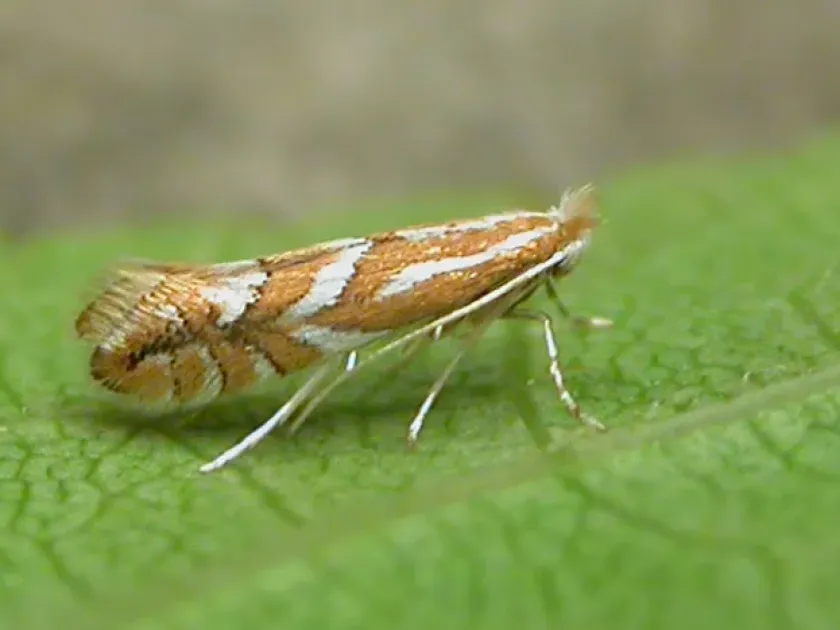
The apple leaf miner, Phyllonorycter malella, is a tiny moth belonging to the Gracillariidae family. Adult moths have a wingspan of about 8 mm and exhibit a golden-brown pattern with white markings on their forewings.
The larvae are flattened, which is an evolutionary adaptation for mining inside the narrow spaces of host leaves. Their development is closely linked to the physiological state of the apple tree leaves.
Pupation occurs within a small, protective cocoon constructed inside the mine created by the caterpillar. This provides a secluded environment that protects the developing insect from predators.
The life cycle varies depending on climate conditions, with multiple generations developing during a single growing season in warmer regions, which increases the potential for infestation.
Winter is typically spent in the pupal stage, hidden within the leaf litter beneath the trees. This makes sanitation a critical step in managing the pest population in commercial orchards.
What it damages
The primary host for this pest is the apple tree. While it prefers Malus species, in cases of extreme pressure, it may occasionally be found on other related fruit trees like pear or quince.
Larvae consume the leaf parenchyma specifically on the underside of the leaf. This activity creates characteristic blotch-like mines while leaving the upper cuticle intact.
Severe infestations lead to a significant reduction in the photosynthetic capacity of the tree. As a result, the trees become weakened, showing reduced growth and lower quality of fruit production.
In cases of heavy infestation, the leaves may wither and drop prematurely in late summer. This loss of canopy cover stresses the tree, making it more susceptible to winter frost damage.
The cumulative damage often leads to smaller apple size and poor storage quality, significantly impacting the commercial value of the harvest for fruit growers.
When it appears
The emergence of the first generation of adults usually corresponds with the flowering period of apple trees, which serves as a biological signal for starting monitoring efforts.
The second generation of larvae is typically the most destructive, appearing in mid-summer when the population density reaches its peak after several weeks of rapid breeding.
In favorable conditions, a third generation may develop, which complicates control efforts because the population stages become staggered and overlapping throughout the season.
As autumn approaches, the insect prepares for overwintering. The falling leaves provide the final habitat for the pupae, which will remain there until the following spring.
Monitoring with pheromone traps is highly recommended to detect the exact timing of adult flights, allowing for precise and efficient pesticide application.
Signs of infestation
The most distinctive symptom is the presence of white or brownish blotch mines on the lower surface of the apple leaves. These mines grow larger as the caterpillar consumes more tissue.
The upper surface of the affected leaf may show a slightly distorted or wrinkled appearance, which can be seen when viewing the canopy from the ground during a summer inspection.
By holding the leaf up to the light, one can often see the dark body of the caterpillar or the small dark deposits of excrement inside the mine cavity.
Widespread discoloration and premature yellowing of the canopy during the peak growing season are classic signs that the infestation has reached a critical level.
- Small, pale blotches on the undersides of leaves.
- Premature leaf drop in late August or September.
- Leaf curling and deformation.
- Visible larvae or frass within the mines.
Control measures
Cultural control is highly effective; removing and composting or burying leaf litter in autumn significantly reduces the number of overwintering pupae and the next year's initial population.
Cultivating the soil in the orchard floor during spring helps to bury any remaining pupae, disrupting their ability to successfully emerge as adults in the following cycle.
Biological control options include the use of insecticides based on Bacillus thuringiensis, which are highly targeted and offer a reduced risk to beneficial insects in the orchard.
Chemical intervention should be strategically timed to target the egg-laying stage or newly emerged larvae. Systemic insecticides are generally the most effective against this hidden pest.
To ensure long-term success, orchard managers should rotate different chemical classes to prevent the development of resistance within the Phyllonorycter malella population.
Taxonomy
- Latin name
- Phyllonorycter malella
- Order
- Lepidoptera (butterflies)
- Family
- Gracillariidae
- EPPO code
- PRYCML
Discussion
No discussions yet — be the first.