
Beech leaf miner
Phyllonorycter maestingella
Description
How to identify
The beech leaf miner is a moth species belonging to the Gracillariidae family. These tiny moths have a wingspan of only 7 to 9 millimeters, making them difficult to spot in the forest.
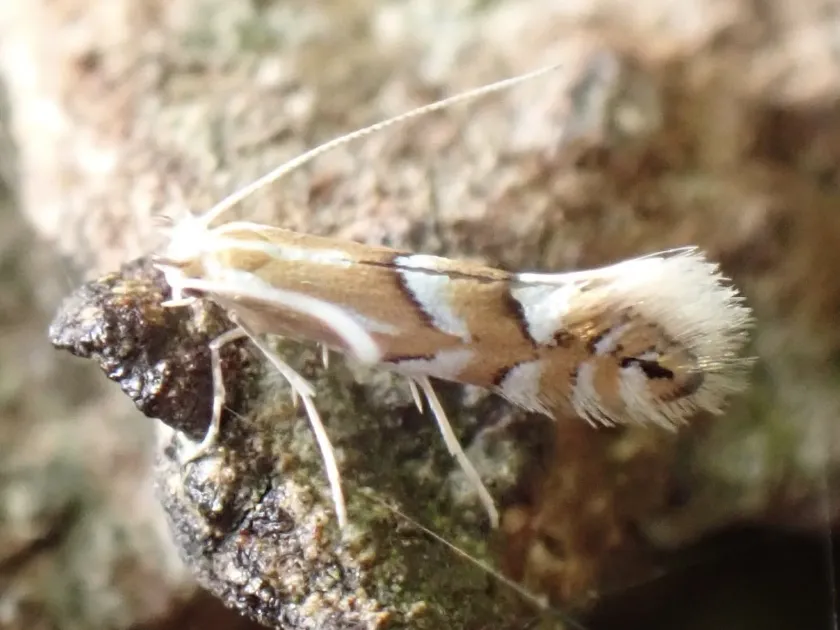
The forewings are characterized by a golden-brown pattern with white streaks and spots, providing perfect camouflage against the rough bark of a beech tree.
The larvae are flattened, which is an evolutionary adaptation for living inside the leaf, between the upper and lower epidermal layers of the beech leaf tissue.
Pupation occurs within the mine itself. The larva constructs a small, silken cocoon to protect itself while it undergoes the transition into an adult moth.
This species is highly specialized, meaning it relies entirely on the beech tree for its development, closely aligning its life cycle with the tree's budding process.
What it damages
The primary host for this pest is the European beech (Fagus sylvatica). It thrives in both dense forest stands and ornamental park landscapes where beech trees are planted.
Larvae consume the leaf parenchyma, creating characteristic mines or blotches. This process disrupts the plant's ability to perform photosynthesis efficiently.
High infestation rates result in premature chlorosis and leaf drop, which weakens the tree's vigor and makes it more susceptible to secondary diseases and environmental stress.
In ornamental settings, the aesthetic value of the trees is severely diminished as the canopy turns brown and appears unhealthy throughout the summer months.
Repeated annual damage can significantly reduce the growth rates of young trees and affect the quality of timber in managed forest stands.
When it appears
Adult moths emerge in early spring, precisely when the beech buds begin to open. This timing ensures that the larvae have immediate access to fresh leaf tissue.
Depending on the climatic conditions, the species can produce multiple generations per year, leading to an extended period of damage throughout the growing season.
The most intense larval activity is typically observed from late spring through mid-summer, when the mines become most visible across the canopy.
The insect spends the winter in the pupal stage, often hidden in leaf litter on the ground or within the crevices of the tree's bark, awaiting the return of spring.
Monitoring the flight activity of adult moths using pheromone traps is essential for predicting outbreak severity and timing mitigation efforts appropriately.
Signs of infestation
The most distinct sign of infestation is the presence of small, light-colored mines on the underside of the leaves, which eventually turn brown as the tissue dies.
If you inspect a mine under a light, you can often see small, dark pellets, which are the larvae's excrement, helping to confirm that the damage is caused by a leaf miner.
Severely infested leaves may show signs of curling at the edges, and in cases of heavy pressure, the entire crown of the tree may appear scorched or rusty.
Premature leaf fall is a critical indicator of a high pest population, often occurring several weeks before the normal autumn senescence of the beech trees.
- Light-colored, blister-like mines on the leaf undersides.
- Visible dark granular frass inside the mined areas.
- Canopy discoloration resembling a rust or drought effect.
- Early leaf abscission in late summer.
Control measures
Biological control methods are preferred in forest management, focusing on preserving natural predators such as parasitic wasps that naturally regulate moth populations.
For ornamental or high-value trees, systemic insecticides can be applied. Treatment timing is crucial and must coincide with the initial egg-laying period.
Sanitation practices, such as raking and removing infested leaf litter in the autumn, can significantly reduce the number of pupae that survive the winter.
Maintaining a healthy, biodiverse environment encourages birds and other beneficial insects to feed on the adult moths and larvae, providing natural suppression.
Integrated Pest Management (IPM) strategies, including pheromone trapping, are recommended to minimize chemical usage while effectively managing the pest population.
Taxonomy
- Latin name
- Phyllonorycter maestingella
- Order
- Lepidoptera (butterflies)
- Family
- Gracillariidae
- EPPO code
- PRYCMA
Discussion
No discussions yet — be the first.