
Lime leaf miner
Phyllonorycter issikii
Description
How to identify
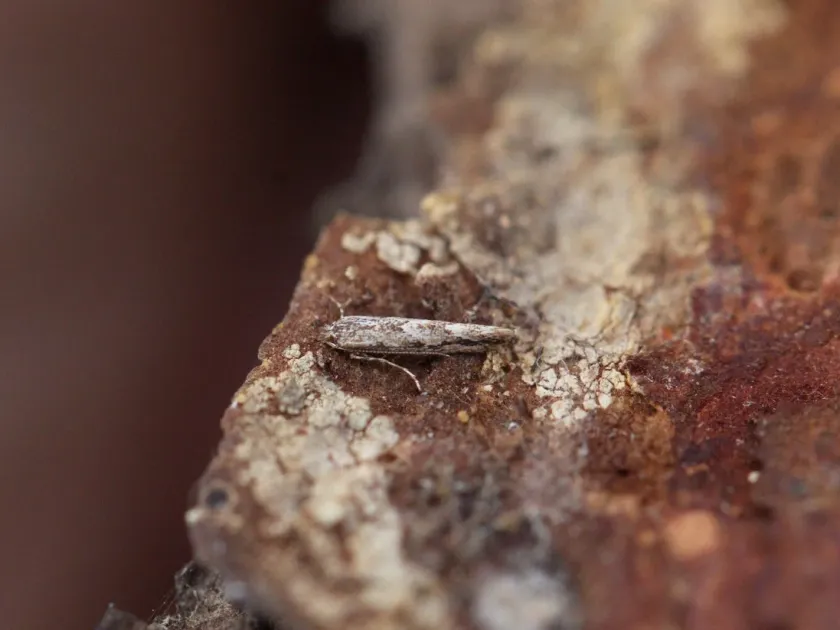
The lime leaf miner (Phyllonorycter issikii) is a small moth belonging to the Gracillariidae family. Adult moths are very small, with a wingspan ranging from 7 to 9 mm, and are characterized by their gold-brown forewings adorned with white markings.
The larvae are specialized leaf miners that undergo a distinct morphological transformation. In their early stages, they possess a flattened, wedge-shaped body designed for feeding on plant cell sap within the leaf tissue, later becoming more cylindrical.
The life cycle is closely synchronized with the phenology of the host linden trees. Depending on the climate, the species can complete two to three generations annually, which often leads to exponential population growth during warm summers.
The pupal stage occurs within the leaf mine itself, protected by a delicate silk cocoon spun by the larva. This protected environment allows the insect to survive moderate environmental fluctuations and protects it from many contact insecticides.
Overwintering typically occurs as a pupa, either inside fallen leaves or within bark crevices. This overwintering strategy makes the pest highly resilient, as the pupae are well-protected from winter temperature drops.
What it damages
The primary hosts for Phyllonorycter issikii are species of the genus Tilia, commonly known as linden or lime trees. While they have a strong preference for specific Tilia species, they can infest various ornamental lime varieties in urban settings.
Damage is caused exclusively by the larvae, which feed on the internal tissues of the leaf. This mining activity disrupts photosynthesis, leading to a significant decrease in the tree’s overall energy production and carbohydrate storage.
Severe infestations cause leaves to yellow, curl, and drop prematurely. This not only impairs the tree's health but also creates a significant visual impact, often leaving trees looking ragged and thin by late summer.
For young nursery stock or newly planted urban trees, intense leaf miner activity can result in significant growth stunting. Chronic infestations over several years can lower the tree's vigor, making it susceptible to secondary stressors.
During peak infestation years, nearly every leaf on a tree may be affected, resulting in a brown and withered appearance. This premature leaf loss limits the tree's ability to prepare for dormancy, reducing its overall winter hardiness.
Signs of infestation
Early symptoms include the appearance of small, light-colored translucent patches on the leaves. These patches represent the initial feeding chambers of the larvae and are often overlooked until the infestation becomes more widespread.
As the larvae continue to feed, the mines expand and merge, creating large, irregular blotches. These mines are typically found on the underside of the leaves, where the tissue becomes thin and fragile.
The presence of fine silken threads used by the larvae to pull the leaf edges together causes the foliage to pucker and fold. This structural deformation is a clear diagnostic sign of the lime leaf miner's activity.
Close inspection of the underside of affected leaves will reveal small, dark granules, which are the larval frass (excrement). The presence of this waste product inside the mine distinguishes it from environmental damage or leaf diseases.
Premature leaf drop in mid-to-late summer, accompanied by the sight of brown, blotchy leaves scattered under the canopy, is a definitive indicator of a heavy infestation that likely occurred earlier in the season.
Control measures
The most effective cultural practice is the thorough removal and destruction of fallen leaves in the autumn. Since the pupae overwinter in the leaf litter, removing this material significantly reduces the starting population for the following year.
Systemic insecticides are the preferred choice for chemical management. These products are absorbed by the tree and move into the leaf tissue, providing effective control even against larvae feeding safely inside their mines.
Biological control methods, including the preservation of natural parasitoids, are becoming increasingly important. Avoiding the use of broad-spectrum pesticides helps maintain populations of beneficial wasps that predate on the larvae.
Monitoring using pheromone traps is recommended to track adult flight activity. This allows arborists to time their control interventions precisely, ensuring that treatments are applied when the larvae are most vulnerable.
Maintaining high tree health through adequate irrigation and fertilization can help trees withstand leaf miner pressure. A vigorous tree can often tolerate a degree of leaf damage without showing long-term declines in health or structure.
Taxonomy
- Latin name
- Phyllonorycter issikii
- Order
- Lepidoptera (butterflies)
- Family
- Gracillariidae
- EPPO code
- PRYCIS
Discussion
No discussions yet — be the first.