
Apple leaf miner
Phyllonorycter corylifoliella
Description
How to identify
The Apple Leaf Miner (Phyllonorycter corylifoliella) is a small moth belonging to the Gracillariidae family, known for its destructive larvae stage.
Adult moths are tiny, typically measuring about 8-10 mm in wingspan, with a distinct pattern of white, black, and brownish scales on their forewings.
Females lay tiny, translucent eggs on the undersides of leaves, carefully placing them near the leaf veins for protection.
The larvae are specialized miners that have evolved flattened bodies to live and feed within the internal tissues of host plant leaves.
The pupal stage occurs inside the leaf mine, where the insect constructs a silk cocoon to protect itself from predators and environmental stress.
What it damages
This pest primary infests apple and pear trees, though it can also be found on cherry, plum, and various ornamental rosaceous shrubs.
Larvae feed on the leaf mesophyll, creating extensive mines that disrupt the photosynthetic capacity of the foliage.
Severe infestations lead to premature leaf drop, which significantly weakens the trees and reduces their carbohydrate reserves for winter.
As the tree's health declines, overall fruit yield decreases, and the remaining apples often lack the necessary size and sugar content.
Chronic infestations over multiple years can result in stunted growth and a general decline in tree vigor, making them susceptible to other diseases.
When it appears
The life cycle typically includes two or three generations per year, depending on the climatic conditions of the region.
Hibernation occurs primarily as pupae or adults within the leaf litter and deep crevices of the tree bark throughout the winter months.
Spring activity begins during the bud burst and flowering stages, when overwintering moths emerge to mate and start laying eggs on new foliage.
The summer generations develop rapidly, with the entire cycle from egg to adult often taking as little as a month under warm temperatures.
Toward the end of the season, the final generation enters diapause, preparing to survive the cold period in protected locations.
Signs of infestation
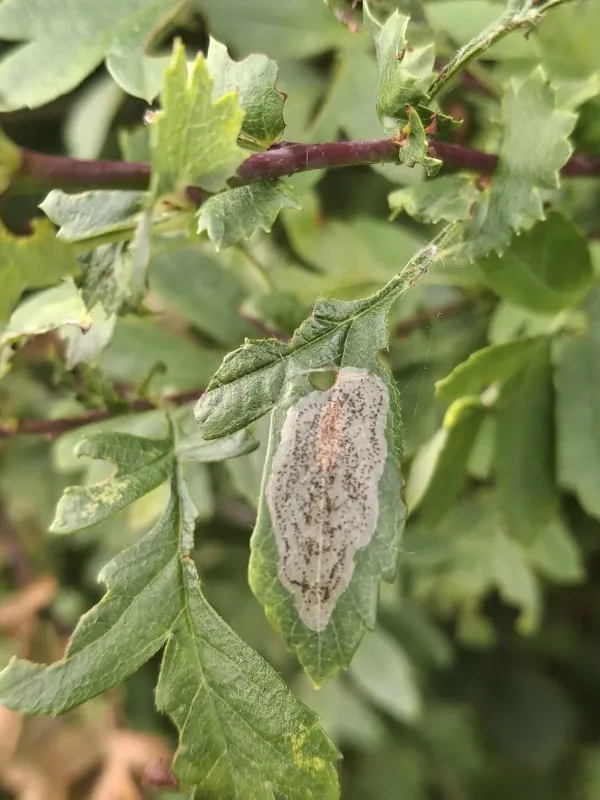
The first signs are small, white, translucent spots on the lower leaf surface that eventually evolve into characteristic blotch mines.
The skin of the leaf over the mine becomes folded and puckered, giving the leaf a deformed or crinkled appearance as the larva consumes the interior.
When held up to a light source, the dark, granular frass left behind by the larva becomes visible inside the mined area of the leaf.
Affected leaves may begin to brown and wither, leading to a scorched look across the canopy if the infestation reaches high levels.
- Small white blotches on undersides of leaves.
- Visible puckering and folding of leaf epidermis.
- Presence of dark frass within the mine tissues.
Control measures
Sanitation is key: raking and destroying fallen leaves during late autumn effectively eliminates the primary overwintering sites for the pupae.
Pheromone traps are highly effective for monitoring moth population levels and timing chemical applications to target peak egg-laying periods.
Encouraging natural predators, such as parasitic wasps and predatory mites, can help maintain pest populations below the economic injury level.
If chemical intervention is necessary, systemic insecticides applied during the early stages of larval development offer the best control results.
Proper orchard management, including consistent pruning and balanced fertilization, increases tree resilience against leaf miner damage.
Taxonomy
- Latin name
- Phyllonorycter corylifoliella
- Order
- Lepidoptera (butterflies)
- Family
- Gracillariidae
- EPPO code
- PRYCCO
Discussion
No discussions yet — be the first.