
Cherry leaf miner
Phyllonorycter cerasicolella
Description
How to identify
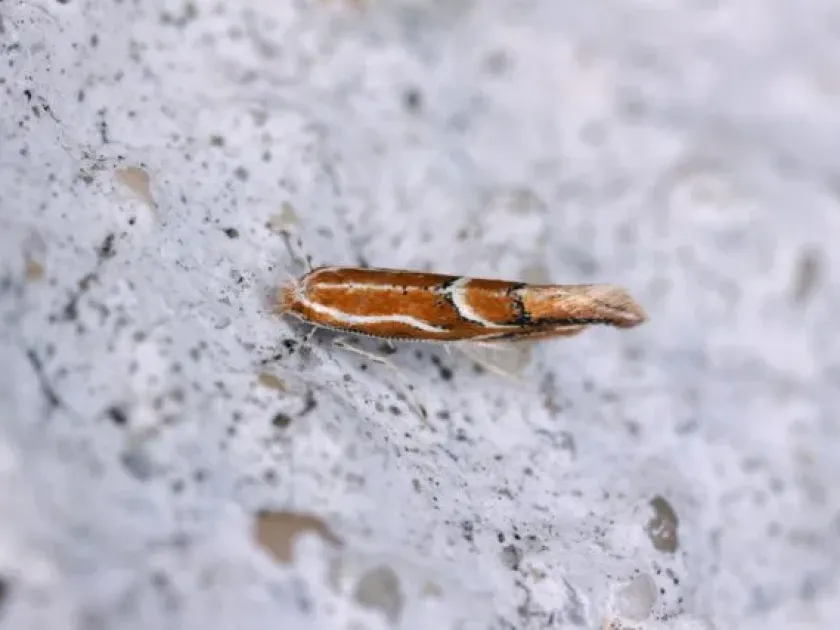
The cherry leaf miner (Phyllonorycter cerasicolella) is a small moth belonging to the family Gracillariidae, order Lepidoptera. It has a wingspan of approximately 7–9 mm.
The forewings of the adult moth are ochre-brown with distinctive white stripes and a black spot at the tip. The hindwings are narrow with long fringes.
The larvae (caterpillars) go through several stages of development, changing their body shape from flattened for mining inside the leaf to cylindrical.
Pupae are generally dark in color and develop within the leaf mines created by the caterpillars. Adults are primarily nocturnal or crepuscular.
The life cycle consists of the egg, five larval instars, pupa, and adult. Depending on the climate, the pest can complete two to three generations per year.
What it damages
The primary hosts for this pest are fruit trees from the Rosaceae family. Cherry and sour cherry trees are the most commonly affected species.
Plum, apricot, and peach trees can also suffer from the cherry leaf miner if they are situated in areas with high infestation rates.
Damage occurs when larvae feed on the leaf parenchyma between the upper and lower epidermis, which destroys the leaf's photosynthetic ability.
Mass infestations cause premature leaf drop, which significantly weakens the tree, especially as it prepares for winter dormancy.
This feeding damage results in reduced cold hardiness, lower fruit quality, and poor flower bud development for the following season.
When it appears
The flight of the first generation of adults typically coincides with the flowering stage of cherry trees in the spring, usually during April or May.
A second generation of the pest appears in mid-summer when the foliage is fully developed and available for colonization.
Development from egg to adult takes approximately 30 to 45 days, depending heavily on ambient temperature and humidity levels.
In autumn, the final generation of larvae pupate within fallen leaves or bark crevices, remaining dormant until the following spring.
Warm and humid weather conditions accelerate the developmental cycle, leading to higher population growth during the growing season.
Signs of infestation
The most visible sign of infestation is the presence of "mines," which appear as pale, translucent spots on the leaf surface that eventually turn brown.
These mines are typically oval or elongated and are found on the underside of the leaf, which makes early detection somewhat difficult.
If you inspect the leaf against light, you can see dark pellets of larval frass (excrement) and the larva itself or the pupal cocoon inside the mine.
Over time, the leaf becomes deformed, curled, and discolored, which eventually leads to it falling off the branch prematurely.
- Pale, dried-out blotches on leaves.
- Premature yellowing and leaf shedding.
- Leaf curling and deformation.
Control measures
A primary cultural control method is the thorough collection and destruction of fallen leaves in autumn, as these are the main overwintering sites.
Tilling the soil in the orchard during autumn is recommended to expose overwintering pupae and increase their exposure to natural predators.
Chemical control involves the use of insecticides during the adult flight period or when the first small larvae are observed feeding on foliage.
Biological treatments using specific bacterial strains are highly effective against younger larval stages and are environmentally friendly.
Rotation of different insecticide classes is essential to manage the risk of the population developing resistance to commonly used treatments.
Taxonomy
- Latin name
- Phyllonorycter cerasicolella
- Order
- Lepidoptera (butterflies)
- Family
- Gracillariidae
- EPPO code
- PRYCCE
Discussion
No discussions yet — be the first.