
Willow leaf miner
Phyllocnistis saligna
Description
How to identify
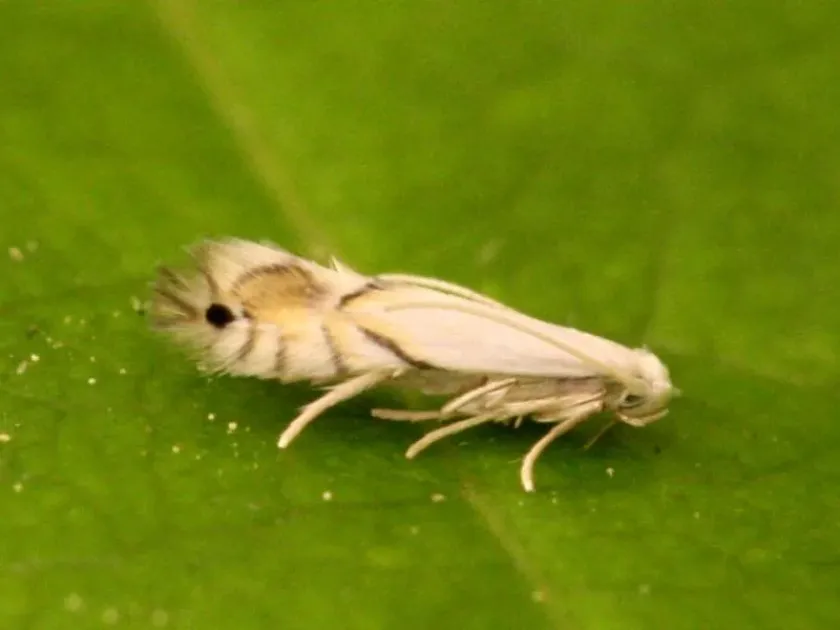
The willow leaf miner (Phyllocnistis saligna) is a moth belonging to the family Gracillariidae. The adult moth is a tiny insect with a wingspan of only 6–8 mm.
The adult moth is characterized by silver-white wings with a distinct dark spot at the apex, which is a key diagnostic feature for identification.
Larvae of this species are highly specialized leaf miners. They have a flattened, translucent, pale green body, which is perfectly adapted for surviving between the epidermal layers of the host leaves.
Because of their small size and cryptic lifestyle, adult moths are rarely seen in the field, and identification is usually based on the damage they leave behind.
The species has a distinct systematic position within the leaf-mining moths and is known specifically for its preference for willow trees.
What it damages
This pest primarily attacks various species and varieties of the genus Salix (willow), including ornamental and weeping forms commonly used in landscaping.
Occasionally, damage may extend to poplar trees, as they share similar host tissue characteristics within the Salicaceae family.
The damage is caused by larvae that mine the epidermis of leaves, creating long, winding tunnels that disrupt the leaf's normal metabolic functions.
Heavy infestation can lead to significant aesthetic damage, as the foliage turns yellow, curls, and eventually drops prematurely from the tree.
In nurseries, this pest can be particularly damaging to young plants, potentially causing stunted growth and reducing the commercial value of the stock.
When it appears
Adult moths overwinter in bark crevices, leaf litter, or other sheltered spots, emerging as soon as temperatures rise in the early spring.
The moth is multivoltine, meaning it can complete several generations throughout the growing season, with the cycle peaking in mid-summer.
Eggs are typically laid singly on young leaves, usually near the midrib, ensuring the larvae have immediate access to fresh tissue upon hatching.
The development time from egg to adult is relatively short, often taking less than a month, which allows the population to increase rapidly under favorable conditions.
As autumn approaches, the final generation of adults seeks hibernation sites to survive the winter months, completing the annual biological cycle.
Signs of infestation
The most visible sign of infestation is the presence of long, serpentine, silvery-colored mines that traverse the leaf surface.
The appearance of these mines is due to the larval feeding habits, which create air-filled spaces beneath the leaf epidermis, giving them a reflective, metallic sheen.
Affected leaves often exhibit curling along the margins or around the midrib, as the larvae frequently use these areas to construct their pupation cocoons.
In cases of severe infestation, the tree's overall appearance becomes distressed, with a mosaic of yellowing and necrotic patches appearing across the crown.
- Silvery, winding serpentine trails on leaves.
- Deformed, curled leaf margins.
- Premature yellowing and leaf drop.
- Presence of small cocoons inside rolled leaf edges.
Control measures
Effective management begins with strict sanitation, including the removal and destruction of fallen leaves in autumn to eliminate overwintering pupae.
Chemical control using systemic insecticides is often necessary for larger trees, as the product must penetrate the leaf tissue to reach the hidden larvae.
Biological control, including the use of targeted microbial pesticides, can be effective if applied early in the larval stage of each generation.
Regular monitoring of the trees during the spring and early summer allows for timely intervention before the pest reaches high population densities.
Maintaining tree vigor through proper watering and fertilization can help the plants better withstand the stress caused by larval feeding damage.
Taxonomy
- Latin name
- Phyllocnistis saligna
- Order
- Lepidoptera (butterflies)
- Family
- Gracillariidae
- EPPO code
- PHYNSA
Discussion
No discussions yet — be the first.