
Aspen leaf miner
Phyllocnistis labyrinthella
Description
How to identify
The aspen leaf miner (Phyllocnistis labyrinthella) is a small moth belonging to the Gracillariidae family, known for its specific larval behavior in aspen and poplar trees.
Adult moths are very small with a wingspan of only 6–8 mm, possessing white-silvery wings with distinct dark markings near the tips.
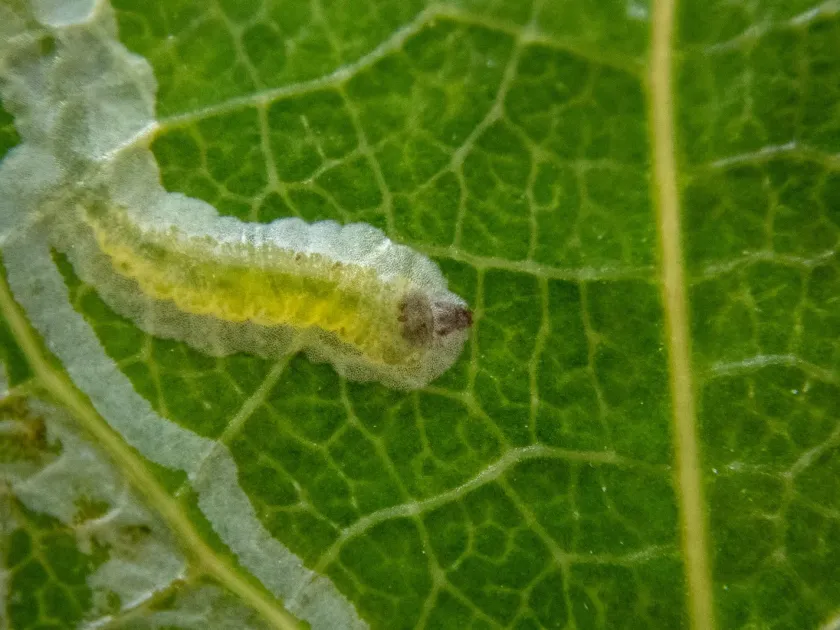
The larvae are specialized miners that live exclusively between the upper and lower layers of the leaf epidermis, creating unique serpentine tunnels.
Identifying the pest is best achieved by recognizing the characteristic silver trails on the leaves, as the adult moths are nocturnal and rarely seen.
The taxonomic classification places it within the Order Lepidoptera, specifically adapted to exploit the nutrient-rich tissues of the host plant.
What it damages
The primary host for this species is the European aspen (Populus tremula), though it may occasionally affect other species within the Populus genus.
Larvae consume the leaf parenchyma, leaving behind the epidermal layer, which leads to the formation of silvery, winding mines that disrupt photosynthesis.
Heavy infestations can lead to significant foliage damage, causing leaves to curl, brown, and fall prematurely during the growing season.
Reduced photosynthetic capacity directly impacts the tree's health, making it more susceptible to environmental stress and secondary pathogen infections.
In forest management, high populations of this miner can cause aesthetic damage and growth reduction in young aspen stands or ornamental trees.
When it appears
The life cycle is closely synchronized with the phenology of the host tree, with the first generation appearing shortly after the buds break in spring.
Females lay individual eggs near the veins on the leaf surface, and upon hatching, larvae immediately begin mining the internal tissue.
Two generations are typically observed each year, with the second generation often causing more visible damage during mid-to-late summer.
The developmental rate of the larvae is highly dependent on ambient temperature, with faster growth occurring during warm and dry summer months.
Pupation occurs within the leaf mine, after which the adult moth emerges through a small exit hole to begin the next reproductive cycle.
Signs of infestation
The most prominent sign is the presence of long, serpentine, silver-colored tracks on the surface of the aspen leaves.
A thin dark line of frass (excrement) can usually be seen running through the center of the mine, distinguishing it from other leaf miners.
Affected leaves often display signs of necrosis along the edges and may show premature yellowing or wilting as the season progresses.
A close inspection of the leaf underside often reveals small silken cocoons or the site where the pupa is situated within the epidermal layers.
- Silvery, winding serpentine mines on leaves.
- Central dark line of waste material within the mines.
- Premature leaf drop and yellowing foliage.
Control measures
Cultural control is a practical first step, involving the removal and destruction of fallen leaves in autumn to disrupt the pest's overwintering sites.
For high-value ornamental trees, systemic insecticides can be applied as a spray or soil drench to treat the larvae inside the leaves.
Timing is crucial: applications should coincide with the emergence of young larvae to ensure the chemical reaches the pest before it is fully protected.
Biological control methods, such as encouraging natural predators like parasitic wasps, can help manage populations in larger forest ecosystems.
Integrated Pest Management (IPM) strategies emphasize monitoring population levels with pheromone traps to trigger control measures only when necessary.
Taxonomy
- Latin name
- Phyllocnistis labyrinthella
- Order
- Lepidoptera (butterflies)
- Family
- Gracillariidae
- EPPO code
- PHYNSO
Discussion
No discussions yet — be the first.