
Citrus leaf miner
Phyllocnistis citrella
Description
How to identify
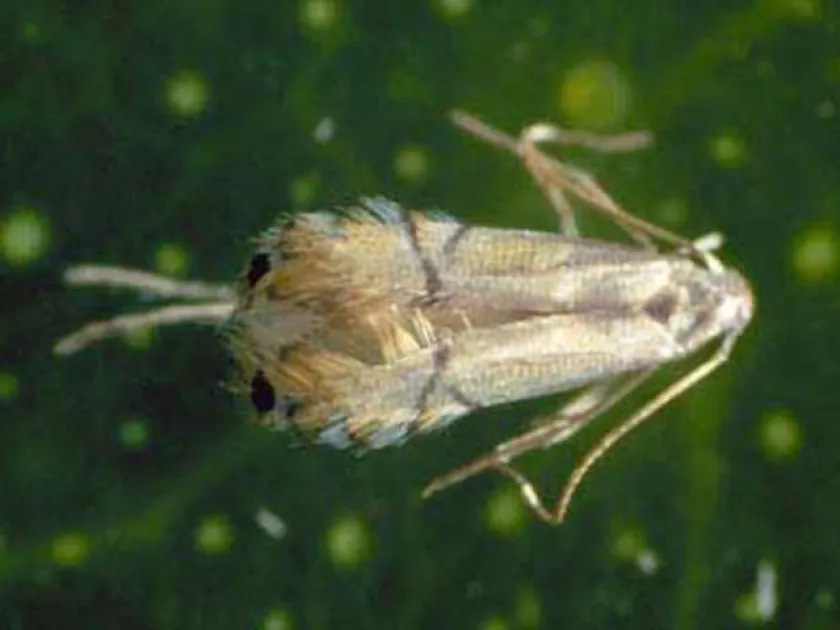
The citrus leaf miner is a small moth belonging to the Gracillariidae family. The adult moth is very small, with a wingspan of about 4-5 mm, and features silver-white wings with a distinct dark spot at the tips.
The lifecycle includes egg, larva, pupa, and adult stages. Females lay tiny, translucent eggs on the undersides of young citrus leaves near the midrib.
The larvae are flattened and possess specialized mouthparts that allow them to mine through the epidermis of the leaf, consuming the mesophyll tissue as they grow.
The pupal stage occurs within a chamber formed by the larva at the edge of the leaf. The larva folds the leaf margin over itself, creating a protective curl before transforming into a pupa.
In warm climates, the entire lifecycle can be completed in as little as 14 to 20 days, allowing the population to explode rapidly during the growing season.
What it damages
The pest primarily targets trees within the Rutaceae family, especially the genus Citrus. Lemons, limes, oranges, and grapefruits are highly susceptible to infestations.
The damage is almost exclusively confined to young, succulent leaves. Older, hardened leaves are rarely attacked, as the larvae cannot penetrate the mature epidermal layers effectively.
By mining the internal tissues, the larvae disrupt photosynthesis and hinder the development of the leaf. This significantly weakens the tree, especially in young saplings.
The tunnels created by the larvae provide entry points for secondary pathogens, such as the bacterium causing citrus canker, which can lead to devastating disease outbreaks in orchards.
Severe infestations cause massive leaf deformation, stunted shoot growth, and a reduction in the plant's overall energy reserves, negatively impacting future fruit quality.
Signs of infestation
The most characteristic sign of an infestation is the presence of winding, silvery trails on the leaf surface. These are the mines created by larvae feeding under the thin outer layer of the leaf.
Leaves that are heavily infested often appear curled, twisted, and distorted. In severe cases, the leaf edges fold over completely, which is a clear indication of pupation activity.
The tunnels often contain a dark, continuous line of frass (excrement) along the center, which helps in identifying the presence of the larva within the mine.
During the peak season, young shoots may appear stunted or burnt due to the density of the larval tunnels throughout the new growth.
- Winding silvery trails on leaves.
- Curled and distorted leaf edges.
- Stunted growth of new shoots.
- Presence of pupal chambers on leaf margins.
Control measures
Integrated pest management (IPM) is essential. Pruning and destroying heavily infested leaves can help reduce the population size, provided it is done early in the infestation cycle.
Chemical control with systemic insecticides, such as imidacloprid or abamectin, is highly effective. These products are absorbed by the plant and kill the larvae hidden inside the leaf tissue.
Timing is critical: applications should coincide with the onset of new growth flushes, when the moths are most active and laying eggs on the tender, new foliage.
Biological control agents, particularly parasitic wasps, play a vital role in natural suppression. Encouraging these beneficial insects can significantly reduce the need for chemical sprays.
Monitoring using pheromone traps can help track moth activity, allowing growers to target insecticide applications precisely when they are most needed to prevent widespread damage.
Taxonomy
- Latin name
- Phyllocnistis citrella
- Order
- Lepidoptera (butterflies)
- Family
- Gracillariidae
- EPPO code
- PHYNCI
Discussion
No discussions yet — be the first.