
Beech woolly aphid
Phyllaphis fagi
Description
How to identify
The Beech woolly aphid (Phyllaphis fagi) is a distinct species within the Aphididae family, primarily known for the dense white, wool-like wax secretions that cover the aphids while they feed on the leaves of beech trees.
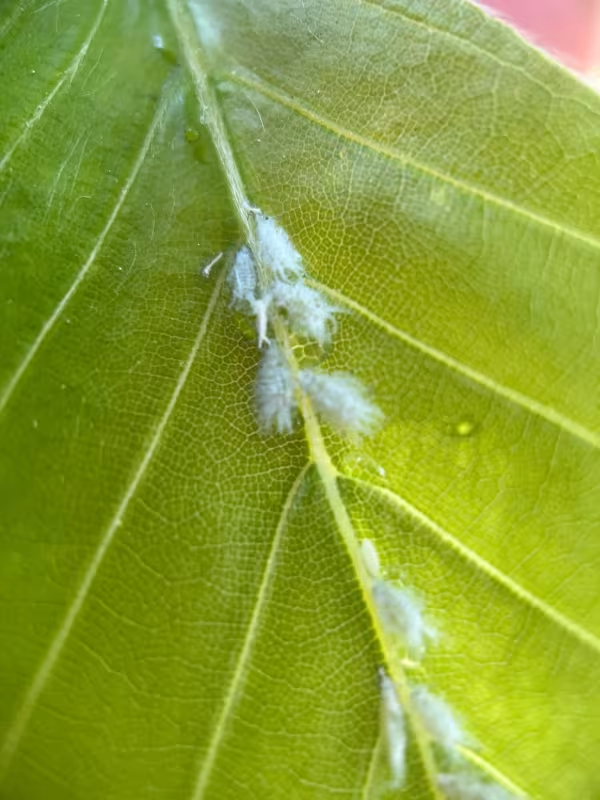
Adult aphids are typically yellowish-green in color but are obscured by the masses of white, fluffy wax filaments, which give the colonies the appearance of white cotton patches on the underside of leaves.
The life cycle begins in spring when overwintering eggs on the bark hatch into stem mothers. These aphids multiply rapidly, establishing new colonies on the emerging foliage.
Throughout the growing season, multiple generations are produced through parthenogenesis. This allows the population to reach high densities very quickly if conditions are favorable.
As autumn arrives, sexual forms of the aphid appear. After mating, the females deposit eggs in bark crevices, which serve as the overwintering stage to restart the cycle the following year.
What it damages
The primary host for this pest is the European beech (Fagus sylvatica) and its cultivars. It is frequently found in managed forests, parks, and ornamental garden plantings.
By piercing the leaf tissue with their stylets, these aphids extract sap, leading to nutritional deficiencies and physiological stress for the tree.
Infested leaves often become curled, deformed, and stunted. This physical damage can significantly detract from the aesthetic value of the trees in landscape settings.
The excretion of honeydew promotes the growth of sooty mold, a fungus that forms a black layer on the leaf surface, thereby reducing the tree's ability to perform photosynthesis efficiently.
Severe infestations can trigger premature leaf drop in late summer, which hinders the tree's ability to store energy for the coming winter and impacts annual wood increment.
Signs of infestation
The most prominent sign of an infestation is the presence of fluffy, white, wool-like material clustered along the veins on the undersides of the beech leaves.
The foliage shows signs of curling or wrinkling, which is a common reaction to the localized cell damage caused by the aphid feeding patterns.
A sticky residue known as honeydew may be visible on the upper surfaces of lower leaves or on the ground beneath the tree, attracting ants and wasps.
The appearance of sooty mold, seen as a fine black coating on the leaves, is a secondary sign that indicates a long-standing and heavy aphid infestation.
In mid-summer, a tree might look sickly with discolored foliage, or appear as if it is shedding leaves earlier than the natural seasonal senescence should dictate.
Control measures
Effective management begins with early detection. Regularly inspect the undersides of beech leaves in late spring to identify the presence of initial colonies.
Encouraging natural predators such as ladybirds, lacewings, and hoverflies is highly effective for long-term suppression of aphid populations in diverse environments.
For severe infestations in ornamental settings, systemic insecticides applied as a soil drench or foliage spray can provide excellent control, as they penetrate the plant tissues.
When using sprays, it is crucial to ensure thorough coverage, especially targeting the undersides of the leaves where the aphids reside under their protective wax layer.
Maintaining tree vigor through proper irrigation and balanced fertilization helps the tree withstand aphid pressure and minimizes the overall impact of the infestation on tree health.
Taxonomy
- Latin name
- Phyllaphis fagi
- Order
- Hemiptera (bugs, aphids, leafhoppers)
- Family
- Aphididae
- EPPO code
- PHYAFA
Discussion
No discussions yet — be the first.