
Damson-hop aphid
Phorodon
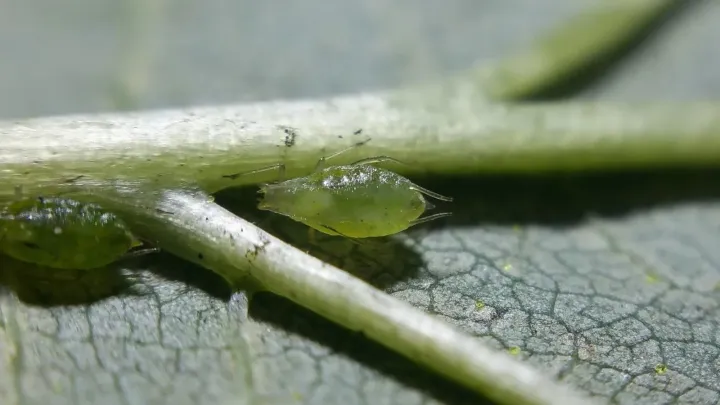
Description
How to identify
The damson-hop aphid (Phorodon humuli) is a small sap-sucking insect belonging to the family Aphididae, order Hemiptera, and is a significant agricultural pest.
Adult aphids typically reach 1.5 to 2 mm in length and exhibit a pale yellowish-green color, which provides excellent camouflage on their host plants.
Morphologically, this species is identified by its prominent frontal tubercles on the head and long antennae that extend beyond the length of the body.
The population includes both wingless forms, which remain on the host plant to reproduce, and winged forms capable of migrating to new locations.
Their life cycle involves a complex alternation between winter hosts (prunus species) and summer hosts (hop plants), essential for their annual survival.
What it damages
The primary crop damaged by this aphid is the common hop (Humulus lupulus), where infestations can lead to severe losses in yield and quality.
Secondary hosts for this pest include trees such as the damson plum, sloe, and other related Prunus species that serve as breeding grounds in early spring.
Aphids feed by inserting their stylets into plant tissues to suck phloem sap, which deprives the plant of essential nutrients and disrupts growth.
In hops, feeding damage results in deformed cones, reduced lupulin content, and chemical changes that are detrimental to the brewing industry.
Furthermore, these insects act as vectors for several plant viruses, spreading disease throughout the crop and causing significant systemic damage.
When it appears
The life cycle begins in early spring when eggs deposited on Prunus branches hatch, and the first generations develop on these woody hosts.
In early summer, winged migratory forms emerge and disperse to hop fields, establishing new colonies that multiply rapidly through parthenogenesis.
Throughout the summer, multiple overlapping generations occur, leading to a massive increase in population density if environmental conditions are favorable.
As autumn approaches, falling temperatures and shorter days trigger the production of sexual forms that migrate back to woody hosts for mating.
The cycle concludes with the deposition of eggs in bark crevices, where they enter diapause to survive the winter temperatures safely.
Signs of infestation
The most noticeable signs of infestation are leaf curling and yellowing, caused by the localized depletion of sap and toxic salivary secretions.
The presence of honeydew, a sticky substance secreted by the aphids, often leads to the growth of sooty mold, which impairs photosynthesis.
Close inspection of the underside of leaves usually reveals high densities of aphids clustered together in colonies, often accompanied by ants.
Hop cones exhibit reduced growth, stunted development, and may turn brown, rendering the crop commercially unsuitable for processing.
The general decline of plant vigor and the presence of ants are reliable indicators that an aphid outbreak is currently occurring in the field.
Control measures
The most effective strategy for managing damson-hop aphids is the removal of wild plum or sloe trees in the vicinity to break the winter cycle.
Integrated pest management (IPM) involves using systemic insecticides that are effective against aphids protected by curled leaves on the plants.
It is crucial to monitor field populations regularly and treat only when thresholds are exceeded to maintain a balance with beneficial insect predators.
Preserving natural enemies such as ladybirds, lacewings, and hoverflies is highly recommended as a sustainable part of any control program.
- Strategic application of selective insecticides to minimize environmental impact.
- Regular field scouting to detect initial migration from winter hosts.
- Promotion of hedgerows that support natural predator populations for long-term control.
Taxonomy
- Latin name
- Phorodon
- Order
- Hemiptera (bugs, aphids, leafhoppers)
- Family
- Aphididae
- EPPO code
- PHODSP
Discussion
No discussions yet — be the first.