
Pholcus phalangioides
Pholcus phalangioides
Description
How to identify
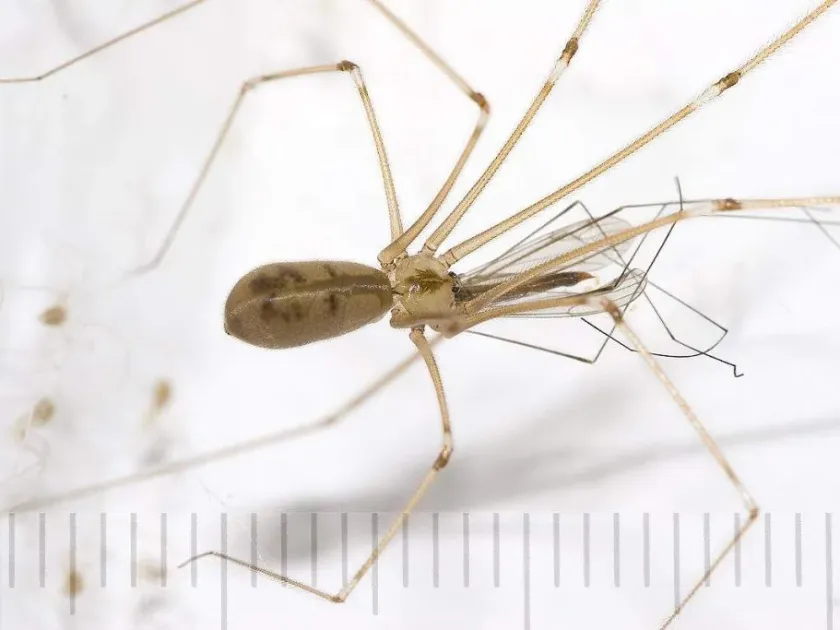
Pholcus phalangioides, commonly known as the cellar spider or daddy long-legs, belongs to the family Pholcidae. This spider is easily identified by its extremely long, delicate legs and small, pale-colored body.
Adult females typically reach a body length of about 9 millimeters, with a grayish-brown or pale-yellow coloration. Their body structure is slender, allowing them to remain inconspicuous in corners.
These spiders construct loose, tangled webs, often in sheltered and dark areas. They are highly synanthropic, preferring human-made structures like greenhouses, sheds, and agricultural storage areas.
Unlike many other spider species, they are social to some extent within their colonies and tend to stay in the same area if there is an adequate supply of small insects.
Their movement is slow and deliberate, but when threatened, they perform a characteristic rapid vibrating motion in their webs to blur their silhouette and escape predators.
What it damages
From an agronomic perspective, Pholcus phalangioides is not a plant pest. It does not consume plant tissues, sap, or roots and poses no direct threat to crop health.
The perceived damage is purely structural and sanitary. The accumulation of dusty webs on greenhouse frames, irrigation pipes, and equipment can interfere with daily maintenance tasks.
Heavy web accumulation can trap dust and debris, which may harbor fungal spores or bacteria that can indirectly affect the microclimate and sanitation of the growing environment.
In post-harvest facilities, the presence of these spiders and their webs can be problematic for product quality control, as debris may contaminate packaging or fresh produce.
Overall, they should be viewed as non-harmful inhabitants of the agricultural environment rather than as pests requiring intensive eradication programs.
When it appears
Pholcus phalangioides remains active throughout the year in controlled environments, such as heated greenhouses and warehouses, where the climate remains stable.
Their reproduction cycle is closely tied to ambient temperatures. Females carry their eggs in a light-weight silk bundle held by their chelicerae until the spiderlings hatch.
The population tends to increase during the spring and summer months when higher temperatures and humidity favor the development of their prey species, ensuring a food supply.
In colder, unheated structures, the spiders may significantly reduce their activity, though they are highly resilient and can survive periods of food scarcity.
The lifespan and maturation of an individual spider depend on the consistency of the greenhouse microclimate and the frequency of disturbance to their webs.
Control measures
Eradication is generally unnecessary because Pholcus phalangioides acts as a biological control agent, consuming small nuisance insects that can be pests in a greenhouse setting.
If their presence becomes excessive, the best management approach is physical exclusion and regular sanitation rather than the use of chemical pesticides.
Using chemical insecticides to eliminate spiders is discouraged, as it can disrupt the natural balance and kill beneficial insects that actually protect your crops.
- Regular cleaning of greenhouse structures and removal of webs.
- Improving ventilation to keep humidity levels moderate.
- Sealing cracks and gaps in greenhouse cladding.
- Installing mesh screens on ventilation vents to limit entry.
Management efforts should prioritize cleanliness and physical exclusion to ensure that spider populations remain at levels that do not interfere with agricultural operations.
Taxonomy
- Latin name
- Pholcus phalangioides
- Family
- Pholcidae
- EPPO code
- PHLUPH
Discussion
No discussions yet — be the first.