
Ringed seal
Phoca hispida
Description
How to identify
The ringed seal (Phoca hispida) belongs to the order Carnivora and the family Phocidae. While primarily a marine mammal, its presence near coastal agricultural and aquaculture sites can present unique operational challenges.
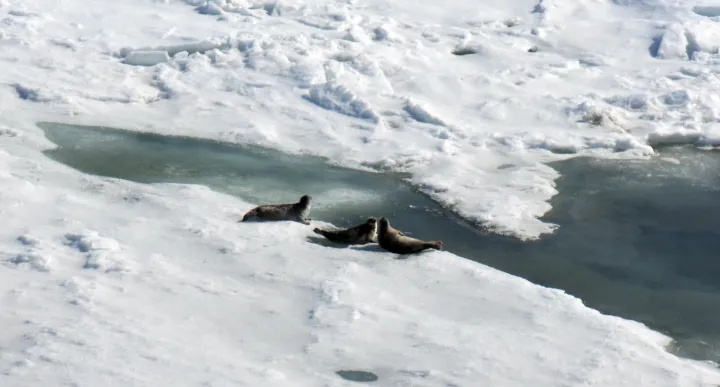
The species is identified by its small size and the distinct ring-like patterns on its fur, which provide camouflage in its natural ice-covered habitat. Adults typically reach up to 1.5 meters in length.
Their life cycle is governed by seasonal ice formation for whelping and molting. During non-breeding seasons, they are often found in coastal waters, sometimes encroaching on human-made aquatic structures.
These seals are highly intelligent and opportunistic, meaning they may investigate and interact with human-built objects, such as floating docks, water intakes, and containment nets.
Understanding their behavior is critical for agricultural managers whose operations are integrated with freshwater or coastal marine environments.
What it damages
The ringed seal does not feed on traditional crops; however, it causes significant damage to aquaculture systems, which are increasingly common in modern integrated agricultural practices.
Seals frequently tear netting and containment barriers in search of fish, resulting in the loss of aquatic resources and damage to expensive infrastructure.
The intrusion of seals into water intake systems can block filtration devices, leading to interruptions in the water supply essential for irrigation and facility maintenance.
Biological contamination from seal populations near water sources can impact the water quality, potentially causing issues for sensitive irrigation systems or local ecosystems.
Mechanical damage to riverbanks or irrigation canal walls occurs when seals haul out on land near agricultural zones, contributing to localized soil erosion.
Control measures
Acoustic deterrent devices are the primary method of managing seal populations near agricultural infrastructure, as they discourage intrusion without harming the animals.
Reinforcing irrigation canal intake pipes with heavy-duty steel grates prevents animals from entering the facility and causing mechanical failure in pumping systems.
The implementation of visual deterrents, such as high-contrast floating buoys or movement-activated strobe lights, can effectively steer seals away from sensitive areas.
Proactive maintenance of containment nets using high-tensile materials ensures that animals are unable to penetrate the barriers during their routine foraging explorations.
Establishing collaborative monitoring programs with wildlife management agencies helps predict seal arrival times and allows for the adjustment of operational activities to minimize conflict.
Taxonomy
- Latin name
- Phoca hispida
- Family
- Phocidae
- EPPO code
- PJOCHI
Discussion
No discussions yet — be the first.