
Harvestman
Phalangium opilio
Description
How to identify
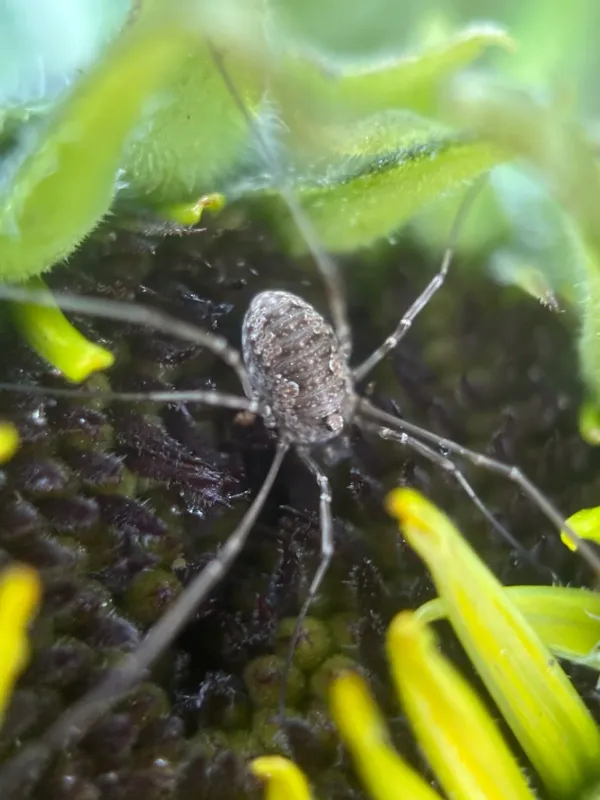
The harvestman (Phalangium opilio), commonly known as a daddy longlegs, belongs to the order Opiliones. It is an arachnid easily distinguished by its long, spindly legs and compact body structure.
Unlike true spiders, the harvestman has a fused body where the cephalothorax and abdomen are joined without a narrow waist. This gives them a robust, oval-shaped appearance despite their fragile-looking legs.
They typically exhibit a mottled brownish or gray color, often featuring a dark, saddle-like marking on the dorsal side of their bodies. They possess two eyes situated on a small central mound.
A key biological trait is the ability to shed their legs to escape from predators, a mechanism known as autotomy. Even after separation, the leg may continue to twitch, serving as a distraction.
Harvestmen do not produce silk or venom. They are generally elusive, preferring to spend their days in dark, damp areas, emerging at night to search for food.
What it damages
While often considered neutral or even beneficial due to their predatory habits, harvestmen can act as pests under certain conditions. They are omnivorous, consuming both living insects and plant tissues.
In garden settings, they may feed on young plant shoots, tender leaves, or flowers when alternative food sources are scarce. This feeding can lead to minor but noticeable mechanical damage to crops.
Their potential for damage increases significantly in greenhouse environments where high humidity and limited food variety may drive them to feed on young seedlings or delicate ornamental plants.
Although they rarely cause large-scale crop failure, their presence in large numbers can compromise the aesthetic quality of plants and provide entry points for secondary plant diseases.
It is crucial to recognize that they also predate on aphids and mites, meaning their control should be managed carefully to avoid disrupting the local biological balance.
When it appears
The life cycle of the harvestman is seasonally dependent. They typically overwinter in the egg stage, which are laid in soil or under organic debris during the autumn months.
Larvae emerge in the spring, undergoing several molts throughout the summer to reach maturity. The population density usually peaks in mid-to-late summer, coinciding with the period of greatest activity.
Favorable weather conditions, specifically warm and humid summers, accelerate their development and can lead to higher population numbers in agricultural zones.
As temperatures begin to drop in the autumn, adult harvestmen die off, having already ensured the survival of the next generation through their eggs deposited in secure, sheltered environments.
Monitoring efforts are most effective during the summer months, particularly at night when these arachnids are most actively feeding on foliage.
Signs of infestation
Identifying a harvestman infestation requires nocturnal observation, as they are strictly nocturnal. Finding them on stems or foliage during the night is the primary indicator of their presence.
Look for jagged, irregular feeding patterns on leaves. Unlike damage from chewing insects, harvestman damage is often erratic and may be accompanied by small scratches on the leaf epidermis.
The presence of large numbers of harvestmen hiding under mulch, garden waste, or within dense groundcover during the day confirms a significant population density.
An absence of spiderwebs in the vicinity, combined with the discovery of long-legged arachnids, helps differentiate harvestmen from true spiders that might otherwise be harmless or beneficial.
Stunted growth or visible lesions on very young seedlings can occasionally be attributed to intensive feeding by harvestmen when their primary insect prey is unavailable.
Control measures
Sanitation is the most effective management tool. Removing dead leaves, weeds, and decaying wood from the garden eliminates the essential daytime hiding spots for harvestmen.
Regular soil cultivation helps disrupt their lifecycle by destroying potential egg-laying sites in the topsoil and exposing larvae to environmental stressors.
While chemical control is seldom required, standard insecticides used for general pest management can reduce their numbers if their feeding causes unacceptable crop loss.
Promoting a diverse garden ecosystem encourages natural predators, such as certain birds and larger insects, which can help keep the harvestman population in check.
- Hand-pick and relocate individuals found on crops.
- Use synthetic mulches to reduce habitat suitability.
- Maintain proper greenhouse hygiene to prevent infestations.
Taxonomy
- Latin name
- Phalangium opilio
- Family
- Phalangiidae
- EPPO code
- PHNMOP
Discussion
No discussions yet — be the first.