
Harvestman
Opilio
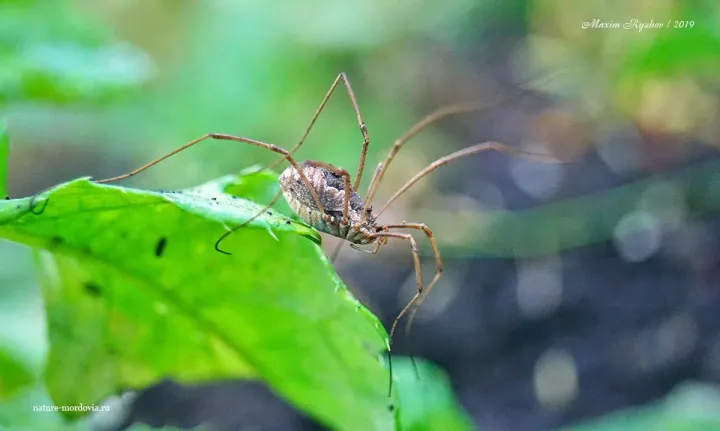
Description
How to identify
Harvestmen (order Opiliones) are arachnids often confused with spiders. However, they are anatomically distinct, featuring a fused body where the cephalothorax and abdomen are joined as one, and exceptionally long, thin legs that can be shed if threatened.
Unlike true spiders, harvestmen do not possess venom glands and do not spin webs. They are entirely predatory, relying on their agility and sensory organs on their legs to navigate their environment and locate prey.
Their bodies are segmented, and they possess a single pair of eyes located on a small tubercle in the center of their body, which is sufficient for sensing shadows and movement in their surroundings.
They are frequently found in moist, shaded areas of agricultural fields, on tree bark, or hidden among leaf litter. Their defensive behavior includes secreting a pungent, chemical scent to deter potential predators.
In terms of agriculture, harvestmen are significant inhabitants of the agroecosystem. Because they are harmless to vegetation, they should be viewed as natural allies rather than threats to crops.
What it damages
Harvestmen are not pests and cause no damage to agricultural crops. They are strictly predators and scavengers, meaning they do not consume plant tissues, stems, leaves, or fruits of any cultivated plants.
Their primary role in the field is that of a natural biological control agent. They feed on small insects, including aphids, mites, small larvae, and insect eggs, effectively helping to reduce populations of actual agricultural pests.
Farmers sometimes mistakenly identify harvestmen as the cause of plant damage simply because they are spotted in close proximity to damaged areas. However, the harvestman is only present to feed on the pests that are causing the harm.
Since they lack the specialized mouthparts required to pierce and consume plant sap or leaves, it is biologically impossible for them to damage crops.
Overall, harvestmen serve as silent guardians of the harvest, contributing to pest management without the need for additional chemical intervention.
When it appears
Harvestmen are most active during the warm months, typically from late spring through late autumn. Their population density usually peaks in mid-to-late summer, aligning with the highest activity levels of their prey.
Their life cycle depends on the climate; in many species, they overwinter as eggs laid in the soil or protected crevices of tree bark, emerging when soil temperatures become suitable for development.
They are largely nocturnal or crepuscular, meaning they prefer to be active in low-light conditions, staying in protected, humid areas during the heat of the day to prevent dehydration.
The development from egg to adult involves several molting stages, with individuals gradually increasing in size throughout the season. Most harvestmen live for a single growing season.
Their appearance in the fields during harvest time is a normal biological phenomenon and serves as a positive indicator of an active and healthy ecosystem within the farm.
Signs of infestation
There are no signs of crop damage caused by harvestmen, as they are not phytophagous organisms. Any observed plant tissue loss or injury should be attributed to other insect species or environmental factors.
The main sign of their presence is simply seeing the arachnids themselves. They are easily recognizable by their delicate, stilt-like legs and their tendency to remain still when they detect nearby movement.
Occasionally, you may find discarded exoskeletons after molting on leaves or soil. These are sometimes mistaken for pest activity, but they are merely harmless remnants of the harvestman's growth process.
Seeing a harvestman near a plant should encourage the observer to look for the aphids or other pests that might be attracting the predator to that specific location.
There is no need to monitor for "signs of infestation" regarding harvestmen, as they do not swarm or cause damage to crops, and their presence is strictly beneficial.
Control measures
No control measures are necessary for harvestmen; in fact, their removal would be counterproductive. They are highly effective predators that help maintain a balance in the farm ecosystem.
The use of broad-spectrum pesticides is highly detrimental to harvestman populations. Agronomists should focus on using selective biological controls to preserve these beneficial arachnids.
Maintaining hedgerows, grass strips, or mulch-covered soil areas within the agricultural landscape provides essential habitat for harvestmen to survive and multiply.
Integrated Pest Management (IPM) practices prioritize the protection of harvestmen as they naturally suppress pest numbers, reducing the overall requirement for synthetic chemical applications.
Education is key; farmers should be aware that harvestmen are allies. By fostering an environment conducive to their survival, growers can leverage natural predation as a free and sustainable crop protection strategy.
Taxonomy
- Latin name
- Opilio
- Family
- Phalangiidae
- EPPO code
- OPILSP
Discussion
No discussions yet — be the first.