
Sea lamprey
Petromyzon marinus
Description
How to identify
The sea lamprey (Petromyzon marinus) is a primitive, jawless vertebrate belonging to the order Petromyzontiformes and the family Petromyzontidae.
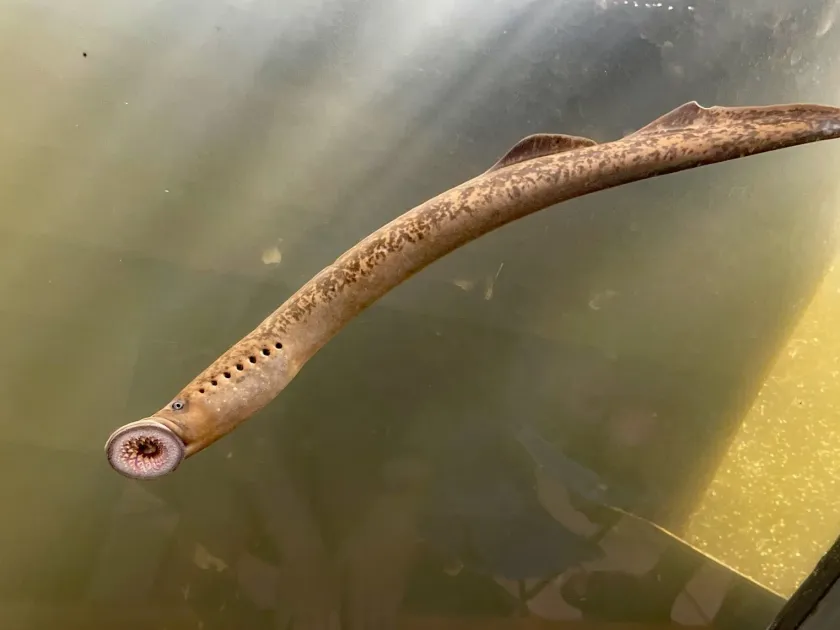
These organisms have an eel-like body without scales or paired fins, typically reaching lengths of 60 to 120 centimeters when fully mature.
The most distinctive feature is the oral disk, a circular suction cup lined with sharp, keratinized teeth used to attach to and feed on host fish.
Adult coloration ranges from brownish to gray, providing effective camouflage in the bottom environments of rivers and lakes where they reside.
The juvenile stage, known as ammocoetes, lives burrowed in the sediment for several years, filtering organic matter and detritus from the water column.
What it damages
Although sea lamprey does not directly attack crops, it is a devastating invasive species that causes massive damage to commercial and recreational fisheries.
By parasitizing native fish species, they weaken or kill valuable stocks, which impacts the economic stability of regions dependent on aquaculture.
A single lamprey can kill up to 40 pounds of fish throughout its parasitic phase, significantly reducing the biodiversity of freshwater ecosystems.
The presence of high numbers of lamprey can also create operational challenges for water intake systems used for irrigation in agricultural zones.
Indirect ecological damage includes the disruption of the food web, which can negatively affect the overall health of water bodies used for farming.
When it appears
Sea lampreys migrate from the sea or large lakes into freshwater streams during the spring season to spawn in suitable nesting areas.
Spawning occurs when water temperatures reach appropriate levels, usually between 10 and 15 degrees Celsius, after which adult lampreys die.
Larval development in the substrate is a long-term process, with ammocoetes staying in the sediment until they undergo metamorphosis into adults.
The parasitic phase takes place mostly during the summer and autumn months, when adults actively swim in search of host fish to feed upon.
Control efforts are most intense during the spring, as this is the period when adults can be targeted at barriers before they reach spawning grounds.
Signs of infestation
The primary sign of infestation is the presence of circular, crater-like wounds on the bodies of fish caught in affected water bodies.
A noticeable decline in local fish populations over several seasons often indicates that a sea lamprey population has become established in the area.
During the spawning season, one can observe adult lampreys clustering near man-made dams, culverts, or natural obstacles in the river stream.
The presence of ammocoetes can be detected by specialized surveys of the riverbed sediments in slow-moving, silty areas of the water system.
Fish mortality rates often spike in areas with high lamprey density, leading to visible dead fish floating or washing up along the shoreline.
Control measures
The primary control method involves the use of lampricides, which are chemicals specifically designed to kill lamprey larvae without harming other fish.
Physical barriers and dams are constructed to block the upstream migration of adult lampreys, effectively isolating them from potential spawning sites.
Trapping systems are installed alongside barriers to collect and remove adults, which helps to further reduce the reproductive potential of the population.
Sterile Male Release Technique (SMRT) is used to disrupt the life cycle, where sterile males compete for mates, resulting in fewer offspring being produced.
Integrated pest management programs rely on continuous monitoring of larval populations to determine where and when control treatments are most needed.
Taxonomy
- Latin name
- Petromyzon marinus
- Family
- Petromyzontidae
- EPPO code
- PTEMMA
Discussion
No discussions yet — be the first.