
River lamprey
Lampetra fluviatilis
Description
How to identify
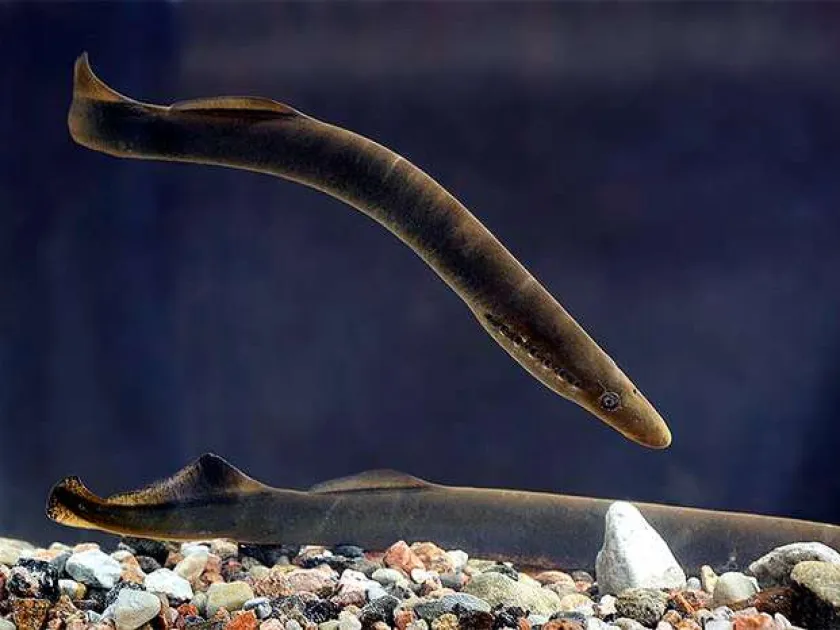
The river lamprey (Lampetra fluviatilis) belongs to the family Petromyzontidae. It is a jawless, eel-like vertebrate that lacks paired fins and scales, representing a primitive evolutionary stage.
Adult specimens grow between 25 and 40 cm in length. The most distinctive feature is the oral disc equipped with keratinized teeth, used to attach itself to host fish.
The coloration of the dorsal side ranges from dark grey to olive-brown, while the belly is usually silvery-white. Eyes are well-developed in the adult stage but remain subcutaneous during the larval phase.
Their complex lifecycle involves a multi-year larval period, known as ammocoetes, where they live buried in river sediment. After metamorphosis, they enter a parasitic adult stage.
Upon reaching sexual maturity, adult lampreys migrate upstream to spawn, after which they die, concluding their single reproductive cycle.
What it damages
While not a pest to land-based crops, the river lamprey is considered a significant biological threat within commercial aquaculture and natural fish populations.
It acts as an ectoparasite, feeding on the blood, skin, and muscular tissues of various host species, including salmon, trout, whitefish, and herring.
The attachment of the lamprey causes severe skin damage, often leading to deep lesions that disrupt the host's physiological balance.
In aquaculture environments, lamprey attacks can lead to stunted growth, reduced market value, and mortality due to primary injury and secondary infections.
The economic impact on fishery managers is linked to the increased mortality rates and the cost of implementing preventive measures to protect valuable stocks.
Signs of infestation
The most evident sign of a lamprey attack is the presence of characteristic circular wounds on the flanks or the dorsal area of the host fish.
Affected fish often exhibit localized tissue necrosis and inflammation around the suction mark, which is a direct result of the lamprey's anticoagulant secretions.
Infected fish tend to exhibit lethargic behavior, reduced swimming performance, and a higher susceptibility to fungal and bacterial diseases.
Routine inspection of fish catches often reveals individuals bearing scars, indicating previous parasitic attacks and suggesting a high prevalence in the water body.
Mass mortality in specific fish populations can sometimes be traced back to high densities of river lamprey in migration corridors.
Control measures
Management strategies focus on physical exclusion and population control to minimize the interaction between lampreys and target fish stocks.
Physical barriers, such as fine-mesh screens and mechanical traps, are frequently deployed in aquaculture systems to prevent lamprey ingress.
Targeted harvesting of adults during their spawning migration is an effective method used in some regions to maintain sustainable balance.
Maintaining high water quality and fish health standards helps increase the resilience of stocks against parasitic pressure and secondary infections.
- Installation of fine-mesh exclusion barriers
- Selective removal of adults during migration
- Regular veterinary monitoring of fish stocks
- Use of electrical deterrent systems
Taxonomy
- Latin name
- Lampetra fluviatilis
- Family
- Petromyzontidae
- EPPO code
- LMPTFL
Discussion
No discussions yet — be the first.