
European brook lamprey
Lampetra planeri
Description
How to identify
The European brook lamprey (Lampetra planeri) is a member of the order Petromyzontiformes and the family Petromyzontidae.
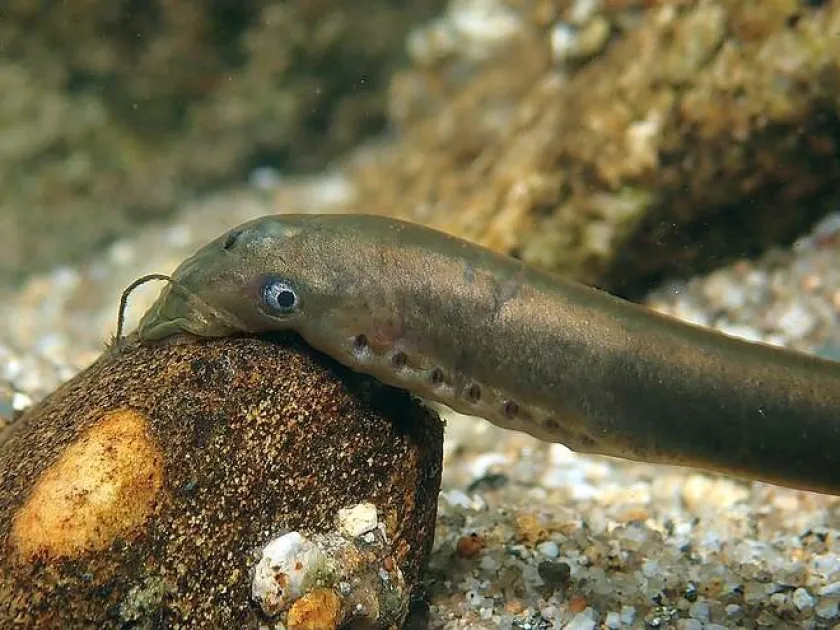
It is a primitive, jawless vertebrate with a long, cylindrical, eel-like body that lacks scales and paired fins.
The species is identifiable by the seven gill openings located on each side of the head, a common feature among lampreys.
Adults typically measure between 10 and 15 centimeters in length and exhibit a grey-brown or dark olive coloration on their upper side.
They prefer clear, well-oxygenated streams and brooks with sandy or gravelly substrates, which are essential for their larval development.
What it damages
The European brook lamprey is not a crop pest and poses no threat to agricultural plants or farming operations.
There is no record of this organism causing damage to crops, irrigation systems, or soil quality in any agricultural context.
The larvae, known as ammocoetes, reside in the sediment and feed primarily on organic detritus, algae, and microorganisms.
Adult lampreys have a non-functional digestive system and do not feed at all; they live off stored energy until they spawn and die.
Therefore, they cannot be categorized as pests, as they interact with no agricultural components throughout their entire life cycle.
When it appears
The lamprey's life cycle lasts several years, with the majority spent as a larvae hidden within the stream bed.
Springtime (typically April to May) marks the period of reproductive activity, as adults emerge to spawn in shallow, gravel-rich areas.
This seasonal activity is entirely dependent on water temperature and the availability of suitable nesting grounds in the riverbed.
Once the spawning process is complete, the adult lampreys reach the end of their life cycle and perish naturally.
Their life cycle does not intersect with planting or harvesting seasons, as they are strictly confined to the aquatic environment.
Control measures
No pest control measures are required or advised, as the European brook lamprey is a harmless and protected aquatic species.
In many regions, this lamprey is recognized as a bioindicator of high water quality and is protected under environmental legislation.
Any management of river systems near agricultural land should focus on maintaining natural habitats rather than seeking eradication.
Using chemicals or pesticides near their habitats would be counterproductive and harmful to the surrounding aquatic ecosystem.
Sustainable agricultural practices should include the protection of waterways where these beneficial organisms reside.
Taxonomy
- Latin name
- Lampetra planeri
- Family
- Petromyzontidae
- EPPO code
- LMPTPL
Discussion
No discussions yet — be the first.