
Lamprey
Petromyzon
Description
How to identify
Lampreys belong to the class Agnatha, or jawless fish, within the family Petromyzontidae. They are primitive vertebrates characterized by an elongated, eel-like body without scales or bones.
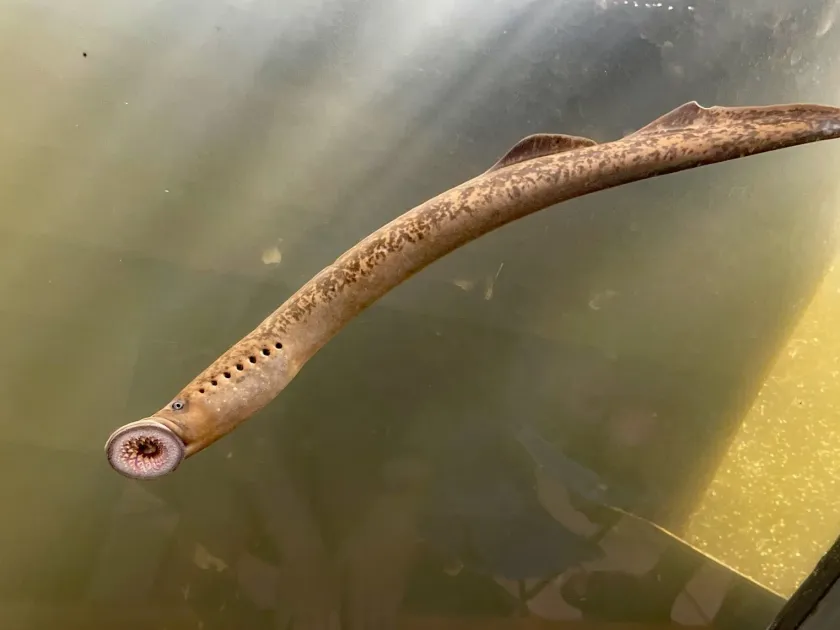
Instead of jaws, they possess a circular suction disc equipped with keratinized teeth. This structure allows them to attach to surfaces, which is their primary method of interacting with their aquatic environment.
Their skin is covered in mucus, and they breathe through seven pairs of gill openings located behind their eyes. This anatomical structure is adapted solely for respiration in water.
Taxonomically, they are distinct from true fish. The life cycle involves a larval stage known as an ammocoete, which lives in river sediment for several years before transforming into an adult.
In agronomy, it is important to clarify that lampreys are not plant pests and have no interaction with agricultural ecosystems.
What it damages
Lampreys are strictly aquatic organisms and do not cause any damage to crops. They do not possess the physiology required to consume or interact with terrestrial plants.
Their diet consists of fish blood (for adults) or organic detritus and microorganisms (for larvae). They have no interest in plant tissues such as leaves, roots, or stems.
There is no record of lampreys causing economic loss to farms or agricultural production. They are completely absent from the spectrum of agricultural pests.
Any mention of lampreys as a threat to crops is scientifically inaccurate. They are strictly a component of aquatic biodiversity.
Farmers do not need to worry about lampreys affecting the yield or health of their cultivated crops.
When it appears
The life cycle of the lamprey is driven by temperature and the flow of water bodies. Spawning typically occurs in late spring when water temperatures meet the requirements for egg development.
Ammocoetes inhabit the substrate of riverbeds for several years, making them permanent residents of the aquatic environment.
Adult migrations occur entirely within river systems or between seas and rivers. These movements are unrelated to the agricultural calendar or planting seasons.
There is no overlap between the seasonal behavior of lampreys and the growth cycles of agricultural plants.
Agricultural operations, such as sowing, harvesting, or pest control, remain unaffected by the presence or migration of lampreys.
Signs of infestation
There are no signs of infestation related to lampreys, as they do not attack plants. Detecting them in irrigation water is not a sign of crop damage.
If lampreys are present in irrigation canals, it is merely an indicator of good water quality, as they are sensitive to environmental pollutants.
There are no symptoms such as wilting, chlorosis, or necrosis associated with lampreys because they are incapable of interacting with terrestrial vegetation.
Monitoring for pests should focus on insects, fungal diseases, and weeds, which are the real threats to agricultural productivity.
One should not confuse the accidental presence of aquatic fauna in water supply lines with a pest outbreak.
Control measures
No control measures are required for lampreys because they are not pests. The use of pesticides or other control agents is harmful, unnecessary, and discouraged.
To prevent lampreys from entering pump systems, simple mechanical filtration or mesh screens on water intake pipes are sufficient.
Mechanical exclusion is the standard engineering practice for protecting irrigation infrastructure from any aquatic debris or fauna.
Agricultural protection programs should focus on relevant pathogens and insects that actually affect crop development.
Respecting the role of lampreys in the aquatic ecosystem is recommended for the overall sustainability of local water resources used in farming.
Taxonomy
- Latin name
- Petromyzon
- Family
- Petromyzontidae
- EPPO code
- PTEMSP
Discussion
No discussions yet — be the first.