
Boxelder aphid
Periphyllus negundinis
Description
How to identify
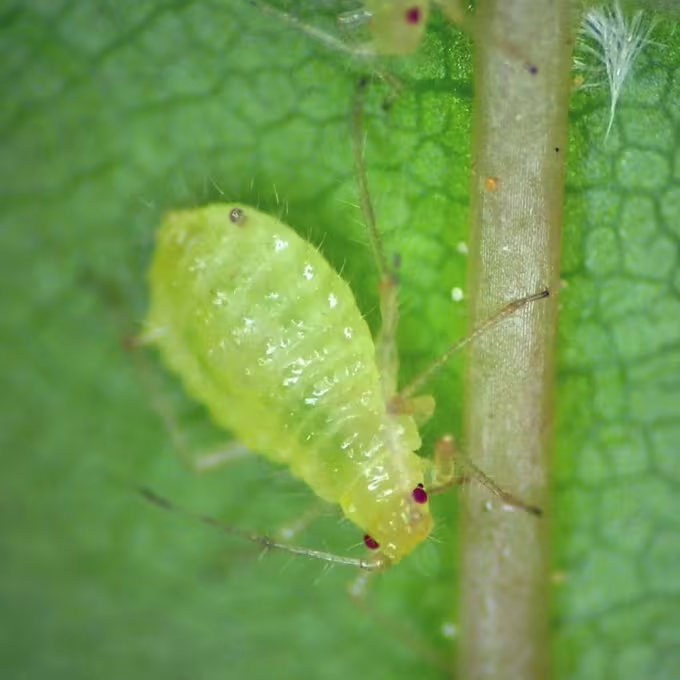
The boxelder aphid, known scientifically as Periphyllus negundinis, is a small insect belonging to the family Aphididae. Wingless virginoparae have a rounded, yellow-green body that reaches 2-3 mm in length.
Winged adults possess a dark head and thorax, along with transparent wings featuring distinct venation patterns. These features help distinguish them from other aphid species commonly found on deciduous trees.
The nymphs resemble the adults but are significantly smaller. Their coloration ranges from light lime green to brownish, which provides excellent camouflage against the undersides of maple leaves.
Reproduction is rapid, and the insects form dense colonies on young shoots and foliage. The species completes its development through incomplete metamorphosis, moving through several nymphal stages.
Overwintering occurs in the egg stage. Females deposit eggs in the crevices of the bark on young branches, ensuring survival through harsh winter conditions until the spring thaw.
What it damages
The primary host for this pest is the boxelder maple (Acer negundo), a tree widely used in urban landscaping. Occasionally, it may also infest other related maple species.
These aphids feed by piercing plant tissues and extracting sap from young leaves, petioles, and tender shoots. This massive extraction of nutrients significantly weakens the tree's health and vigor.
Severe infestations lead to early leaf yellowing and premature leaf drop. This reduces the tree's ornamental value and impairs the photosynthetic processes necessary for the plant to store energy for winter.
Affected shoots often show signs of twisting, growth cessation, or even dieback. In urban environments, trees weakened by aphid feeding are more susceptible to secondary infections and wood-boring pests.
Furthermore, aphids serve as vectors for various plant viruses, transmitting pathogens from infected trees to healthy ones as they move and feed throughout the canopy.
When it appears
Nymphs hatch from eggs in early spring, coinciding with the bud break of the maple trees. This timing allows the pests to immediately exploit the most nutrient-rich plant tissues.
Peak population density usually occurs in late spring and early summer, when environmental conditions are optimal for rapid reproduction and colony expansion.
During the peak of summer, high temperatures and dry conditions may lead to a temporary decrease in aphid activity, though development often continues steadily under moderate climate conditions.
In autumn, sexual forms emerge to mate and lay overwintering eggs. This stage typically takes place in September and October, completing the insect's annual cycle.
The life cycle is closely linked to the phenology of the maple tree, making the trees particularly vulnerable during periods of vigorous vegetative growth.
Signs of infestation
A primary sign of infestation is the curling of leaves, often accompanied by a sticky substance known as honeydew, which the aphids excrete while feeding.
Honeydew serves as a growth substrate for sooty mold, a fungus that develops a black coating on leaves. This coating hinders gas exchange and reduces the efficiency of photosynthesis.
Observing the undersides of the leaves often reveals large clusters of aphids. These colonies are frequently accompanied by ants, which protect the aphids from predators to feed on the sweet honeydew.
Visually, infested trees look distressed; foliage may appear dull, and leaf edges may become dry or necrotic. Heavy dripping of honeydew can also make the ground below the canopy sticky.
Advanced stages of infestation result in premature leaf drop, creating a stark contrast between infested trees and healthier specimens in the surrounding area.
Control measures
Biological control methods focus on conserving natural enemies such as ladybugs, lacewings, and hoverflies, which are highly effective at suppressing aphid populations naturally.
Chemical control involves the application of systemic or contact insecticides. Applications are most successful when timed to coincide with the early nymphal stages.
When selecting chemical products, it is essential to prioritize environmental safety, especially in public parks or near residential areas, by choosing agents with low toxicity to non-target species.
Good horticultural practices, including regular watering and proper fertilization, help improve the tree's immune system and accelerate recovery from pest-induced damage.
- Pruning and thinning the canopy to improve air circulation and light penetration.
- Washing the foliage with a strong jet of water to dislodge small aphid clusters.
- Utilizing biological insecticides based on botanical or fungal compounds for safer management.
Taxonomy
- Latin name
- Periphyllus negundinis
- Order
- Hemiptera (bugs, aphids, leafhoppers)
- Family
- Aphididae
- EPPO code
- PERPNE
Discussion
No discussions yet — be the first.