
American maple aphid
Periphyllus americanus
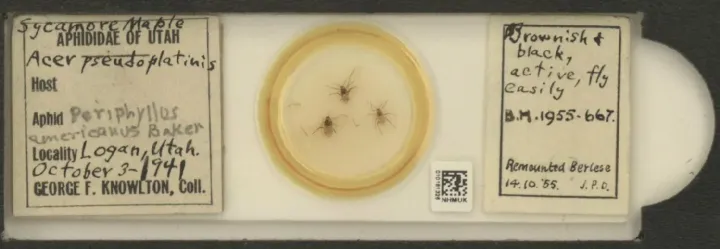
Description
How to identify
The American maple aphid (Periphyllus americanus) is a small sap-sucking insect belonging to the family Aphididae, order Hemiptera. It is specifically adapted to feed on various species of the Acer genus.
The adults typically appear in green or brownish shades, allowing them to blend into the foliage of the host tree. Both winged and wingless forms exist within the colony to facilitate local feeding and distribution.
The life cycle is highly synchronized with the host tree's phenology. Eggs overwinter in bark crevices and hatch into fundatrices as soon as the maple buds begin to swell in spring.
These aphids tend to form dense colonies, often residing on the undersides of leaves or along the petioles where nutrient transport is most active.
As the season progresses, generations continue to overlap, allowing the population to thrive and multiply rapidly under favorable weather conditions.
What it damages
Maple trees serve as the primary host. By piercing the plant tissue with their mouthparts, these aphids extract essential nutrients, which weakens the overall health of the tree.
Heavy infestations can cause visible damage such as leaf curling, chlorosis, and stunted growth of young shoots. This physiological stress reduces the tree's vigor and decorative appeal.
The excretion of honeydew serves as a substrate for sooty mold growth. This dark fungal layer blocks sunlight, further inhibiting photosynthesis and leaving a mess on leaves and branches.
Persistent feeding stress can lead to premature leaf drop, which compromises the tree's ability to store energy for winter dormancy, potentially leading to long-term decline.
In landscape settings, significant outbreaks often result in aesthetic damage that is problematic for park maintenance and ornamental garden management.
When it appears
The appearance of the first generation occurs in early spring, precisely timed with the emergence of new maple leaves to ensure immediate food access.
The peak activity and population density are typically observed during late spring and early summer, when moderate temperatures allow for rapid reproduction cycles.
Mid-summer heat may occasionally cause a decline in population numbers, but populations often resurge or move to neighboring trees to continue their cycle.
The autumn season is critical as the aphid population produces the sexual generation responsible for mating and laying overwintering eggs on the woody parts of the tree.
Monitoring throughout the growing season is essential, as early detection of the spring emergence provides the best window for effective intervention.
Signs of infestation
Initial signs include the distortion and curling of tender new leaves at the tips of branches, which is a common response to aphid feeding damage.
A sticky residue known as honeydew coating the leaves and branches is a clear indication that a sap-sucking pest is present within the tree canopy.
The presence of ants patrolling the branches is often a sign of aphid activity, as ants are known to tend and protect these insects for their sugary secretions.
Dark, soot-like fungal growth on the foliage surface is a secondary symptom caused by the accumulation of honeydew over time.
Visible clusters of small, pale, or dark-colored insects on the stems and leaf undersides are the most direct evidence of a current infestation.
Control measures
Systemic insecticides provide the most reliable management for larger trees, as the chemical is absorbed into the plant's sap and kills the pests directly upon feeding.
Encouraging beneficial insects, such as lady beetles, lacewings, and hoverflies, can provide effective natural control by preying on aphid colonies.
Horticultural oils or insecticidal soaps can be used as a contact treatment to manage localized outbreaks without posing a major risk to the surrounding ecosystem.
Maintaining tree vigor through proper watering and mulching helps the tree withstand the stresses caused by the aphid population during peak seasons.
Regular inspection of the canopy allows for the manual removal or spot treatment of early infestations, preventing widespread damage and maintaining tree health.
Taxonomy
- Latin name
- Periphyllus americanus
- Order
- Hemiptera (bugs, aphids, leafhoppers)
- Family
- Aphididae
- EPPO code
- PERPAM
Discussion
No discussions yet — be the first.