
Red-legged earth mite
Penthaleus major
Description
How to identify
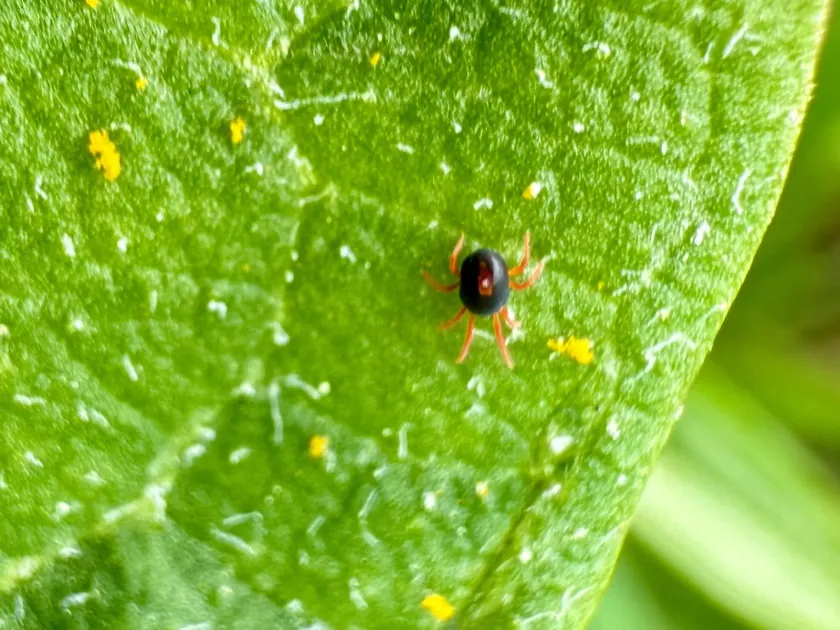
The red-legged earth mite (Penthaleus major) belongs to the Eupodidae family within the order Trombidiformes. Adult mites are tiny, typically measuring between 0.5 and 1 millimeter in length, with an oval-shaped, dark-colored body.
The most distinctive feature of this species is its bright red legs, which provide a sharp contrast against their dark purple or almost black bodies. A red anal plate on the dorsal side of the body is also a key identification mark.
During their life cycle, these mites undergo stages from larvae to adults. Larvae are initially six-legged, but they soon develop into eight-legged nymphs, which look like smaller versions of the adult stage.
These mites are known for their high activity levels in cool, moist environments. They are particularly active on the soil surface and the lower parts of host plants during the early morning and late evening hours.
Reproduction in this species is primarily parthenogenetic, meaning females can produce offspring without fertilization. This reproductive strategy allows the mite population to grow rapidly under favorable environmental conditions.
What it damages
This mite species is a significant agricultural pest that attacks a wide variety of crops, including wheat, barley, oats, and rye. It can also infest legumes, corn, and various common weeds found on farms.
The most severe damage occurs at the seedling stage of cereal crops. Because the plants are small and developing, the mites' feeding can significantly stunt their growth or even cause complete crop failure.
Mites use their specialized mouthparts to pierce plant cells and extract the internal contents. This feeding process destroys chlorophyll-containing cells, leading to a reduction in the plant's photosynthetic capacity.
Large infestations can lead to substantial economic losses by reducing plant vigor, crop density, and yield. In addition to direct feeding damage, these mites are known vectors for certain plant viruses.
Under favorable conditions, such as mild and wet weather, the mite population can build up quickly, causing visible damage to fields within a short timeframe if left unmanaged.
When it appears
The activity of the red-legged earth mite is strongly tied to seasonal weather patterns. It thrives in cool, damp conditions, which is why it is most active during the spring and autumn seasons.
The mite survives adverse conditions, particularly extreme heat or dry periods, by producing diapausing eggs. These eggs remain dormant in the soil and can withstand harsh temperatures for extended periods.
Hatching is triggered by the onset of cooler temperatures and adequate soil moisture. Once the soil warms up slightly in the spring, larvae emerge en masse to begin feeding on young winter or early spring crops.
During the peak of summer, when temperatures are high and rainfall is scarce, the mites disappear from the soil surface. They either die off or remain in the egg stage waiting for the return of favorable conditions.
Farmers should be most vigilant during the early growing season. Consistent monitoring during the emergence of winter cereals is essential for detecting the presence of these mites before damage becomes severe.
Signs of infestation
Initial signs of infestation appear as small, whitish, or silvery spots on the leaves. These spots are the result of the mite feeding, which removes the chlorophyll from the leaf surface.
As the feeding continues, these spots may merge, causing the leaves to turn yellow and eventually wither. Heavily infested seedlings often appear bleached and wilted, with stunted development compared to healthy plants.
Plants affected by the mites often show a generalized unhealthy appearance, characterized by yellowing tips and, in severe cases, the death of the foliage. These patches of damage can expand over time.
Close observation of the soil surface near the base of the plants or the underside of leaves will reveal the mites themselves. Their bright red legs make them distinguishable even to the naked eye if inspected carefully.
Identifying the mites early is crucial, as the damage they cause is progressive. Regular field scouting is the best way to determine if a population is present and if it requires an intervention.
Control measures
Integrated pest management (IPM) is the most effective approach for controlling the red-legged earth mite. This includes crop rotation, which breaks the pest's cycle by removing its food source from the field.
Weed control is also essential, as many common weeds serve as alternative hosts for the mites during periods when the primary crop is not present in the field. Removing these host plants limits the mite's ability to survive.
If mite numbers reach economic thresholds, chemical control may be necessary. Farmers should apply registered acaricides, ensuring that the timing coincides with the mite's period of peak activity for the best results.
- Regular monitoring and field scouting during cool, moist weather.
- Strategic tillage to disrupt mite habitat and egg survival.
- Using insecticide-treated seeds to provide early-season protection.
- Rotating chemical classes to prevent the development of pesticide resistance.
Always adhere to local agricultural regulations regarding pesticide usage. Proper timing and dosage are critical to ensuring that the chemical control is both effective and environmentally responsible.
Taxonomy
- Latin name
- Penthaleus major
- Order
- Mites
- Family
- Penthaleidae
- EPPO code
- PENHMA
Discussion
No discussions yet — be the first.